
🎯 Game Design
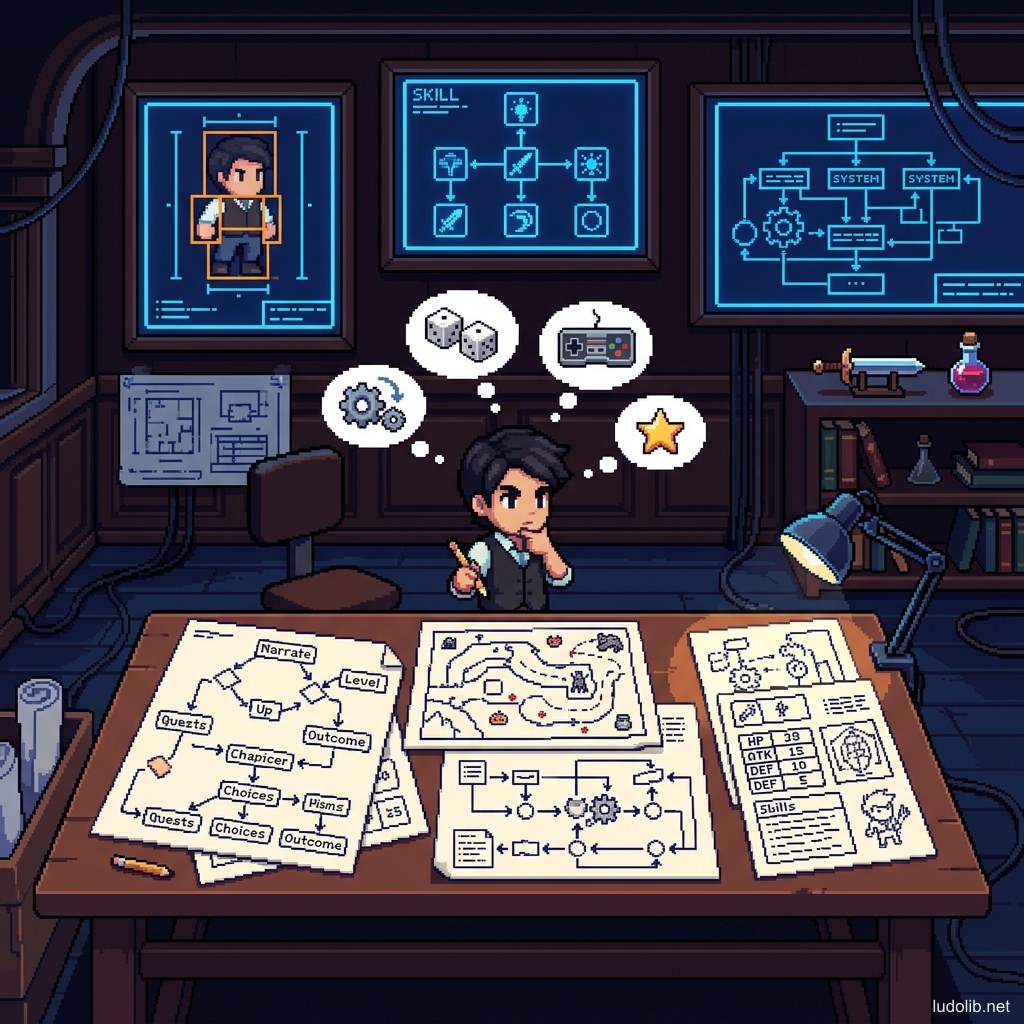
This section gathers all knowledge about the rules, systems, and structures of a game — the logical brain behind every gaming experience.
Articles in this group
- Claymorphism in Game UI: Tactile 3D inflated clay interface style with soft ambient shadows and pastel palettes.
- Hybrid-Casual: Mobile genre fusing accessible hyper-casual mechanics with deep RPG meta progression.
- Zero Tutorial Friction: UI/UX design philosophy eliminating text walls for instant intuitive onboarding.
- Diegetic UI: In-game user interface elements embedded directly within the physical fictional world.
- Core Gameplay: Anatomy of the core loop, gameplay actions, and 10 fatal design pitfalls.
- Game Mechanics: The MDA framework, feedback loops, skill trees.
- Layers of Engagement: Analysis of the 4 layers of objectives and 4 psychological anchors that retain players.
- Game Genres: An encyclopedia categorizing game mechanics from Action to Puzzle.
- Game Themes: A synthesis of storyline context directions (Sci-Fi, Horror…).
- Level Design: The art of directing the player experience through space.
- Narrative Design: Weaving the storyline into gameplay, from linear to branching.
- Hitbox: The invisible collision zones that determine every hit.
- I-frames: Invincibility frames, the classic dodging mechanic.
- Frame Rate: Frame Data and the art of manipulating combat tempo.
- Emotional Design: The philosophy of emotional design — every system must have a clear emotional goal.
- Bartle Player Types: Richard Bartle’s taxonomy framework of 4 player types (Killers, Achievers, Socializers, Explorers).
- Game Experience Breakdown: The anatomy of 15 core game experiences — each experience being the intersection of 2 design elements.
- Game Balancing: The art of managing player time and distributing resources to keep the game ecosystem fair.
- 10 Game Design Rules: 10 immutable principles about player psychology that help navigate all design decisions.
- 10 Bad Tips That Kill Your Game: 10 counterproductive game design tips and how to fix them.
- FTUE: The first 15 minutes of experience that dictate the life or death of a game (First Time User Experience).
- Boss: Definition of Boss mechanics and stratification in combat design.
- Checkpoint: Definition of Checkpoints as progress saving structures in level design.
- Co-op: Mechanics of cooperative multiplayer and social interaction in games.
- Cool-down: Function of cool-down as a pacing and resource control mechanism.
- Creep: Definition and role of Creeps as resource units in combat loops.
- Drop rate: Concepts of Drop Rate, RNG, and loot tiers in game economy.
- Dynamic Difficulty Adjustment: DDA, implicitly changing challenge parameters based on player performance.
- EXP: Experience Points, the virtual unit measuring the progress and growth of the player.
- Emergent Gameplay: Complex intersecting interaction scenarios that automatically form due to colliding interactions.
- Encounter Design: A specialized subsystem of spatial design and combat algorithms.
- Faucets and Sinks: Two pillar concepts in designing a Game Economy.
- Feedback Loop: A cyclical computational loop describing a continuous cause-and-effect process.
- Flow: The Flow State — the perfect channel between boredom and anxiety.
- Frustration Factor: FUUU Factor, a scale measuring the player’s emotional frustration.
- God-view: An omniscient perspective design method placing the display viewpoint from high above.
- Grinding: Player behavior of repeatedly performing a specific action to accumulate resources.
- Leaderboard: A data chart interface directly juxtaposing user stat achievements.
- Narrative: Story / Plot - the manner in which a story is conveyed to the player.
- Obstacles: Environmental technical parameters programmed to hinder the player’s linear movement flow.
- Overpowered: OP, a situation where an entity possesses overwhelmingly superior power.
- PVP & PVE: Player vs Player and Player vs Environment formats.
- Pacing: The distribution chart of impact frequency and event stimulation intensity.
- Pity System: A hidden mathematical design system intended to mitigate bad luck against RNG.
- Progression: The growth and unlocking of power, skills, and system access.
- RNG: Random Number Generation, the core mathematical algorithm generating unpredictable data.
- Retention: The percentage of players who return to an application after installing it.
- Skill Tree: A branching root-like interface system helping describe the player’s progress.