
⚖️ Game Balancing
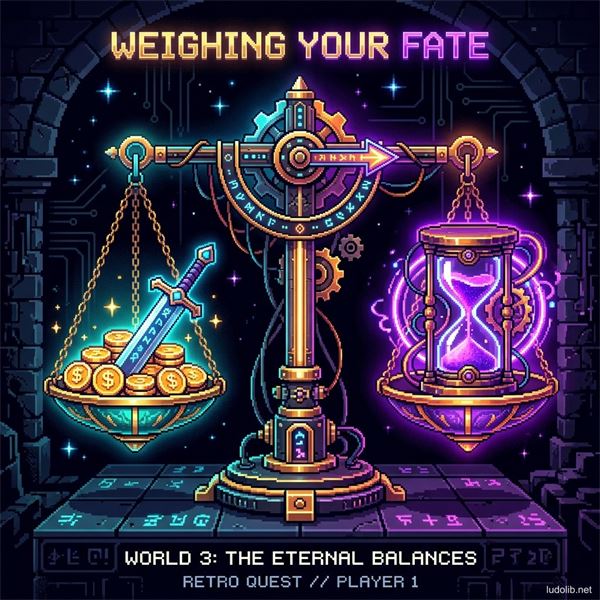 Illustration: The art of system design — where developers must maintain equilibrium between difficulty, player effort, and the in-game economy.
Quick Summary
Game Balancing is the process of refining rules, stats, and economic systems to ensure the game maintains fairness, challenge, and entertainment value. The core goal of balancing is to optimize Retention and revenue while keeping players in a Flow state, avoiding the feeling of it being too easy (boring) or too hard (despairing).
Based on the analytical system of expert Anton Slashcev, balancing is not just about changing health or damage parameters, but the art of managing the player’s time and the value of resources [S1].
1. The Four Pillars of a Stable Game Economy
A well-balanced game must possess a solid economy, especially in Live Service or F2P (Free-to-Play) models. These four pillars include:
- Stable Currency: Strictly managing inflation. If too much money is printed, the value of rewards will decrease, causing players to lose motivation.
- Rational Pricing: The price of items must accurately reflect supply-demand value and its impact on the progression system.
- Fair Distribution: Rewards received must be commensurate with the Effort and time players invest.
- Dynamic Supply and Demand: Adjusting commodity volumes and prices in real-time based on community behavioral data.
2. Key Concepts in Balancing
To manipulate the system, a Game Designer must master the mechanics constituting the balancing foundation:
2.1. Symmetry vs. Asymmetry
- Symmetry: Every player starts with entirely identical conditions (e.g., Chess). Often used in Esports.
- Asymmetry: Factions or characters have distinctly different strengths and weaknesses (e.g., StarCraft or the Hero system in Hero Shooters). This type requires a continuous balancing process.
2.2. Feedback Loops
- Positive Loop: Amplifies an advantage (Snowball effect). The winner finds it easier to win more.
- Negative Loop: Restrains an advantage to maintain balance (e.g., high levels require extremely massive EXP to reach the next level, giving trailers a chance to catch up).
2.3. Power Management (Power Curve & Power Creep)
- Power Curve: The curve illustrating the player’s power increasing over time or resources.
- Power Creep: The phenomenon where new content (characters, gear) is stronger than old content, making the old content obsolete. This is the most intractable problem for every Live Service game.
2.4. Faucets and Sinks
- Sources (Faucets): Places pumping resources into the system (Quests, killing monsters, achievements).
- Sinks: Places reclaiming resources (Upgrading, repairing gear, buying cosmetic items) to combat inflation.
3. Operational Frameworks
3.1. R.I.S.E. Framework
- Retention: Flattening the difficulty in the early game phase so newbies don’t quit.
- Income: Monetizing without slipping into the “Pay-to-Win” boundary.
- Satisfaction: Rewards must be large enough to maintain motivation.
- Engagement: Encouraging consistent and steady progression.
3.2. Integrating Psychoanalysis
- Bartle Taxonomy: Balancing the experience to cater to all 4 player segments: Killers, Achievers, Socializers, and Explorers.
- Flow Theory: Continuously aligning the challenge level with the player’s current skill through Dynamic Difficulty Adjustment mechanics.
4. Pro Tips for Real Combat
To fine-tune parameters, the development team doesn’t rely on gut feelings but must apply a data-driven process:
- Player Segmentation: Segmenting players by skill or spending level (Spenders vs. Non-spenders) to adjust difficulty and tailored Offers.
- Early Generosity: Quickly hooking players with abundant resources at levels 1-10, then gradually tightening the progression to create habits.
- Manage Gameplay Stress: Alternating between highly challenging segments and resting beats (Cooldown/Relief) to control the Frustration Factor.
- A/B Testing & Data-Driven: Releasing iterative updates, closely monitoring resource consumption data and Difficulty spikes to make adjustments [S1].
🔗 References
- [S1] Anton Slashcev, “How to Balance Your Mobile Game” — A comprehensive framework on game economy and balancing design.