
🧲 Retention
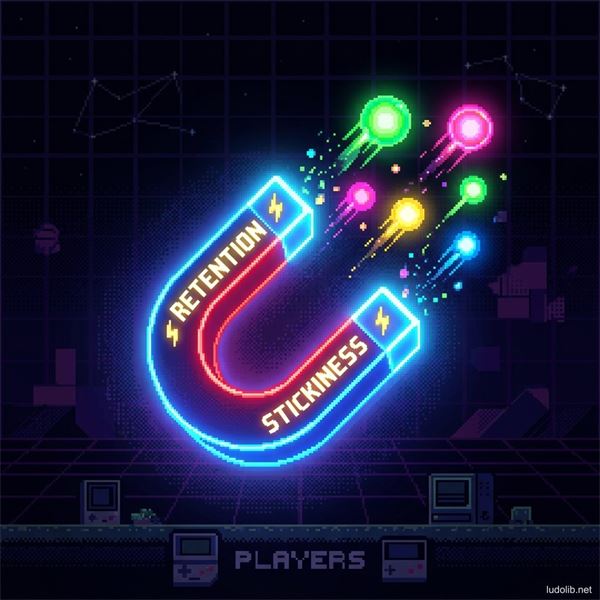 Illustration: A magnetic design feature — The core system pulling players back to the interaction epicenter.
Quick Summary
Retention is the percentage of players who return to an application after installing it. This is a life-or-death metric measuring the “health” and attractiveness of any game, especially Live Service model games. If the Churn rate indicates system leaks, Retention proves that the interactive mechanics are functioning effectively to form habits in players.
Unlike expensive User Acquisition advertising campaigns, maintaining a stable Retention rate is proof of an excellently balanced design system.
1. The Three Life-or-Death Measurement Milestones
The industry categorizes the player’s engagement lifecycle into standard timelines to diagnose Game Design issues:
- D1 Retention (Day 1): The percentage of players who download the game today and log back in tomorrow. The ideal level is usually . If D1 is too low (under ), the cause is usually a terrible initial experience phase (FTUE), a high Frustration Factor, or laggy performance.
- D7 Retention (Day 7): Measures the transition from a “trial experience” to “habit formation”. At this milestone, players usually start hitting resource barrier walls (Paywalls). The golden ratio usually falls around . The success or failure of D7 depends heavily on the Pacing algorithm.
- D30 Retention (Day 30): The verdict for long-term sustainability. A rate at the 30-day mark proves the game possesses good Addictive Game Design, a strong player community, and the ability to optimize customer lifetime value (LTV).
2. The Retention Optimization Design Ecosystem
Retaining users is not born out of luck but is the result of weaving behavioral psychology elements into the source code:
2.1. Grasping Reward Psychology
The Faucets and Sinks structure must be set up so that players always have Short-term and Long-term goals. Distributing daily drip-feed rewards (Daily Login Rewards) creates a volume of repetitive Dopamine stimulation, forcing players to maintain their access habit to avoid the Fear Of Missing Out (FOMO) syndrome.
2.2. Social Ties
Human beings are fundamentally social creatures. When Game Designers integrate Guilds, Cooperative (Co-op) parties, or Leaderboards, they create mental barriers making it hard for players to quit. Quitting the game at this point means abandoning a community and their virtual status. According to the Bartle Player Types model, this element hits hard on the Socializers and Killers groups.
2.3. Balancing the Progression Curve
Players need to feel continuous Progression to achieve the Flow state. If the game suddenly becomes too hard without providing a reasonable power advancement path, they will get depressed. Applying Dynamic Difficulty Adjustment helps flatten the spiking bumps of difficulty.
3. The Ethical Line in Retention Design
While Retention is the holy grail for all developers, pushing retention mechanics at all costs can mutate into toxic psychological manipulation. “Dark Patterns” designs exploiting chance-based wheels or enforcing strict real-time obligations can break the inherent entertainment structure, turning the game into a forced Chore.
True balance lies in designing so that players want to return because the core experience brings satisfaction, not because they feel forced to return.
🔗 References
- Mobile Game Data Analytics Industry (DevToDev).
🔭 See Also
- 8 Framework Retention — 8 structured Retention design method frameworks (HOOK, JOY, RETAIN, GAME, CORE, FLOW, STICK, LAST)
- FTUE
- Churn rate
- LTV
- Feedback Loop