
🔄 Mobile Game Loop Breakdown
Quick Summary
Mobile Game Loop Breakdown is a structural map of a complete mobile game loop — from the moment a player starts a level to when resources are redistributed. The loop consists of 5 main nodes: Core-Gameplay → Win/Fail → Metagame/Monetization → Progression → Core-Gameplay. Understanding the resource flow through each node allows designers to control Retention and revenue simultaneously. [S1]
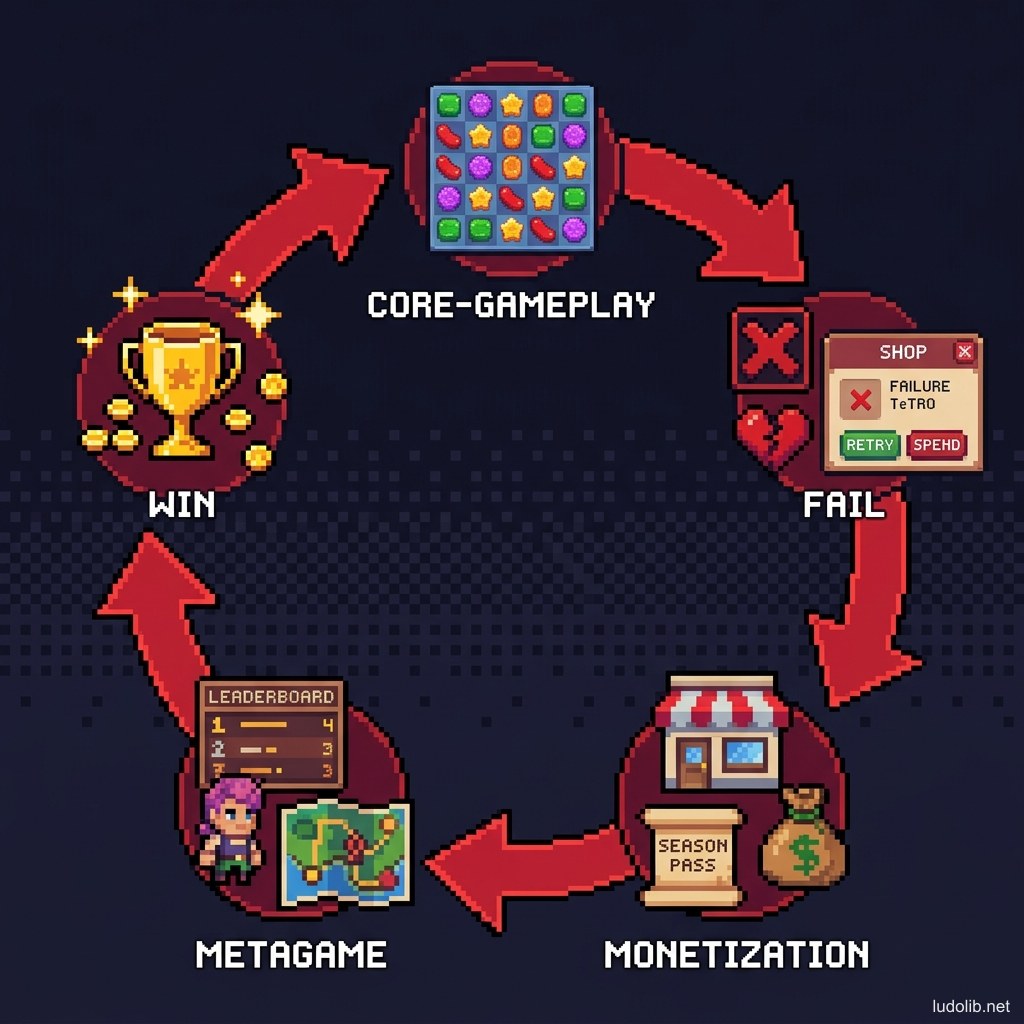 Illustration: Mobile game loop diagram — 5 primary nodes and resource flows throughout the system.
A mobile game is not a series of isolated levels — it is a closed-loop resource ecosystem. Every time a player wins or loses triggers a chain reaction of currency, scores, and state changes. This infographic from Anton Slashcev (Executive Producer) dissects the entire loop into clear nodes with specifically defined inflows (+) and outflows (−). [S1]
Loop Overview Diagram
CORE-GAMEPLAY
   ↙ WIN          ↘ FAIL
METAGAME        MONETIZATION
   ↘                ↙
      PROGRESSION
          ↓
   CORE-GAMEPLAY (repeats)
Each complete loop cycle is a resource transformation — players put in (Boosters, Lives) and receive back (Currency, Power Level, Player Satisfaction).
Node 1 — Core-Gameplay
Core-Gameplay is the center of the loop — where players actually play the game. All primary action takes place here (match-3, tower defense, puzzle…).
Resources consumed:
- Boosters (−): Players use support items during the level
There are only 2 exit directions from Core-Gameplay:
- ✅ WIN → progresses to Metagame
- ❌ FAIL → progresses to Monetization
Important
Core-Gameplay design determines how frequently players win or lose — and therefore controls both the Metagame inflow and Monetization inflow simultaneously. Adjusting difficulty here is the single most powerful lever affecting the entire system.
Node 2a — WIN
When a player wins a level, they receive resource rewards and enter Metagame.
Resources received:
| Resource | Symbol | Meaning |
|---|---|---|
| Currency | 🪙 + | Primary currency for spending within the game |
| Meta Score | ⭐ + | Ranking points and long-term progress |
| Progress Points | XP + | Points that trigger Level Ups and Quests |
WIN is the positive reward of the loop — creating a sense of satisfaction and providing resources to continue investing in Metagame.
Node 2b — FAIL
When a player fails, they lose resources and are directed to Monetization — where they can choose to continue using real money or accumulated resources.
Resources lost:
| Resource | Symbol | Meaning |
|---|---|---|
| Lives | ❤️ − | Limits the number of free attempts |
| Currency | 🪙 − | Opportunity cost of a failed attempt |
Real-world example: The “Continue?” screen offering “+5 moves for 900 coins” after a loss — this is the most classic Monetization conversion point in casual mobile games.
FAIL is the pressure mechanism that drives Monetization without feeling coercive — players choose to spend to continue, rather than being forced.
Node 3a — Metagame
Metagame is the outer layer surrounding Core-Gameplay — where players invest Currency and Meta Score into long-term and social experiences.
Metagame Components:
| Component | Function |
|---|---|
| Leaderboard | Social competition, displays rankings between players |
| Cosmetic Items | Aesthetic items to personalize characters / environments |
| Global Map & Narrative | World map and story that draws players further into the game |
| Decor | Decoration system (house, garden, town) — creates a sense of ownership |
Resource flow through Metagame:
- Meta Score (−): Spend Meta points to unlock new content
- Player Satisfaction (+): The result of investing in Metagame — a sense of progress and self-expression
Metagame answers the question: “Why should I keep playing after completing that level?”
Node 3b — Monetization
Monetization is where real revenue is generated — activated primarily by the FAIL state.
Monetization Components:
| Component | Description |
|---|---|
| Shop | Fixed-price or bundle item store |
| Offers | Time-limited deals, personalized based on player behavior |
| Season Pass | Seasonal subscription model — pay to unlock rewards tied to progression |
Resource flow through Monetization:
| In/Out | Resource |
|---|---|
| Real Money (−) | Player spends real currency |
| Currency (+) | Receives in-game currency |
| Boosters (+) | Receives support items |
| Lives (+) | Receives additional lives to continue playing |
Tip
Good design ensures Monetization feels like a convenient choice, not a mandatory requirement. Players should be able to progress for free — just more slowly.
Node 4 — Progression
Progression is the conversion hub — receiving resources from both Metagame and Monetization and transforming them into power to re-enter Core-Gameplay stronger.
Progression Components:
| Component | Description |
|---|---|
| Win Streak & Quests | Rewards for winning streaks and completing missions |
| Level Up & Upgrades | Upgrade characters, skills, equipment — increases Power Level |
Resource flow through Progression:
| In/Out | Resource | Meaning |
|---|---|---|
| Boosters (+) | Receive more | Preparation for the next session |
| Currency (−) | Spend | Invest in upgrades |
| Power Level (+) | Increases | Player enters the next level stronger |
| Progress Points (−) | Consumed | XP used to trigger Level Up |
Progression is the loop’s “memory” — accumulating results from many sessions into long-term strength.
Consolidated Resource Flow
| Resource | Sources In | Sources Out |
|---|---|---|
| Currency | WIN, Monetization | Progression (upgrade), Metagame (cosmetic) |
| Boosters | Monetization, Progression | Core-Gameplay (consumed) |
| Lives | Monetization | FAIL (depleted) |
| Meta Score | WIN | Metagame (spent) |
| Progress Points | WIN | Progression (Level Up) |
| Power Level | Progression | Core-Gameplay (effectiveness) |
Design Applications
When FAIL Rate is too high: → Too many players are funneled into Monetization → Churn increases if Monetization isn’t compelling → Adjust Core-Gameplay difficulty or balance Lives regeneration rate.
When WIN Rate is too high: → Progression becomes meaningless, Monetization is bypassed → Increase difficulty or create additional reasons for players to voluntarily use Boosters.
When Metagame fails to engage: → Players win but have no reason to continue → Invest in narrative, social features, cosmetic systems.
See Also
- Feedback Loop — Positive and negative feedback loop mechanisms in game design
- Progression — Progression systems (Effort × Reward)
- Retention — Player retention strategies
- Live Service — Managing a continuously running game service
- Gacha — Probability-based Monetization model
- Faucets and Sinks — Economy management model for Sources and Sinks
- Mobile Game Balancing — Comprehensive balancing for mobile games
- Pity System — Fairness mechanism in probability-based systems
References
- [S1] Anton Slashcev, “Mobile Game Loop Breakdown” — Executive Producer infographic (2024)
- [S2] Ethan Levy, The Mobile Game Loop Design Handbook (2021)
- [S3] Will Luton, Free-to-Play: Making Money From Games You Give Away (2013)