
😰 Loss Aversion in Puzzle Games
Quick Summary
Loss Aversion is a behavioral psychology phenomenon in which humans feel the pain of losing something roughly twice as strongly as the pleasure of gaining something equivalent. [S2] In Puzzle game design, this mechanism is systematically exploited: when a player is about to fail a level, they don’t just lose one life — they can simultaneously lose up to 6 different types of rewards. That accumulated pain is the psychological lever used to trigger spending. [S1]
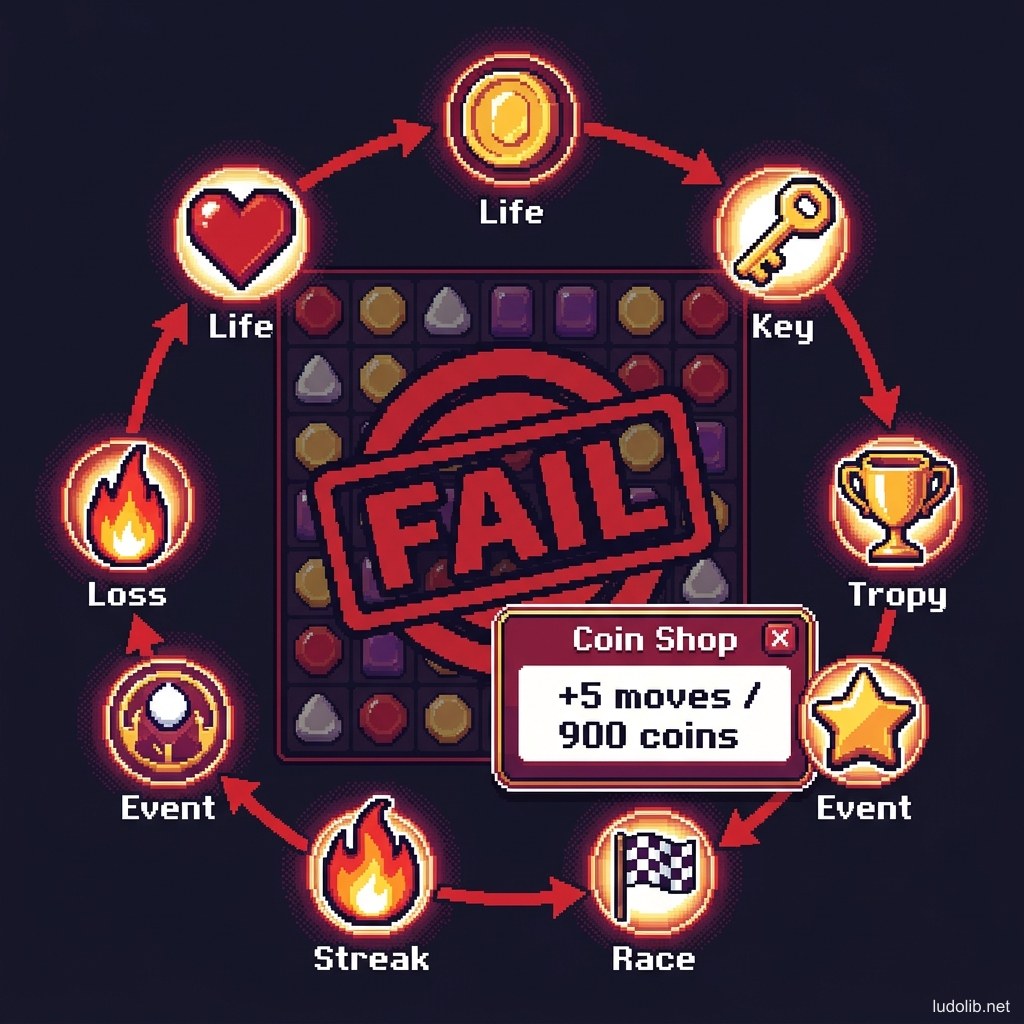 Illustration: 6 simultaneous layers of loss when failing a puzzle level — each layer is a distinct psychological pressure.
The central question this framework poses: “How much will you lose when failing a level?” — and the answer isn’t one thing, but six. [S1]
Psychological Foundation: Why Does Losing Hurt More Than Winning Feels Good?
Loss Aversion is one of behavioral economics’ most important findings, researched by Daniel Kahneman and Amos Tversky (1979). [S2] Experiments demonstrate:
Losing 200 in gains** to compensate.
In mobile game design, this principle is applied in reverse: rather than promising rewards to persuade players to spend, designers pre-arrange things the player is about to lose and ask: “Do you want to pay to keep them?“
6 Loss Layers When Failing a Level
When the FAIL screen appears in a typical puzzle game (e.g., Homescapes, Gardenscapes), players can simultaneously face up to 6 loss layers:
❤️ 1. One Life
The most basic mechanism. Each failure consumes one life. When lives run out, the player must wait (typically 30 minutes per life) or purchase more. This is a time gate — but compared to the 5 remaining layers, its psychological pressure is the weakest.
🔑 2. Key for Season Pass
Some levels reward Keys upon completion — keys used to unlock rewards in the Season Pass. The “Continue?” screen notifies: “You will lose Keys!”
Players who have invested time in the Season Pass feel losing a key as losing earned progress — a form of sunk cost pressure.
🎁 3. Additional Rewards
Some levels carry bonus rewards for first-try completion or under special conditions. Failure means losing these rewards permanently — typically rare items or special currency.
Notification: “You’ll lose your reward for the event stage!”
⭐ 4. Event Stage Reward
When a level belongs to a time-limited event, failure doesn’t just cost the reward — it wastes an event attempt that cannot be recovered. FOMO (Fear of Missing Out) combined with loss aversion creates a double pressure.
🏆 5. Your Place in Race Tournament
If a level is part of a competitive tournament or leaderboard (like Knight’s Race), failure can drop the player’s ranking. The “Continue?” screen notifies: “You will lose the Cat’s Gift and your place in the race!”
This is social pressure — not just material loss, but loss of relative standing compared to other players.
🔥 6. Win Streak Progress
A Win Streak (consecutive wins) grants increasing special bonuses. One failure breaks the entire streak — all previous accumulation resets to zero.
This is the most emotionally brutal form of loss because it erases the history of effort, not just a single reward.
Summary: 6 Loss Layers
| # | Loss Type | Psychological Mechanism | Pressure Intensity |
|---|---|---|---|
| 1 | One Life | Time gate | ⭐⭐ |
| 2 | Key for Season Pass | Sunk cost | ⭐⭐⭐ |
| 3 | Additional Rewards | Loss of unique reward | ⭐⭐⭐ |
| 4 | Event Stage Reward | FOMO + scarcity | ⭐⭐⭐⭐ |
| 5 | Race Tournament Place | Social status loss | ⭐⭐⭐⭐ |
| 6 | Win Streak Progress | History erasure | ⭐⭐⭐⭐⭐ |
The Conversion Mechanism: The “Continue?” Button
All 6 loss layers converge on a single point: the “Continue?” button priced at +5 moves / 900 coins.
Psychological pressure accumulated from 6 loss layers
                    ↓
           "Play On 🪙 900"
                    ↓
     Player spends to avoid losing
This isn’t a player buying more moves — psychologically, they are paying to avoid pain. This subtle distinction creates significantly higher conversion rates than conventional purchase mechanics. [S3]
Tip
“Want to Avoid 6x Loss Aversion? Just Buy Extra Moves :)” — Anton Slashcev [S1]
This blunt, humorous observation openly exposes the mechanism: designers don’t hide that this is deliberately engineered loss aversion.
Application and Ethical Boundaries
Legitimate applications:
- Combine loss aversion with genuinely valuable content — players don’t feel manipulated if the rewards are worth it.
- Limit the number of loss layers displayed simultaneously — too many cause overwhelm and backfire.
Boundaries requiring care:
- Loss aversion combined with Gacha → can create compulsive spending loops.
- Applied to child players → an ethical grey zone examined by regulatory bodies worldwide [S4].
- If players feel manipulated rather than served → long-term trust erodes, churn increases.
See Also
- Game Monetization Models — Overview of revenue models in mobile games
- Mobile Game Loop Breakdown — The full loop in which Loss Aversion is the lever at the FAIL node
- Mobile Game Balancing — Balancing win/loss ratios to control Loss Aversion trigger frequency
- Pity System — The opposing mechanism: ensuring players don’t lose indefinitely
- Retention — Loss Aversion as a short-term retention tool
- Gacha — Probability-based mechanics combined with loss aversion
- Emotional Design — Broader emotional design including loss aversion
- Frustration Factor — When Loss Aversion is pushed beyond acceptable limits
References
- [S1] Anton Slashcev, “How Puzzles Use Loss Aversion for Monetizing Level Fails” — Executive Producer / Playliner infographic (2024)
- [S2] Daniel Kahneman & Amos Tversky, “Prospect Theory: An Analysis of Decision under Risk” — Econometrica (1979) — foundational research on Loss Aversion
- [S3] Nir Eyal, Hooked: How to Build Habit-Forming Products (2014) — analysis of pain avoidance mechanisms in product design
- [S4] European Parliament, “Online Gambling and Video Games: Regulatory Approaches” (2022) — report on child player protection regulations