
🧩 Puzzle Game
Quick Summary
Puzzle Games focus on developing logical thinking, pattern recognition, number processing, or spatial construction capability. The genre designs challenges for the brain rather than evaluating muscle reflexes.
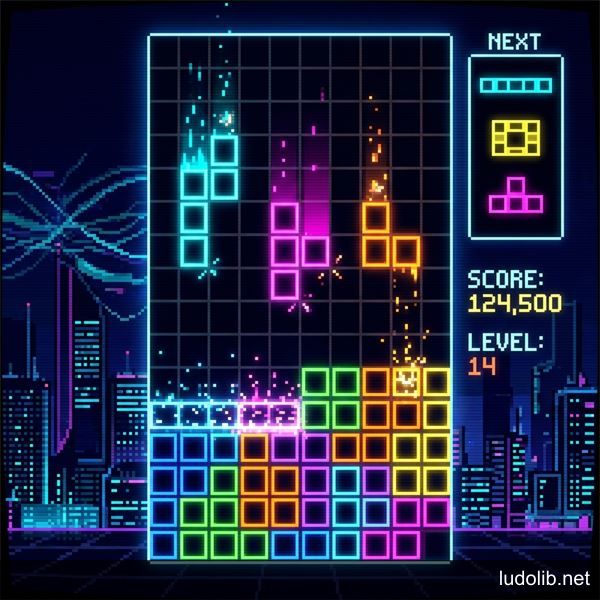
Puzzle Games are a genre system focused exclusively on the process of logical deductive intelligence, algorithm pattern recognition, and the participant’s spatial block simulation construction. Though sharing friendly graphics, the core orientation of this game type is entirely different from typical casual interaction entertainment (Casual Games) due to its specialized focus on progressive difficulty spikes.
Main Structural Branches
1. Tile-Matching
- Rule: Players must operate to change the position of a randomly established array of graphic objects, based on the principle of shifting colors or geometric configurations to the same state meeting the game’s formula rules.
- Industry heritage products: Tetris (1984) (Fill falling block space) and Bejeweled (2001) (Freely swap adjacent blocks).
2. Physics and Spatial Environment
- Since the transition to Game Engines with integrated real-world physics measurement systems, developers moved toward combining gravity, mass, and friction force parameters into puzzle mechanics.
- Challenges typically place players in closed 3D graphic environments containing switches, lens tiles, or weight-measurement blocks.
- Outstanding representatives: Portal 1 & 2 (Uses a sci-fi portal gun connecting spatial structures), The Talos Principle, The Witness.
3. Decoding and Programming Logic
- A group applying encryption learning systems or conditional mechanisms where players use binary logic or command sequence structures to automatically generate result answers.
- Examples: Zachtronics brand games (Opus Magnum), or the impressive design of Baba Is You — where given logic structures in word-statement form can be pushed around to completely change the output standard rules.
Theorem Design Thinking
Unlike the accumulating progressive stat rewards (XP/Level) or item systems in other genre groups, the sole core element establishing user continuation in Puzzle format is the psychological reward state (“Eureka cognitive phase” — the relief of achieving a logical solution after a cleverly organized sequence of analysis and trial-error processes managed by the systems design team).