
🎮 What is a Video Game?
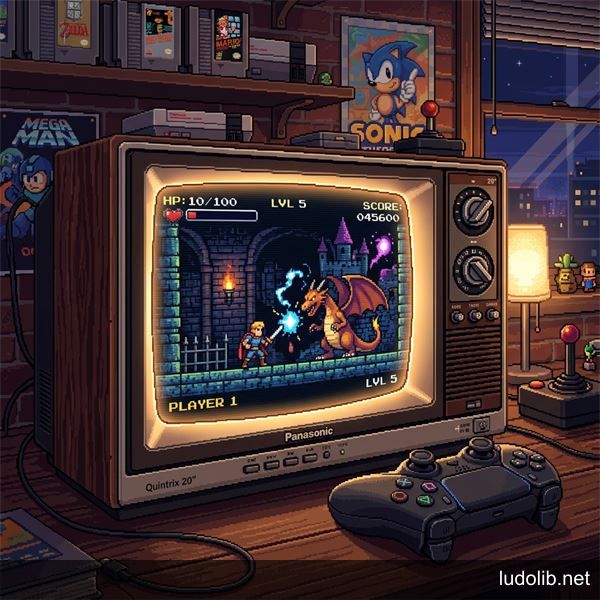
“A game is a series of interesting choices.” — Sid Meier, legendary designer of the Civilization series
1. Core Definition
A video game is an interactive form of entertainment — where a player uses input devices (controllers, keyboards, touchscreens) to interact with a world simulated by software, displayed on a screen with audio-visual feedback.
This is the most fundamental distinction between video games and all other passive entertainment (film, music, books): the audience becomes an actor. Players don’t just observe — they make decisions with real consequences inside that world.
Simply put: a film tells a story the filmmaker chose. But a video game invites you to write your own story — even if it’s just the story of “did I turn left or right?“
2. The Internal Structure of a Video Game
🎓 2.1 Academic Perspective: The MDA Framework
The most cited framework in academic game design is MDA — Mechanics, Dynamics, Aesthetics, published by Robin Hunicke, Marc LeBlanc, and Robert Zubek at GDC (Game Developers Conference) in 2004.
Source: Hunicke, R., LeBlanc, M., & Zubek, R. (2004). MDA: A Formal Approach to Game Design and Game Research. Proceedings of the AAAI Workshop on Challenges in Game AI.
MDA separates a game into three causally related layers, viewed from designer → player:
[Designer] → Mechanics → Dynamics → Aesthetics → [Player]
[Player]   → Aesthetics → Dynamics → Mechanics → [Designer]
⚙️ Mechanics
The pure data and algorithmic components of a game: rules, actions the player may take, win/lose conditions, how scores are calculated. This is the only thing the designer directly controls when writing code and designing systems.
Tetris example: Blocks fall under gravity, players rotate and move pieces, clearing full horizontal rows scores points — all Mechanics.
🔄 Dynamics
The emergent behavior that appears when Mechanics run in practice with players. Dynamics cannot be directly programmed — they result from players interacting with Mechanics in ways the designer cannot fully predict.
Tetris example: The escalating tension as fall speed increases, the strategy of “waiting for the straight bar” to clear 4 rows at once — these are Dynamics. The designer didn’t code “tension”; they coded the speed mechanic, and tension emerges naturally.
🎭 Aesthetics
The emotional response players experience when engaging with a game. LeBlanc lists 8 typical aesthetics: Sensation, Fantasy, Narrative, Challenge, Fellowship, Discovery, Expression, Submission.
Note: “Aesthetics” in MDA does not mean good/bad graphics — it means the player’s subjective feeling. Tetris with simple pixel graphics can still produce a very powerful “Challenge” Aesthetic.
The Key Insight of MDA
Designers approach games left to right (Mechanics → Dynamics → Aesthetics): “I want players to feel suspense — what Dynamics do I need, and what Mechanics produce those Dynamics?”
Players experience games right to left (Aesthetics → Dynamics → Mechanics): They feel suspense, realize they’re managing resources, and only finally understand the underlying rules.
The core answer: According to MDA, a game only requires Mechanics to exist. Dynamics and Aesthetics are inevitable consequences — they cannot be absent if Mechanics are designed correctly. Narrative is not a requirement. Tetris, Pong, and Chess have no story yet are complete, outstanding games.
→ Deep dive into MDA application in game design: Game Mechanics
💡 2.2 Common Perspective: Three Easy-to-Remember Elements
(This is the popular interpretation used in the gaming community and introductory textbooks — not a formal academic framework)
Rules (equivalent to Mechanics): What can you do in this game? In Super Mario Bros: jump over pits, stomp enemies, collect mushrooms.
Story / Setting (one form of Aesthetics): Why are you doing this? Because you’re Mario saving the princess. This is an optional layer — Tetris has no setting yet is extremely compelling. → Narrative Design
Feedback: What does the game tell you after you act? The “ding” when collecting a coin, screen shake when hit, score increasing. Good feedback creates a “rewarding” feeling after each action — this is actually part of Dynamics in MDA.
When everything works together smoothly, players reach what psychologist Mihaly Csikszentmihalyi calls “Flow” — complete immersion, losing track of time, challenge perfectly matched to skill.
3. How Do Video Games Differ from Other Games?
| Criterion | Board Games | Sports | Video Games |
|---|---|---|---|
| Environment | Physical (board, pieces) | Physical (field, ball) | Digital (software) |
| Referee | Human | Human | Computer auto-calculation |
| World Scale | Limited by physics | Limited by physics | Theoretically unlimited |
| Interactivity | High | High | Highest and most diverse |
| Entry Cost | Low | Medium → High | Low (only need a device) |
Video games’ greatest advantage lies in the unlimited nature of digital space: designers are not constrained by laws of physics, physical production costs, or the scale of the real world. A game can simulate an entire universe (No Man’s Sky with 18 × 10¹⁸ planets) or shrink to a single dark room (Amnesia: The Dark Descent) — all depending on design vision.
4. How Are Video Games Classified?
This is a more complex question than most people realize. Unlike film, which is classified by narrative content (Action, Romance, Horror), video games are primarily classified by their control mechanics and the type of decisions they require from players.
The most complete classification system has 2 levels:
🎮 Level 1: Game Genre — Classified by MECHANIC
Answers: “What do you do in this game?”
- First-Person Shooter: Shooting from the character’s eye perspective.
- Action Role-Playing: Combines action combat with character development.
- Turn-Based Strategy: Command-by-turn, requiring deep strategic thinking.
- Puzzle: Solving logic puzzles, no real-time pressure.
- Visual Novels: Interactive storytelling with branching choices.
- …and dozens of other genres.
→ See the full classification map: Game Genres
🎭 Level 2: Game Theme — Classified by SETTING
Answers: “Where does the game take place and what is it about?”
- Horror: Horror atmosphere, psychological tension.
- Sci-Fi & Cyberpunk: Future worlds, high technology, philosophical themes.
- Open World: Free exploration of vast open spaces.
- Survival: Fighting for survival in harsh environments.
→ See the full theme map: Game Themes
5. How Are Video Games Made?
A commercial video game is not simply the product of one programmer. It is a multidisciplinary industry requiring coordination across many specializations:
| Area | Role | Related Articles |
|---|---|---|
| 🎯 Design | Building rules, balancing difficulty, designing levels | Game Mechanics, Level Design |
| 🎨 Art | Drawing characters, environments, animation, interfaces | UI UX Design |
| 🎵 Audio | Background music, sound effects, voice acting | Sound Design |
| 💻 Programming | Turning design into executable code | Game Engine |
| 📖 Writing | Scripting, world-building, character design | Narrative Design |
→ Learn about the people who make games: Game Designer, Game Artist, Game Coder
6. Why Do Video Games Matter?
Video games are not merely “games.” They are the only composite art form that simultaneously combines:
- Visual arts (graphics, animation)
- Auditory arts (music, sound)
- Language arts (scripts, dialogue)
- And something no other medium has: interactivity and agency of the experiencer.
As of 2024, the video game industry generates over $200 billion USD in global annual revenue — larger than the film and music industries combined. Over 3 billion people on Earth play games to some degree. [S: Newzoo Global Games Market Report 2024]
→ Explore the industry’s history: History of Video Games → Understand the economics: Game Monetization Models
7. Recommended Starting Points
Depending on your interests, here are suggested paths forward:
If you’re a gamer who wants to understand more deeply: Start with Game Mechanics to understand why games are fun. Then explore Game Genres to name what you’re playing.
If you want to learn about history: Visit History of Video Games — from the simple 2-button Pong (1972) to vast open worlds like GTA V.
If you want to make games: Your journey begins at Game Designer, Game Artist, and Game Coder — the three backbone roles of every game studio.
If you’re interested in the industry: Read Game Monetization Models and Gaming Platforms to understand the economic picture behind each game.
You stand before the gate of a vast knowledge base. Choose your direction.