
🏕️ Survival
Quick Summary
Survival places players in a harsh, deprived simulated environment to test their ability to maintain basic vitality. Players interact with the world through gathering natural resources and managing physiological status metrics such as: Health, Hunger, Thirst, and Body Temperature.
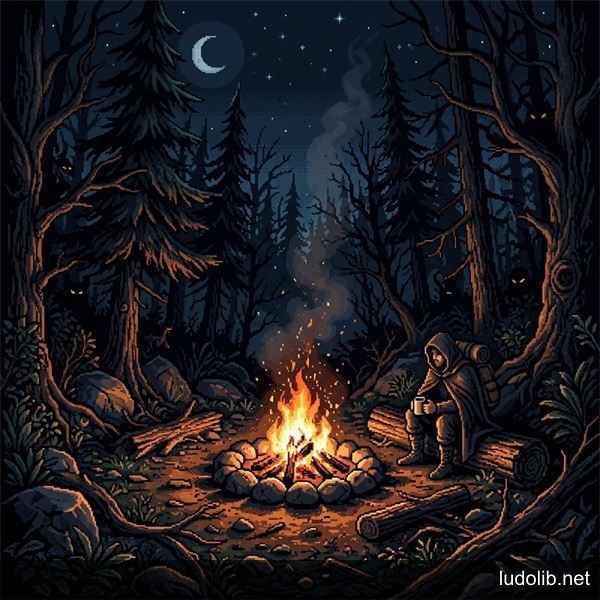 Illustration: A characteristic design feature of the Survival genre, requiring players to simultaneously manage a limited resource inventory and continuously monitor body maintenance indicator interfaces.
The core of the Survival design format is the complete withdrawal of the player’s default equipment advantages. The game establishes the character’s starting point in the most primitive state (lacking symbolic power items) in a naturally antagonistic environment. The core mechanic loop is tightly bound to the pressure of maintaining indicators: The central health bar is directly depleted by the design algorithm if supplementary wrapping indicators like Hunger, Thirst, and Stress hit specific warning levels.
Parameter and Resource Management (Gameplay Mechanics)
The foundational experience of the survival genre establishes barriers by limiting the field resource supply model, focusing on two basic Game Mechanics branches:
- Resource Management: Every resource on the map intrinsically has a Trade-off value rule. Establishing an inventory structure limit (Inventory Limit / Encumbrance) doesn’t allow carrying the entire amount of found necessities, thereby forcing the player’s psychological process to conduct a Cost-Benefit analysis before entering high-risk gathering areas.
- Crafting System (Farming & Crafting): Closely intersecting with the core morphological loop of Farming & Crafting Sims. Users start by creating low-level basic tools (picking up stones, sharpening wood), then gradually access more complex algorithmic technological design blueprints to convert primitive resources into defensive weapons and base building shelter architectures.
Typical Design Formats
- Primitive Environment Survival Structure: The application by Minecraft defined the boundaries of the standard loop - where the natural Day/Night cycle environment acts as a difficulty-increasing catalyst. The automatic spike in pressure at night trains the ability to accumulate sheltering reflexes and control natural spatial risks.
- Multiplayer Survival: Games like Rust or ARK: Survival Evolved tightly link intrinsic physiological indicators with a large concurrent player community environment. The risk system is intentionally shifted from the Environment (PvE) to competitive protocols, direct tactical raiding between player networks (PvP), simulating the harsh scale of having property destroyed while offline.
- Specific Environment Survival Variables: Prominently in the game Subnautica, designers allocate extreme underwater space exploration experiences and establish an additional new pressure management variable: Oxygen Compression Level (O2). Players enter a survival loop linearly calculated and tied to diving equipment volume alongside a limited countdown display duration.