
🍄 Platformers & Runners
Quick Summary
Platformers & Runners are two core action-movement genre groups. Platformers require players to technically jump between platforms and space boundaries, while Runners (Auto Runner) simplify controls to obstacle-avoidance reflexes on a continuously advancing single axis.
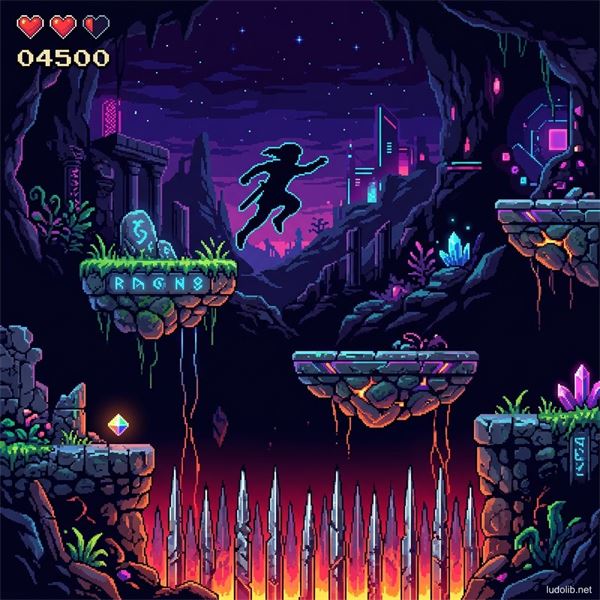
The two largest defining systems represent games focused on mechanical and spatial calculation ability, requiring the protagonist to use physical capabilities to traverse interrupted terrain without tactical gunplay.
1. Platformer
This foundational format appeared alongside the explosion of Super Mario Bros. The term “Platform” in design methodology refers to the structural format of floating platforms or layers elevated off the ground. The basic objective is always to control the character’s aerial position and safely land on a different surface to navigate or avoid environmental hazards.
Platformer Sub-branches
- 2D Platformer: Movement displayed on a single plane with X (Horizontal) and Y (Vertical) axes. Players have absolute spatial position control. (Examples: Shovel Knight, Celeste, Hollow Knight).
- 3D Platformer: Expands into multi-dimensional omni-directional movement. More complex challenge because it requires shadow sensing capability to determine the Z spatial dimension. (Examples: Mario Odyssey, Crash Bandicoot).
- Cinematic Platformer: Typically uses physical interaction variations approaching real-world physics principles, simulating very realistic characters through impressive camera techniques while reducing animation spring-bounce (Examples: Inside, Limbo).
2. Runners (Auto Runner / Endless Runner)
A function-reduced sub-branch of Platformer, receiving enormous scale application with the development of touch-screen Mobile Game platforms.
- Auto-run mechanic: Acceleration force and forward movement state are fixed. Players lose the freedom to change direction — only intervening in micro-reflex windows (Jump/Slide/Lane switch).
- Objective: Survive as long as possible or collect point reward milestones (Highscore). Difficulty parameters increase based on the system establishing unlimited infinite acceleration.
- Popular examples: Temple Run, Subway Surfers, Bit.Trip Runner.
Architectural Connections
The survival-critical element determining the entire quality success of a Platformer comes from the precise parameter measurement capability of the Map Structure Engineers (Level Design). They are responsible for calculating jump trajectory acceleration, accurately calibrating cliff heights, and configuring the character’s physical collision zone (Hitbox) to provide a fair conquest feeling without erroneous computer judgments.