
🎵 Arcade & Rhythm
Quick Summary
Arcade & Rhythm is a genre group focused on challenging players’ reflex and memorization skills, either through achieving the highest possible score or executing button inputs precisely synchronized with a music beat.
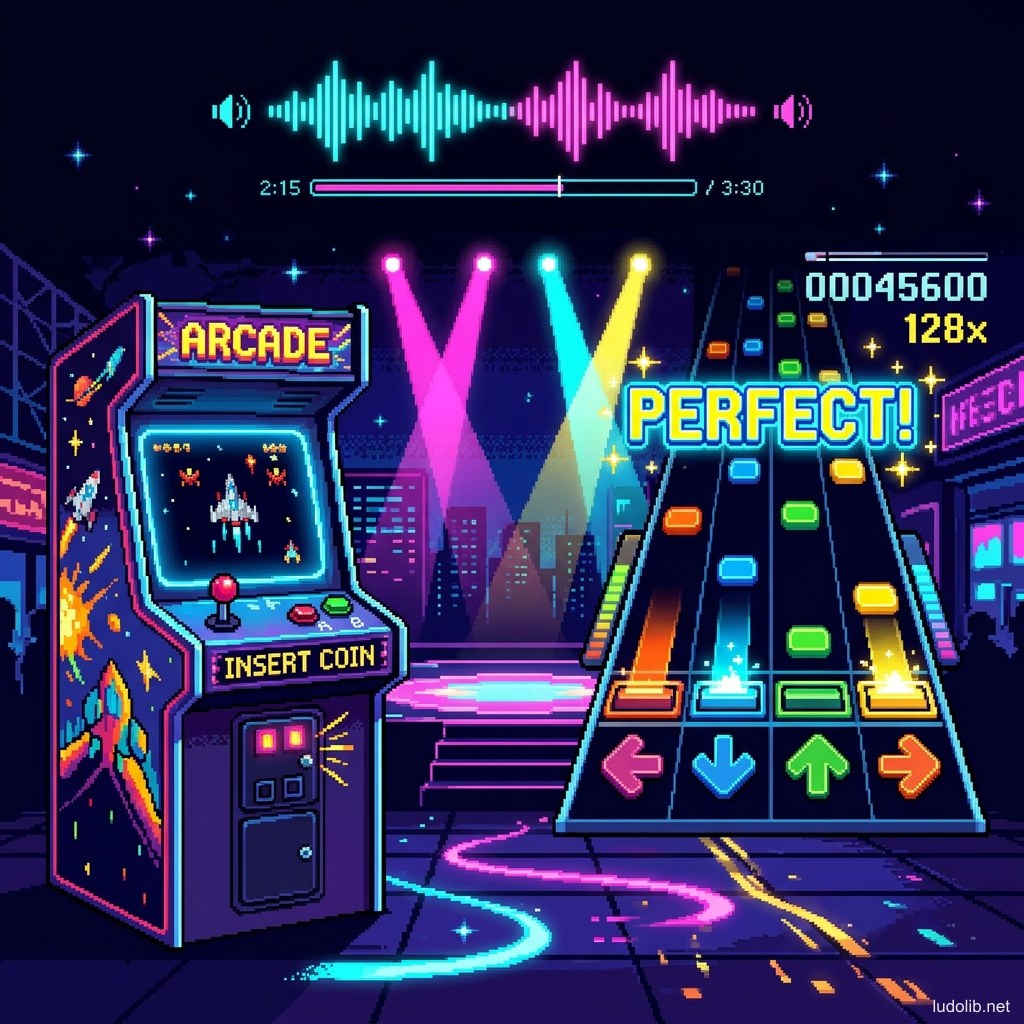 Illustration: Traditional arcade cabinet (left) and Rhythm game interface with a falling note chart, showing a PERFECT response when the player hits on beat (right).
On Steam’s classification system, Arcade & Rhythm groups together games bearing the traditional arcade cabinet design style and pure music rhythm titles. The characteristic of this group is that it typically removes as much story content (Narrative Design) as possible to focus all attention on Score and personal performance.
1. Arcade (Arcade Cabinet Style)
Originating from the Golden Era of Arcade in the history of video games, these systems were designed with extremely short play loops and high difficulty — initially with the business goal of increasing coin-operated (Coin-op) usage rates.
- Focus is on earning the High Score.
- Systems typically have no progress save feature (Save/Load). Upon failure, players must start over.
- Pace is very fast, mechanics are simple to learn but require long periods to master (Easy to learn, hard to master).
2. Rhythm Games
The genre requires players to synchronize control inputs with the rhythm of music.
- Core mechanic: Executing precise input at the moment an object (sliding bar, rhythm key) touches the timing line (Timing window).
- Skill requirements: Depends on beat-hearing skill and muscle memory. Demands quick reflex capabilities through ear-hand coordination.
Notable Games
- Osu!, Guitar Hero, Beat Saber: Use virtual instrument simulations or VR controllers to interact with notes at high BPM.
- Geometry Dash: A hybrid of Platformer controls and music rhythm, requiring players to overcome Obstacles synchronized with the background beat.
- Taiko no Tatsujin: Simulates traditional Japanese drumming based on on-screen signals.
Connections
- Due to the precision element, Sound Design is the foundational core of every music game, closely tracking the requirement for extremely low input lag.
- The characteristic of this game group is particularly well-suited for Speedrunning culture or competitions showcasing independent reflex skill.