
🎢 Pacing
Quick Summary
Pacing (Experience Tempo) is the distribution chart of impact frequency and event stimulation intensity established by the game along a timeline. The design goal of the Pacing algorithm is to navigate the player’s physiological status bar to stay within a balanced threshold, preventing exhaustion from overload or interaction drop-offs due to static boredom.
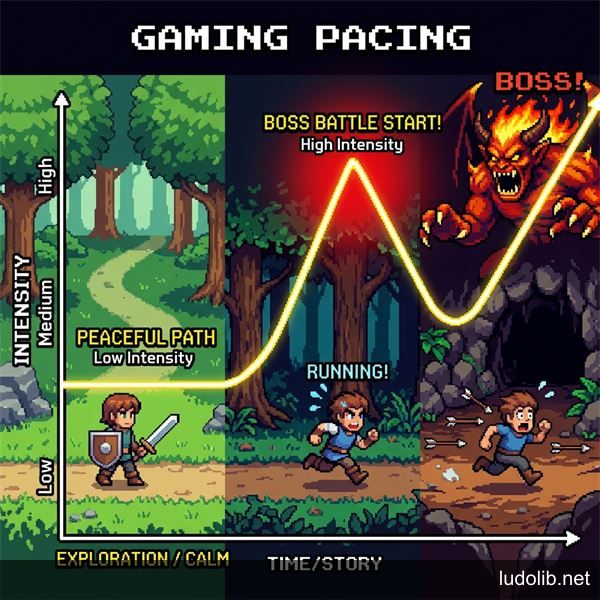 Illustration: The sinusoidal structural distribution of Pacing, alternating between zones of high antagonistic intensity (Climax) and safe corridors acting as rest stops.
Pacing acts as the backbone for maintaining a user’s continuous connection index. It is the priority information planning method of a Game Designer and the structural level of Level Design in deploying system event scripts according to a real-time facade.
Divergent Chart Structure
The software technical landscape does not impose 100% antagonistic density throughout the application’s lifecycle. The Pacing measurement framework usually adheres to a sinusoidal variation including standard phases:
- Build-up Phase: The system initializes an empty environment. Players resolve sparse events, gathering resources at a low amplitude to stimulate a safety assessment state and mental preparation.
- Climax Phase: An isolated Space, high density of machine entities (NPCs), or complex Encounter designs are pushed into the working zone. The operational complexity directly hits the threshold, urging an immediate spike in physiological response speed (Heart rate).
- Cool-down / Resolution Phase: Once the risk is depreciated, the system forms a resting checkpoint, providing a visual resource reward wave. The tension index subsequently gains momentum to drop, creating a satisfying self-feedback loop (Reward loop).
Practical Deployment
- The classic structural design system of Half-Life proves the even interweaving of variables: High-intensity rapid-fire gunfight segments are interrupted by wide terrain halls prioritizing environmental physics puzzles to restore the tempo, before unlocking a Narrative script block.
- The open-branching reference frame of Elden Ring maintains its Pacing flow by placing boundary blocks of drop-point assets or physical shortcuts immediately behind the combat cells holding the Boss, creating a rewarding Flow state stream that instantly relieves pressure.