
🎭 Emotional Design
Quick Summary
Emotional Design is a game design philosophy positing that every system in a game — from mechanics, progression, art, UI, to monetization — must be designed in parallel with specific emotional goals that developers want players to feel.
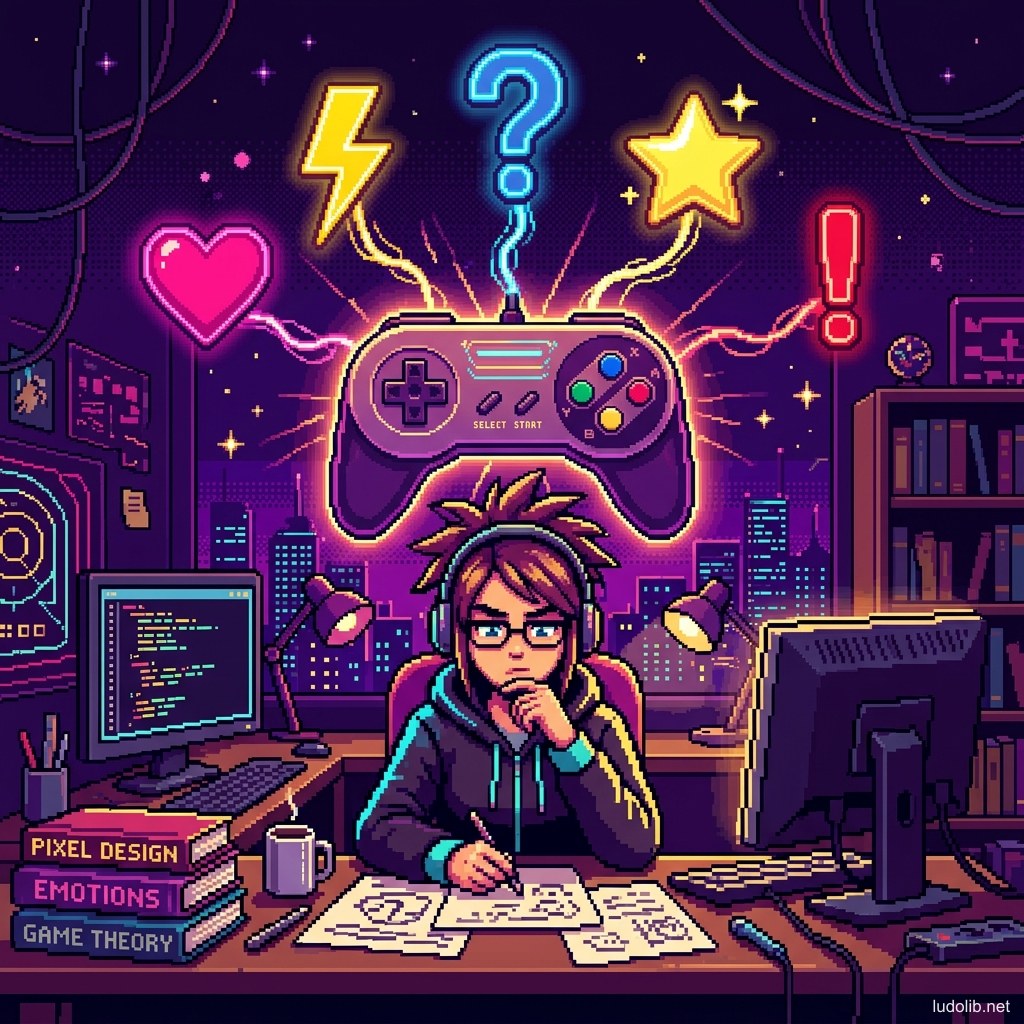 Illustration: A game designer connecting game systems with player emotional responses — the core of the Emotional Design philosophy.
Traditional game design often focuses on building systems: combat mechanics, progression loops, level maps. Emotional Design poses a mandatory parallel question: “How will this system make the player feel?”
This concept is widely popularized in the game design community by Executive Producers and Game Directors at major studios, especially in the mobile game and Live Service sectors — where player retention depends directly on the quality of emotions generated.
The 7 System Layers & Target Emotions
A complete game consists of 7 parallel design layers, each with its own set of target emotions:
1. Core Gameplay — Fun & Challenge
Systems to design: Game mechanics & rules, Core Loop, Difficulty & Pacing.
Target Emotions:
- Fun from interacting with game mechanics
- Curiosity — wanting to experiment with mechanics
- Mastery & Challenge — feeling in control and challenged
Design Note: The Flow state is only achieved when difficulty increases in sync with player skill. Lacking this balance leads to boredom or anxiety.
2. Progression — Anticipation & Achievement
Systems to design: Unlock system, Skill trees, short/long-term goals, rewards & bonuses, introducing new mechanics.
Target Emotions:
- Anticipation — expecting growth
- Desire — craving to reach the next milestone
- Joy — happiness from rewards
- Interest — “What happens next?”
Design Note: The progression system must always clearly show players the distance to the next reward. A distance too large or too vague will break the emotion of anticipation.
3. Art & Design — Immersion & Discovery
Systems to design: Consistent art style & world-building, Animations & VFX, characters & environments.
Target Emotions:
- Immersion — diving deep into the game world
- Game Feel — the “juiciness” of play
- Desire to explore — wanting to discover more
Design Note: Art direction is not just aesthetics — it’s an emotional guidance tool. Colors, lighting, and animation can all be intentionally designed to trigger specific reactions.
4. UI — Intuition & Ease
Systems to design: UI screens, user flow, icons & hints.
Target Emotions:
- Intuitive understanding — understanding immediately without learning
- Ease — easy navigation
- Readability — reading every element excellently
Design Note: A UI causing friction will instantly break the player’s Flow state. Good UI is UI that the player doesn’t realize exists.
5. Tutorial — Competence & “Aha!” Moments
Systems to design: Soft & Hard tutorials, text & visual hints.
Target Emotions:
- Competence & control — feeling in control of the game
- Aha moments — the moment of realizing something
Design Note: The ideal tutorial never says “Press button X”. It places players in a situation where the natural solution is pressing button X, letting them discover it themselves and experience the “Aha!” moment.
6. Monetization — Fairness & Value
Systems to design: Offers & hard currency, ads (Interstitial & Rewarded Video).
Target Emotions:
- Solvable “Pain” — players feel it’s reasonable to pay to solve a problem
- Fairness & value — feeling treated fairly
Design Note: Monetization causing negative emotions (feeling forced to buy, unfairness) will destroy the entire emotional experience built by the other design layers.
7. Live Ops — FOMO & Community Connection
Systems to design: Time-limited events, social mechanics & leaderboards, daily/weekly challenges, holiday features.
Target Emotions:
- FOMO — Fear of Missing Out
- Approval — wanting community recognition
- Excitement — thrill when participating in events
- Variety & festive mood — feeling of freshness, festivity
Design Note: FOMO is a powerful tool but needs cautious use. Abusing FOMO will make players feel manipulated instead of excited.
Core Principle
“Don’t just create systems — design the emotions.” — Anton Slashcev, Executive Producer [S1]
Emotional Design is not adding an extra step to the design process. It is a lens to view every design decision and constantly ask: “What will the player feel when encountering this system?”
The most successful game studios — from Nintendo to Supercell — all have one thing in common: they design emotions before designing systems.
See Also
- Game Mechanics — The foundation of Core Gameplay
- Flow — The ideal psychological state Emotional Design aims for
- Feedback Loop — The backbone of Progression emotions
- Pacing — Adjusting tempo to control player emotions
- Progression — The progression system and anticipation emotions
- Narrative Design — Storytelling as an Emotional Design tool
References
- [S1] Anton Slashcev, “How to Design Games That Evoke Emotions” — a popular infographic in the game design community (2024)
- [S2] Raph Koster, A Theory of Fun for Game Design (2004) — the theoretical foundation of emotions in games
- [S3] Norman, D.A., Emotional Design: Why We Love (or Hate) Everyday Things (2004) — the origin of the Emotional Design concept from UX design