
🎮 Game Experience Breakdown
Quick Summary
Game Experience Breakdown is an analytical framework stipulating that every emotional experience in a game is not a singular element but the intersection of two design elements. Understanding this formula helps designers recreate or enhance a specific experience by intentionally manipulating the exact two components that create it. [S1]
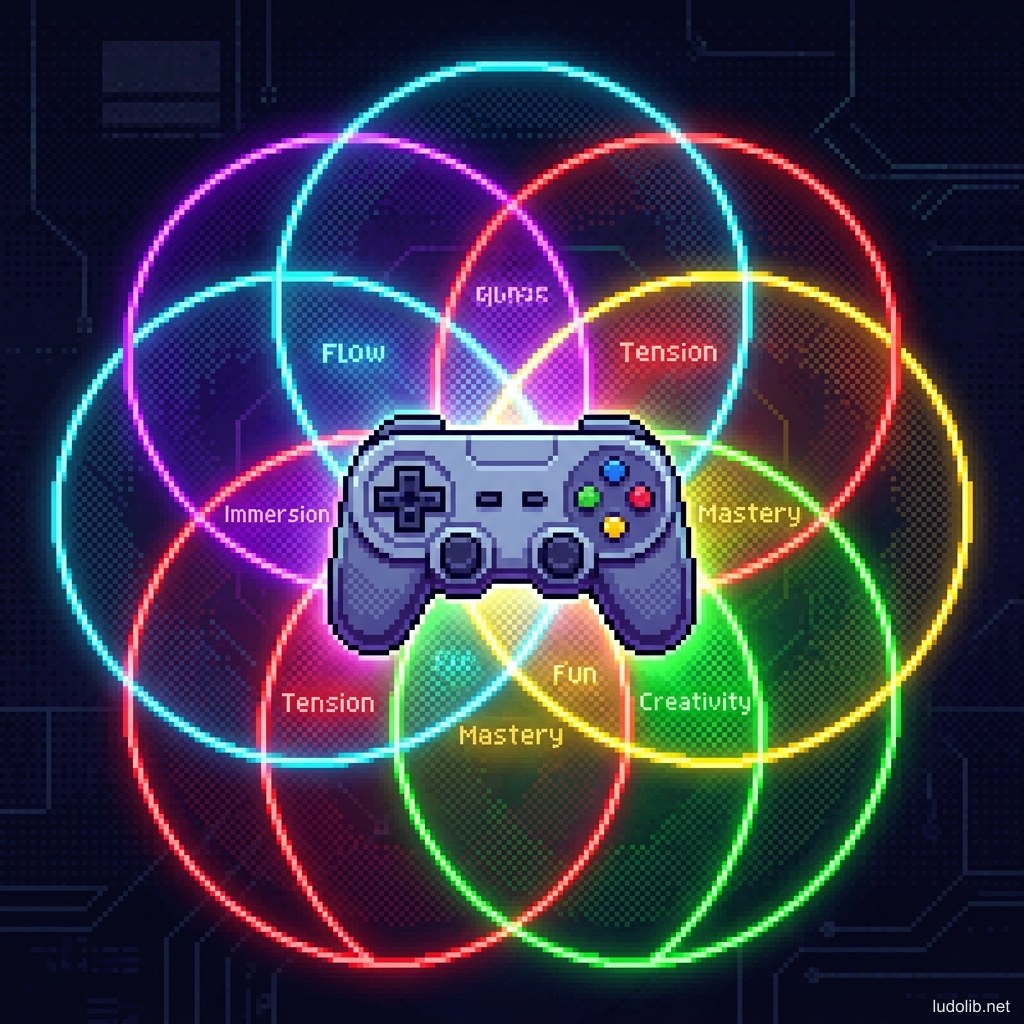 Illustration: 15 core game experiences — each created from the intersection of two distinct design elements.
No “fun” naturally appears in a game — every feeling a player experiences is the result of intentional design decisions. This analytical framework, compiled by Anton Slashcev (Executive Producer), dissects the 15 most common game experiences into constituent pairs of elements — providing designers with a clear map to create or reinforce each type of experience. [S1]
Foundational Principle: Experience = Intersection
Experience X = Element A ∩ Element B
Every experience only emerges when both elements are simultaneously present:
- Missing one of the two → the experience fails to form
- Enhancing both → the experience becomes stronger
- Imbalance between the two → the experience is distorted
15 Core Game Experiences
🎭 1. Immersion
Formula: Aesthetics ∩ Narrative
Immersion is the state where players forget they are sitting in front of a screen and believe in the game world. It cannot come from beautiful graphics alone (Aesthetics without Narrative → beautiful but hollow) or a good story alone (Narrative without Aesthetics → feels like reading a book, not living in that world).
Example: Red Dead Redemption 2 achieves peak Immersion thanks to photorealistic graphics combined with dense environmental lore — every NPC has their own schedule, every street corner tells a story.
See Also: Narrative Design, Emotional Design
🔄 2. Replayability
Formula: Progression ∩ Discovery
Replayability is the reason players start over from the beginning after completing a game. Not enough Progression → no feeling of new character development. Not enough Discovery → the second playthrough is identical to the first.
Example: Hades — each run has different RNG regarding boons and weapons, creating a new Progression path each time, while also revealing new lore → the 50th run still feels like a discovery.
⚡ 3. Tension
Formula: Uncertainty ∩ Urgency
Tension is the fast heartbeat when you don’t know what’s about to happen and don’t have enough time to think. Only Uncertainty without Urgency → slow suspense. Only Urgency without Uncertainty → boring pressure.
Example: The final circle in PUBG — not knowing where the enemy is (Uncertainty) + the rapidly shrinking poison zone (Urgency) = an unreproducible adrenaline rush.
See Also: Pacing, Frustration Factor
🌊 4. Flow
Formula: Challenge ∩ Skill
Flow is the optimal psychological state when players are completely immersed in the action without realizing time passing. The challenge must always be in sync with the player’s current skill — too easy causes boredom, too hard causes anxiety.
Example: Sekiro: Shadows Die Twice — the parry system demands precise timing but always feels fair → as players improve, they continuously achieve the Flow state.
See Also: Flow, Dynamic Difficulty Adjustment, Pacing
💬 5. Engagement
Formula: Agency ∩ Feedback
Engagement is the player feeling that their actions matter. Agency is the ability to make choices that truly affect the game. Feedback is the game clearly responding to the impact of that action. Missing Agency → the player feels like a supporting actor. Missing Feedback → actions feel meaningless.
Example: The dialogue system in Mass Effect — every choice (Agency) yields clear feedback from characters and alters outcomes (Feedback).
See Also: Feedback Loop, Emotional Design
🏆 6. Mastery
Formula: Iteration ∩ Achievement
Mastery is the feeling of getting better over time — not due to stat increases, but due to actual skill development. It requires Iteration (opportunities for repeated practice) and Achievement (milestones confirming true progress).
Example: Street Fighter 6 — the combo system allows infinite practice (Iteration), and the ranking system accurately reflects real proficiency (Achievement).
See Also: Bartle Player Types — Achievers are the group seeking Mastery the most.
📈 7. Progression
Formula: Effort ∩ Reward
Progression differs from Mastery in that it’s about stats increasing, not just skill. The player puts in Effort (time, exertion) and receives a Reward (level up, new item, new unlock). If Effort is too massive compared to Reward → Grinding feels tedious. Conversely → the game loses depth.
Example: Path of Exile — the massive passive tree requires serious investment (Effort) but the Reward is an extremely personalized and powerful build.
🔁 8. Retention
Formula: Habit ∩ Anticipation
Retention is the reason players return the next day. Habit is the behavioral loop reinforced over time (daily login, daily quest). Anticipation is the feeling of waiting for something that is coming (new season, event, patch).
Example: Genshin Impact — the daily resin system (Habit) combined with a pre-announced new character banner schedule (Anticipation) = players returning regularly.
See Also: 8 Framework Retention, Live Service, Addictive Game Design
😄 9. Fun
Formula: Interaction ∩ Joy
Fun is the simplest experience yet the hardest to define. Interaction is the player doing something — jumping, shooting, building, solving puzzles. Joy is the positive feeling arising from that action. Not all Interaction creates Joy — “juice” design (sound effects, visual feedback) is the tool that turns Interaction into Joy.
Example: Candy Crush — the simple candy matching mechanic (Interaction) but the colorful effects and sounds upon matching (Joy) create a satisfying loop.
See Also: Emotional Design, Addictive Game Design
🏔️ 10. Challenge
Formula: Strategy ∩ Complexity
Challenge differs from mere difficulty — it is difficulty with depth. Strategy means multiple viable approaches exist. Complexity means the system has enough layers for strategy to matter. Complexity without Strategy → confusing mess. Strategy without Complexity → too simple.
Example: Into the Breach — a simple 8×8 board but the interactions between units create extremely high strategic complexity.
🗺️ 11. Exploration
Formula: Curiosity ∩ Surprise
Exploration is the motivation to see “what’s behind that blind corner”. Curiosity is environmental design that provokes questions. Surprise is the reward for that question — it’s never just an empty space.
Example: The Legend of Zelda: Breath of the Wild — every mountain on the horizon (Curiosity) has something on it when you climb it (Surprise) — it’s never a dead end.
See Also: Bartle Player Types — Explorers live for this kind of experience.
♟️ 12. Strategy
Formula: Choices ∩ Consequences
Strategy is the feeling that your decisions actually matter. Choices must be numerous and distinctly different. Consequences must be clear enough for the player to learn from the results. Choices without Consequences → the game feels meaningless. Consequences without Choices → the game is too linear.
Example: XCOM 2 — every troop movement decision (Choice) can cause permanent character death (Consequence) → every choice carries weight.
😰 13. Suspense
Formula: Mystery ∩ Risk
Suspense is slow tension — different from Tension, which is immediate stress. Mystery pulls the player forward. Risk creates a cost for mistakes. Together they create the feeling of stepping into the dark knowing there might be danger.
Example: Alien: Isolation — not knowing where the Alien is (Mystery) + dying means reloading (Risk) = every step is an action demanding courage.
🎨 14. Creativity
Formula: Freedom ∩ Constraints
Creativity is the most interesting paradox in game design: too much Freedom → players are paralyzed not knowing what to do. Too many Constraints → no room left for creativity. The sweet spot is Freedom within a framework — enough rules to create a challenge, enough space to solve it in a unique way.
Example: Minecraft — basic physics (Constraints) but unlimited ways to build (Freedom) → players create unimaginable architecture.
🔧 15. Skill
Formula: Failure ∩ Learning
Skill develops through failure — but only when failure teaches something. Failure without Learning → frustration. Learning without Failure → nothing to learn from. A good game ensures every death is a clear lesson, not an arbitrary punishment.
Example: Dark Souls — every death (Failure) leaves a “bloodstain” visible to other players → the community learns from each other (Learning). Additionally, every boss attack has a clear telegraph to learn from.
See Also: Flow, Frustration Factor
Summary: The 15 Experiences Map
| Experience | Element 1 | Element 2 |
|---|---|---|
| Immersion | Aesthetics | Narrative |
| Replayability | Progression | Discovery |
| Tension | Uncertainty | Urgency |
| Flow | Challenge | Skill |
| Engagement | Agency | Feedback |
| Mastery | Iteration | Achievement |
| Progression | Effort | Reward |
| Retention | Habit | Anticipation |
| Fun | Interaction | Joy |
| Challenge | Strategy | Complexity |
| Exploration | Curiosity | Surprise |
| Strategy | Choices | Consequences |
| Suspense | Mystery | Risk |
| Creativity | Freedom | Constraints |
| Skill | Failure | Learning |
Practical Application for Designers
When an experience falls short of expectations, instead of asking “How do we make the game more fun?” — ask “Which element in the pair is missing or weak?”
Debugging Examples:
- Game lacks Tension? → Check Uncertainty (is it unpredictable enough?) and Urgency (is there a deadline?)
- Game lacks Flow? → Check the balance of Challenge vs current player Skill → apply Dynamic Difficulty Adjustment
- Game lacks Retention? → Check Habit (is there a daily loop?) and Anticipation (is there anything to look forward to?) → see 8 Framework Retention
See Also
- Emotional Design — The philosophy of emotional design — a lens parallel to the Game Experience Breakdown
- Flow — The Flow experience analyzed in-depth
- Narrative Design — The Narrative element in the Immersion formula
- Progression — The progression system (Effort × Reward)
- Feedback Loop — The feedback mechanism in the Engagement formula
- Retention — The metric measuring Habit × Anticipation
- 8 Framework Retention — 8 operational frameworks to optimize the Retention experience
- Bartle Player Types — Categorizing players by the experiences they seek
References
- [S1] Anton Slashcev, “Game Experience Breakdown” — Executive Producer infographic (2024)
- [S2] Marc LeBlanc, Robin Hunicke, Robert Zubek, “MDA: A Formal Approach to Game Design and Game Research” (2004) — the foundational academic framework on Mechanics-Dynamics-Aesthetics
- [S3] Raph Koster, A Theory of Fun for Game Design (2004) — theory on Fun and Learning in games