
🎲 Random Number Generation (RNG)
Quick Summary
RNG (Random Number Generation) is a core mathematical algorithm in computing, responsible for generating an unpredictable sequence of data distribution. Within the video game space, RNG dictates all risk factors, random reward systems, and event variables.
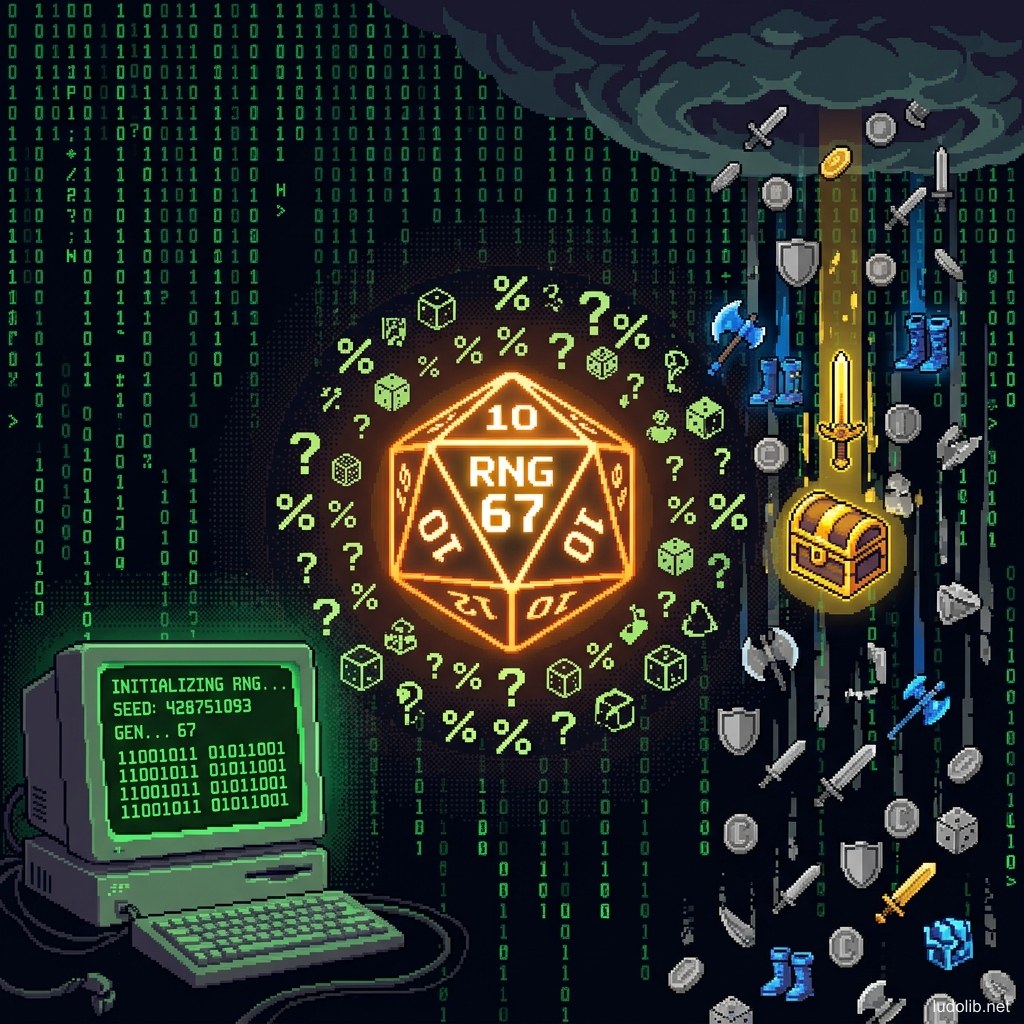 Illustration: RNG Mechanics — a virtual d100 die distributes loot based on probability, from common items (gray) to legendary ones (gold), with a Pseudo-RNG seed generated from the system.
RNG (Random Number Generation) is the computational foundation determining the uncertainty element of all games. In reality, computing devices cannot generate intrinsic randomness (True Random). They use a system called Pseudo-Random Number Generation (Pseudo-RNG) - utilizing an initial seed collected from the system, such as component temperature or real-time clock ticks, to replicate via a complex algorithm to output a result that appears perfectly chaotic.
System Execution Application Levels
The RNG algorithm shapes and governs a large portion of the base design loop:
- Mechanical Damage Probability: Displayed under the Critical Hit Chance parameter or the evasion system. If the rate is 20%, every time an attack command is received, the RNG system rolls a virtual 100-sided die; if it lands on numbers 1 to 20, the attack receives maximum acceleration, doubling the displayed damage amount.
- Resource Economic Value: Controls item Drop rates and the protective blind box economy (Gacha / Lootbox). This system ensures that each individual’s power Progression is distinct because the unboxing results are completely non-uniform.
- Multi-universe and Map Architecture: Procedural Generation technology in games like Minecraft or the card game Slay the Spire uses RNG calculation algorithms to drop room structure image code blocks that are completely radically different after every refresh press launching the server configuration. It infinitely increases a game’s replayability.
Controlling User Psychological Risk
Although randomness creates peak physiological stimulation when a player achieves a rare reward, it also carries the psychological risk of extreme frustration when the algorithm continuously drops low-probability results dozens of times (Loss Streak / Bad Luck). Therefore, Designers rarely use a pure RNG algorithm (True Random). They embed an accompanying corrective algorithm called the Hidden Mercy Mechanism (Pity), allowing the winning probability to progressively increase after every failed check to halt the player’s emotional decline cycle.