
😤 Frustration Factor (FUUU Factor)
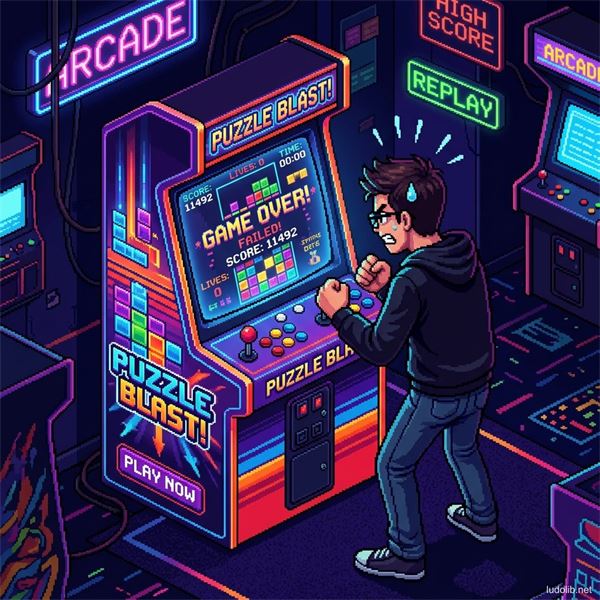 Illustration: A state of extreme frustration when the screen displays “Game Over” while the player is exactly one final move away from clearing the level.
Quick Summary
The Frustration Factor (or FUUU Factor) is a scale measuring the player’s emotional frustration, calculated based on their Near-wins. In puzzle game design, this metric is used as a powerful tool to manipulate player motivation and drive Monetization.
This article is based on Anton Slashcev’s framework “How to design FUUU factor for puzzle games”. It delves into the fragile boundary between the feeling of “I can do it” and despair, thereby helping Level Designers create the most engaging pacing.
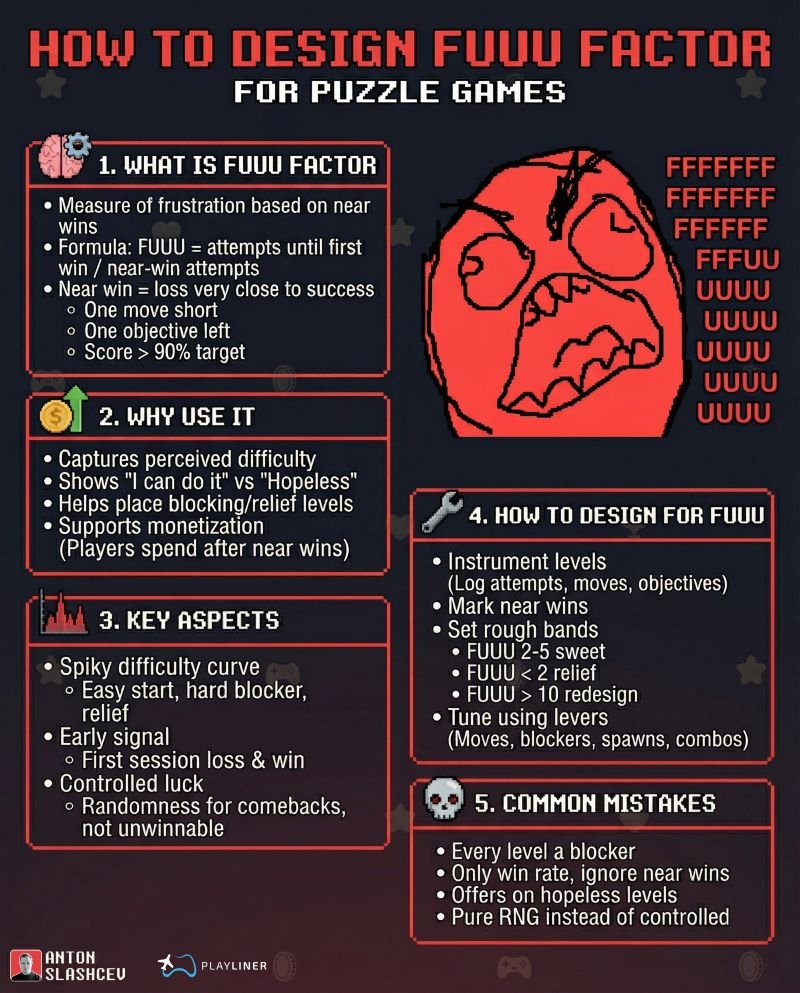 Source: How to design FUUU factor for puzzle games diagram by Anton Slashcev & Playliner
1. Concept: What is the FUUU Factor?
The FUUU Factor is a measure of a player’s disappointment level when they fail right at the finish line.
Basic Formula:
FUUU = Total attempts until win / Number of “Near-win” attempts
What is a “Near win”?
- Exactly one move short in Candy Crush.
- Exactly one objective left.
- Achieving >90% of the level’s required score but still losing.
2. Why use it?
Why do we intentionally frustrate players?
- Measuring perceived difficulty: Helps designers know if a level is truly hard or just feels hard.
- Creating psychological boundaries: Clearly distinguishing between the euphoric feeling of “Just a little more and I’ll clear the level” (I can do it) and surrender “This level is unbeatable” (Hopeless).
- Arranging level pacing: Accurately determining where to place blocking levels for challenge, and where to place relief levels to reduce tension.
- Driving Monetization: This is the most important goal. The feeling of a near win is the strongest stimulator of the desire to spend money. Players tend to be most willing to pay for extra moves or Boosters when they are in the “FUUU” state.
3. Key Aspects
- Spiky difficulty curve: In contrast to slowly increasing difficulty, puzzle games often use the model: Easy start ➡️ Encounter an extremely hard blocking level (Hard blocker) ➡️ Followed by a gentle relief level (Relief).
- Early signal: Analyzing losses and wins right from the first playing sessions to measure the player’s tolerance threshold.
- Controlled luck: Not letting the level be purely random (Pure RNG) making it “Unwinnable”. The game must create beneficial randomness, allowing players to make last-minute Comebacks to maintain hope.
4. How to design for FUUU
To apply the FUUU Factor effectively, the team needs an accurate measurement analysis system:
- Instrument levels: Log every attempt, number of moves, and objectives.
- Tag “Near-wins”: Clearly categorize them in the data system.
- Establish FUUU score bands:
FUUU from 2 - 5: Sweet spot. Just enough frustration to stimulate the player to try again or pay.FUUU < 2: Relief level. Too easy, used to soothe.FUUU > 10: Broken design level. Causes despair, must be redesigned immediately.
- Refining through levers: Adjust the number of moves, the amount of Blockers, the frequency of item Spawns, or the Combos creation rate to keep FUUU at a safe level.
5. Common Mistakes
Game designers often fall into these 4 traps when applying FUUU:
- Abusing blockers: Every level is a tough obstacle. Lacking resting beats will cause the Churn rate to skyrocket.
- Only looking at Win Rate: If you only track the Win rate and ignore the “Near wins” metric, you won’t understand the real reason why players abandon the game.
- Offering purchases at the wrong time: Presenting promotional Offers in “Hopeless levels”. Players won’t buy if they believe spending money still won’t help them win.
- 100% reliance on Pure RNG: Waiting for a miracle instead of providing “Controlled luck” will eliminate the player’s satisfying feeling of clearing a level.