
🎬 Storyboard & Animatic in Games
TL;DR: A storyboard is a set of sketched frames showing the sequence of shots and camera angles before actual production begins. An animatic is a storyboard placed in a timeline with duration and preliminary audio — the “test version” of a cutscene before investing the full production budget.
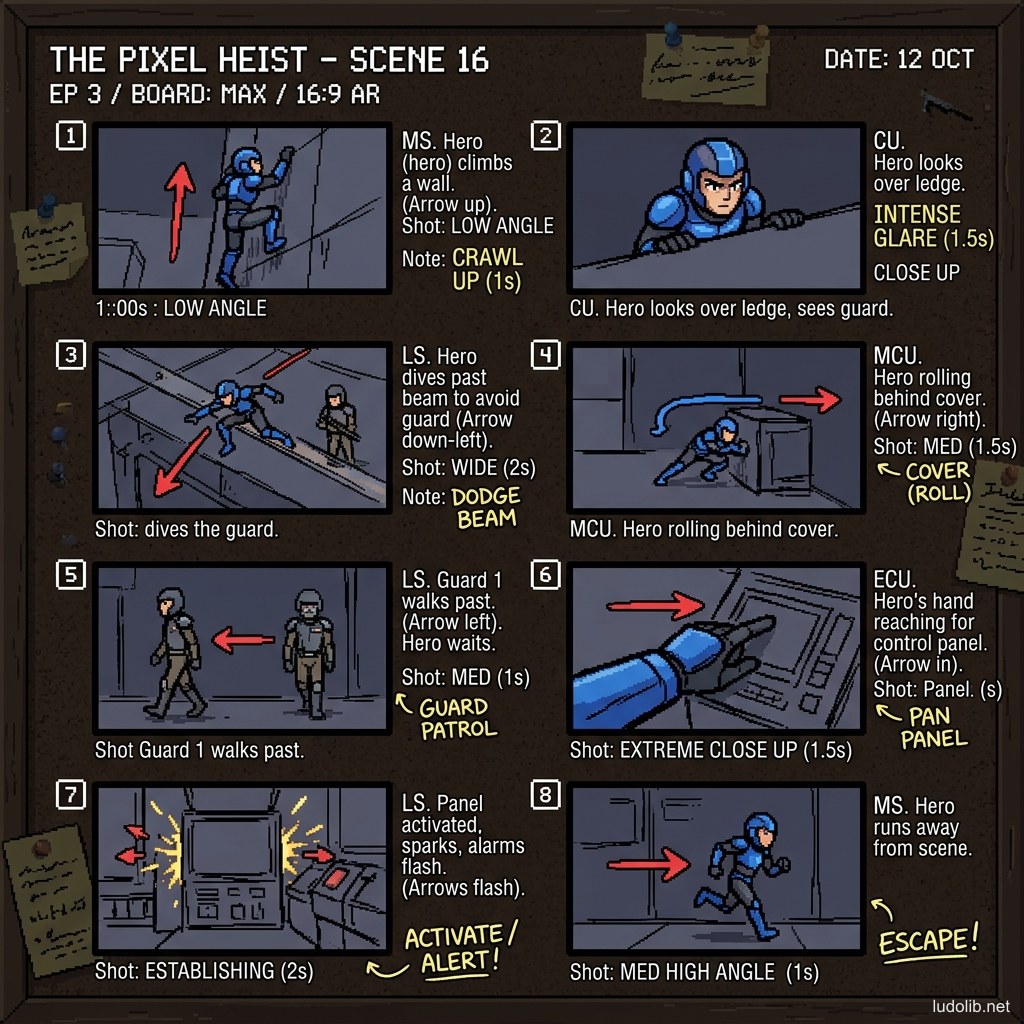
Before any expensive cinematic is rendered, before any motion capture actor puts on a suit, everything starts with a few pages of sketches. Storyboard and Animatic are tools that help creative directors, game designers, and narrative teams agree on the “film” to be told — at the lowest possible cost, at the stage where mistakes are easiest to fix.
Core Concepts
| Concept | Definition | Detail Level |
|---|---|---|
| Thumbnail Boards | Very quick sketches, only testing overall flow | Stick figures, a few seconds/frame |
| Storyboard | Official scene-by-scene breakdown: camera angles, framing, character actions | Rough drawing, 10-30 min/page |
| Animatic | Storyboard placed in timeline with proper timing and scratch audio | Requires editing software |
| Previs (Previsualization) | Rough 3D block-in version, replacing storyboard in large productions | Maya/Unreal block mesh |
Operating Principles
Why Do Games Need Storyboards?
Unlike cinema, games have two intertwined content streams: gameplay (player controls) and cutscene (game controls). Storyboard answers the hard question: “How do we transition from gameplay to cutscene without breaking immersion?” [S1]
Storyboard Language
Storyboards use standard signs and conventions from the film industry [S2]:
- Movement arrows — Direction character moves in the frame
- Camera arrows — Pan, tilt, dolly, crane shot
- Action lines — 180-degree rule (axis of action)
- Framing labels — ECU (Extreme Close-Up), CU, MS, LS, ELS
- Frame count / seconds — Expected duration of each shot
Workflow: Script → Storyboard → Animatic → Production
Script / Narrative Beat
        ↓
Thumbnail Boards (rough, fast)
        ↓
Review with Director → revise
        ↓
Full Storyboard
        ↓
Animatic (placed in timeline + scratch VO)
        ↓
Review: pacing, camera, emotion okay?
        ↓
Move to Motion Capture / 3D Production
The Animatic stage is the most important economic checkpoint [S3]: changing a scene here costs a few hours; changing after mocap is complete costs weeks.
Game Examples
- The Last of Us (Naughty Dog) — Every cutscene goes through at least 3 rounds of storyboard + animatic before entering mocap. Director Neil Druckmann shared that many important scenes were completely rewritten at the animatic stage when the team realized the timing was emotionally ineffective [S1].
- God of War (Santa Monica, 2018) — The “one continuous shot” design (no scene cuts throughout 30 hours of gameplay) required extremely complex storyboards to ensure the camera always has a sensible position without needing hard cuts.
- Hades (Supergiant Games) — Though indie, the team still created animatics for all important narrative moments using simple tools (Photoshop + After Effects) before putting them into the engine.
Trade-offs
| Aspect | Content |
|---|---|
| ✅ Advantages | Detects pacing and camera problems as early as possible. Creates shared vision for the entire team — writer, animator, VO director all reading from the same document. |
| ❌ Disadvantages | Requires Storyboard Artists with both drawing skills and cinematic language understanding — a fairly rare and expensive profile. |
| ⚠️ Common Pitfall | ”Storyboard lock” — team clings too tightly to the initial storyboard, not flexibly adjusting when problems are discovered in production. Storyboard is a plan, not a contract. |