
🎨 Concept Art in Games
TL;DR: Concept Art is the stage of drawing preliminary visual ideas to help the entire team align on the “face” of the game before production. This is the indispensable foundation step in the Game Art pipeline — determining the visual language throughout the entire project.
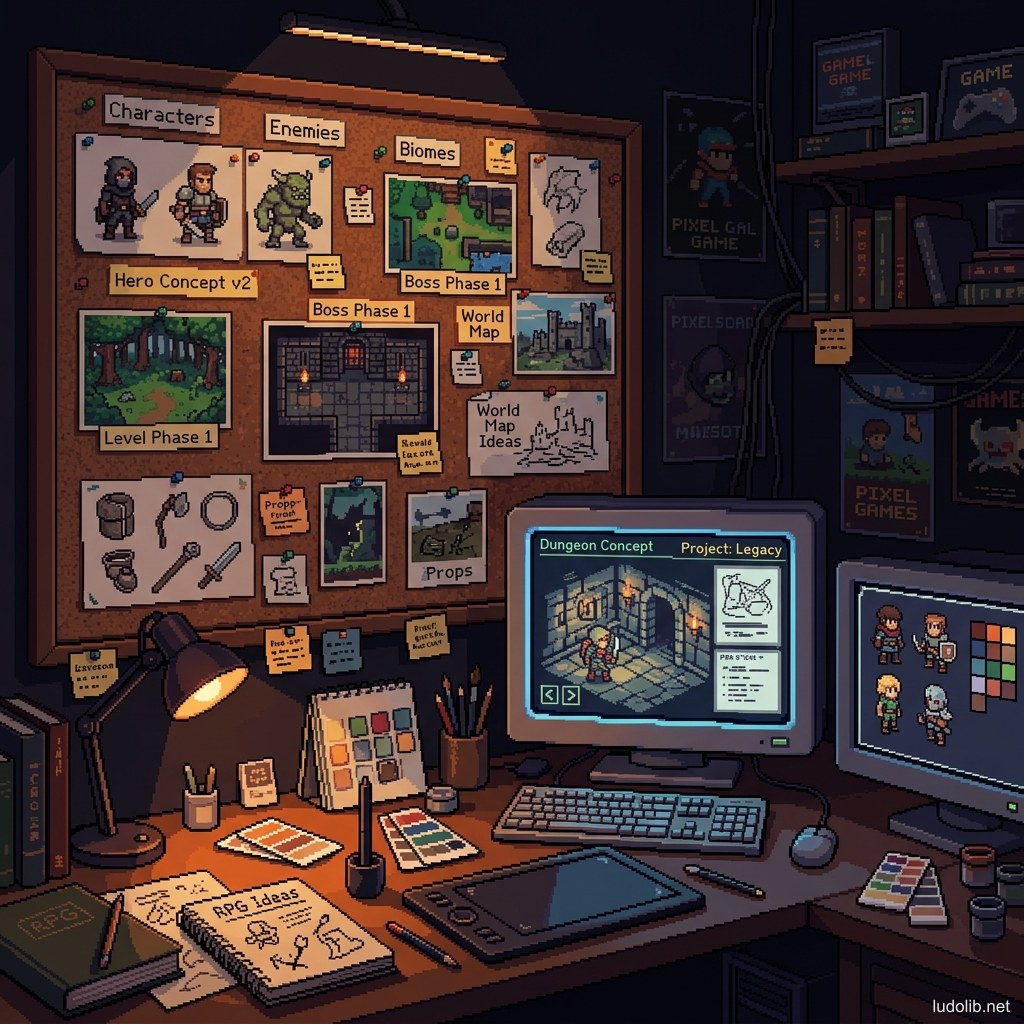
Before a single polygon is constructed in a Game Engine, before any sprite has its first pixel drawn, everything starts with Concept Art. This is a collection of sketches, rough paintings, and mood board image references aimed at answering the core question: “What does this game look like?”
Core Concepts
Concept Art is not finished art (final art). Its value lies in the speed of idea communication and ability to test multiple aesthetic directions at minimal cost — revising a drawing takes a few hours, while revising a complete 3D model takes weeks [S1].
| Type of Concept Art | Purpose | Example |
|---|---|---|
| Character Concept | Define appearance, costume, character expressions | Character costumes per region |
| Environment Concept | Establish color tone, lighting, architecture of the environment | Fantasy City vs. Cyberpunk City |
| Prop Concept | Items, weapons, interactive objects | Faction-specific weapon designs |
| UI/Splash Art | Aesthetic direction for interface, posters, loading screens | Game key visual |
Operating Principles
Concept Artists work in the Explore → Refine → Approve loop:
- Exploration: Draw many quick variations (thumbnails) — sometimes dozens — focusing not on detail but on overall form, tone, and emotion.
- Refinement: Select 2-3 promising directions, develop more detail based on Art Director feedback.
- Approval: The approved version becomes the visual bible — a mandatory reference document for the entire 3D Artist team, Level Designers, and UI Designers.
Many large studios like CD Projekt Red (The Witcher) or Naughty Dog (The Last of Us) publish artbooks after game release — these are essentially curated Concept Art collections [S2].
Game Examples
- Elden Ring (FromSoftware) — The game’s Concept Art was closely designed by Yusuke Kozaki combined with lore descriptions from George R.R. Martin — creating a consistent visual language for the entire Lands Between world.
- Cuphead (Studio MDHR) — All Concept Art was done in the 1930s Fleischer animation style, then transformed into actual Hand-drawn 2D animation, without digital techniques.
- Ori and the Blind Forest (Moon Studios) — The game’s first mood board was just striking watercolor paintings — establishing the characteristic warm pastel tone before a single line of code was written.
Trade-offs
| Aspect | Content |
|---|---|
| ✅ Advantages | Detects aesthetic conflicts early, before investing in production. Creates common language for multinational teams, overcoming language barriers. |
| ❌ Disadvantages | Beautiful Concept Art doesn’t guarantee technical feasibility — sometimes designs are too complex for the actual polygon budget. |
| ⚠️ Common Pitfall | ”Concept Art Lock” — team tries too hard to recreate the concept exactly as-is, not flexibly adjusting when hitting technical constraints. |