
🖼️ Matte Painting in Games
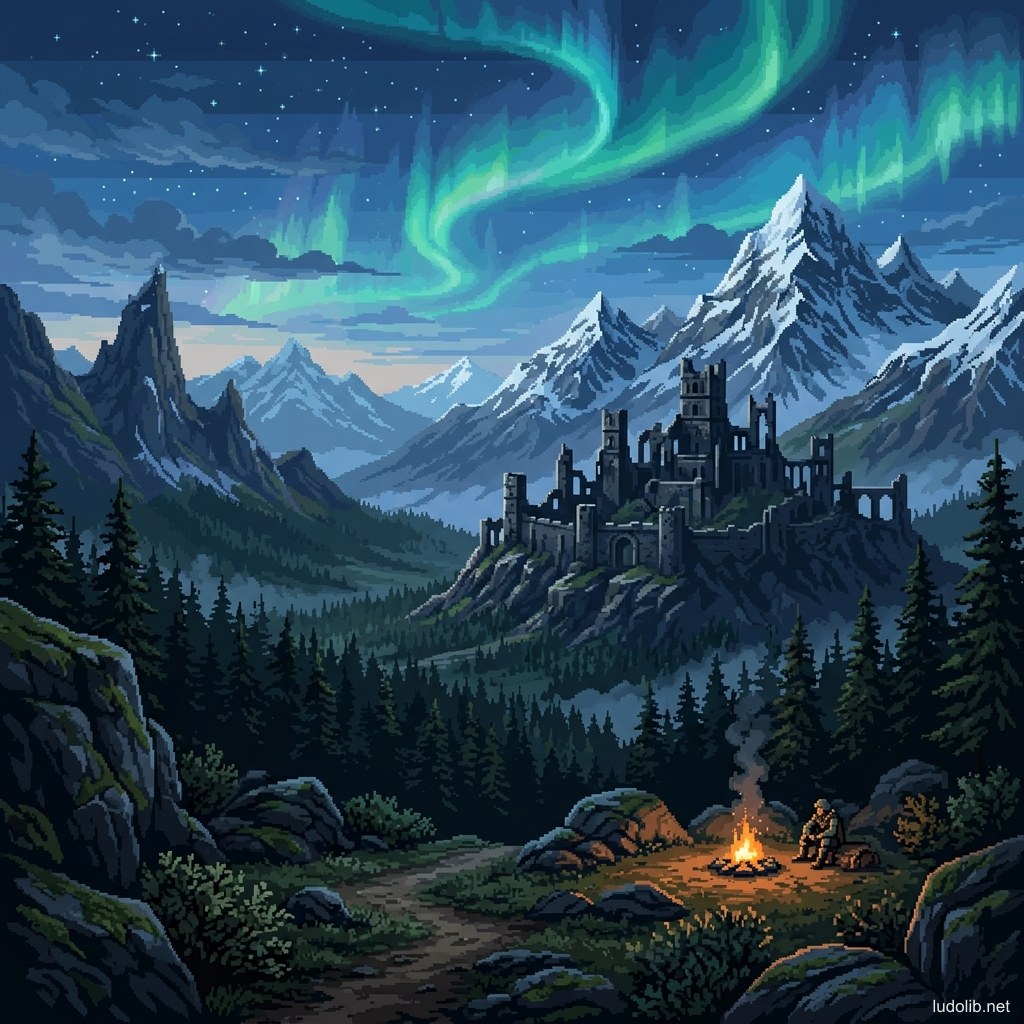
TL;DR: Matte Painting is the technique of painting or compositing large-scale landscape backgrounds — mountains, distant cities, magnificent skies — that cannot be recreated using 3D geometry due to budget or performance limits. This is the “economic magic” of the image production industry: creating the feeling of an infinitely vast world from a flat painting placed in exactly the right spot.
The origins of Matte Painting come from Hollywood cinema of the 1930s–1940s: painters drew castle, city, or mountain scenes on glass — placed in front of camera lenses to “expand” real backgrounds. In modern games, this technique is digitized and combined with 3D geometry to create environments with visual depth — at render costs just a fraction of full 3D construction.
Core Concepts
| Technique | Description | Game Application |
|---|---|---|
| Traditional Matte | Hand-painted on glass, optical compositing | No longer used in modern games |
| Digital Matte | Digital painting in Photoshop, Procreate | Static backgrounds in cutscenes, loading screens |
| 3D-assisted Matte | Rough 3D geometry built → rendered → painted over | Far environment backgrounds in open world |
| Projection Matte | Matte painting projected onto 3D plane, creating parallax as camera moves | Skybox with depth, 2.5D background layers |
| Photobashing | Compositing and editing real photos + paint-over | Production concept matte, quick prototyping |
Operating Principles
Layered Depth
Matte Painting is most effective when organized into multiple layers with different parallax speeds as the camera moves [S1]:
- Foreground: Rocks, grass, trees close to camera — moves fastest
- Midground: Architecture, villages, forests — medium movement
- Background: Distant mountains, cities, horizon — very slow movement
- Sky: Clouds, atmospheric effects — barely moves
Atmospheric Perspective in Matte
The physical law of light: more distant objects will be more faded, paler, and shifted toward blue [S2]. Matte Artists must deliberately apply this rule to create spatial depth:
- Contrast decreasing from foreground → background
- Saturation decreasing
- Temperature shifting toward cool blue
Sky Box vs. Sky Dome vs. Sky Sphere
In 3D games, sky backgrounds are typically implemented in these ways [S3]:
- Skybox (6 faces): 6 square images forming a box surrounding the scene — simple, popular
- Sky Dome/Sphere: 360° panorama image surrounding the scene — more seamless, suitable for HDRI images
- Procedural Sky: Engine automatically calculates sky color based on sun angle — enables day-night cycles
Game Examples
- Journey (thatgamecompany, 2012) — All sky and horizon are built from delicately layered matte painting. Though a 3D game, most of what players see in the distance is painted background, not geometry.
- Ori and the Blind Forest (Moon Studios, 2015) — Background painted in Photoshop with multiple parallax layers, each scrolling at different speeds — creating the exceptional depth characteristic of the game.
- Cuphead (Studio MDHR, 2017) — Backgrounds in each level are matte paintings in 1930s animation style — hand-painted and scanned similar to the classic method before digitizing.
Trade-offs
| Aspect | Content |
|---|---|
| ✅ Advantages | Render cost nearly zero compared to full 3D geometry. Allows creating epic-scale vistas (million-person cities, vast mountain ranges) that 3D geometry cannot achieve on indie budgets. |
| ❌ Disadvantages | No real geometry → no collision, no gameplay interaction. Camera can only move within a narrow range before the matte is “exposed” as a flat image. |
| ⚠️ Common Pitfall | ”Cardboard Cutout Effect” — when parallax is too strong or layer transitions aren’t smooth, background objects look like cardboard pinned to a backdrop. Careful blending and motion blur required. |