
🌳 Skill Tree
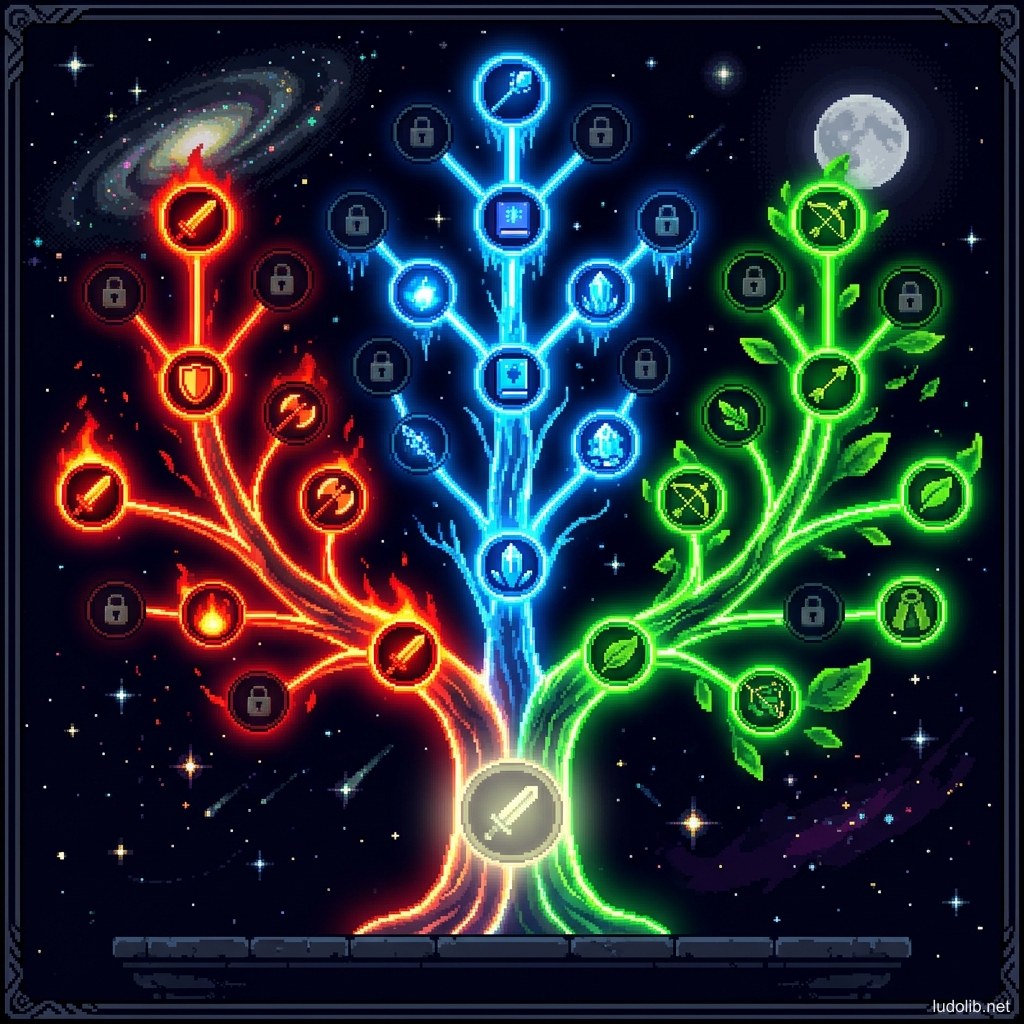 Illustration: A 3-way branching skill tree — Warrior (red), Mage (blue), Archer (green) — each node lights up when unlocked.
A Skill Tree is a branching root-like interface system helping describe the player’s progress and power maturation (Progression System) through spending Experience (EXP) points or Gold. This mechanic particularly dominates Role-Playing Games (RPGs) or modern Action titles.
Why is it called a Tree? Because it possesses a basic “core trunk,” then splits into myriad distinct choice “branches.” A player ascends one Branch, they evolve in that manner and abandon the remaining Branches.
Most Common Variants
- Branching Trees: The immortal original of Diablo II and World of Warcraft. After choosing a Class, you have 3 power branch streams: Ice, Fire, or Poison. Unlocking a Branch requires the condition of maximizing the foundational Nodes below it. Extremely promotes “Build Diversity”.
- Web / Grid Tree: Famous in games like Path of Exile or the Final Fantasy X Sphere Grid. Ignores class boundaries (Classless). You start on a shared grid surface at the navel of the spider web Universe, wherever your roots spread wide, you accumulate the physical effects and health in those slots.
- Tech Tree: The pillar of Strategy franchises (like Age of Empires or Sid Meier’s Civilization). Don’t upgrade guns if you haven’t previously spent resources upgrading Gunpowder and Metallurgy.
Importance to Game Design
A Skill Tree well-designed by a Systems Designer means: Every point allocation decision must be Costly and Change the Play Philosophy. If 1 skill Node only gives the player Health, it is a boring design to be thrown in the trash. A standard Node must be: “Health is halved, but all outgoing damage becomes wide-area AoE.” A skill tree is what hands the power of Self-determining destiny to Gamers.