
🏰 Tower Defense
Quick Summary
Tower Defense is a strategy genre requiring players to build pillar and defensive tower systems along pathways to intercept and destroy streams of enemies moving along predetermined routes, protecting a core objective.
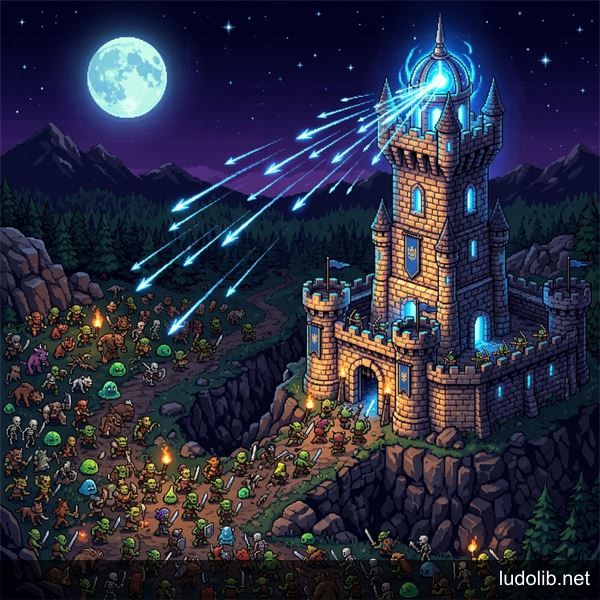
Tower Defense is a micro-strategy sub-branch originating from custom map designs (Mod Maps) within the Real-Time Strategy gaming community (specifically Starcraft and Warcraft). Thanks to its minimalist control structure focused on arrangement thinking, this genre exploded in development when placed on the mobile device ecosystem with convenient tap-swipe interaction.
Core Gameplay Loop
The operational philosophy of Tower Defense lies not in active attack, but in the ability to organize passive defense before multiple waves of computer system attacks.
- Fixed Pathfinding: Enemies move from their spawn point to the main base following pre-established lane routes.
- Resource Management: Players use resources (collected by defeating enemies or over time) to buy, upgrade, and place Guard Towers on land tiles along the path.
- Auto-attack Mechanic: When enemies enter the coverage range (Hitbox), towers automatically activate their function (deal damage, apply slow effects, reduce armor).
- Defeat Condition: The health points at the main stronghold are reduced to zero.
Maze Building Art
Some large-scale Tower Defense variants don’t set fixed static routes but instead provide an empty sandbox area. Here, players maneuver placing tower blocks to force enemies to wind along their chosen path (forming a Maze). The purpose is to extend enemies’ movement distance to maximize the time they spend under fire range.
Notable Representative Works
- Plants vs Zombies: A global phenomenon using a backyard zombie defense setting. The game combines a linear energy system (Sunflowers) with an extremely intuitive interface mechanic.
- Bloons TD 6: The pinnacle of the mobile Mobile Tower Defense franchise with a complex skill tree upgrade system and balloon physics interaction.
- Arknights: A representative combining Tower Defense structure with Gacha character management, integrating a deep story system. The game is testament to the enormous financial potential of Tower Defense crossed with Anime.
Design Connections
The greatest challenge in developing a Tower Defense game for a Game Designer is balancing stats. If the pacing cycle and damage output (DPS) are miscalculated against enemy toughness, the game becomes a tedious arrangement sequence lacking compelling challenge (Dopamine hit).