
💀 Rogue-Likes & Rogue-Lites
Quick Summary
Rogue refers to games based on a short life-death loop mechanism. The defining characteristic is that players lose all their accumulated progress every time they die, forced to restart with a freshly randomly generated map structure.
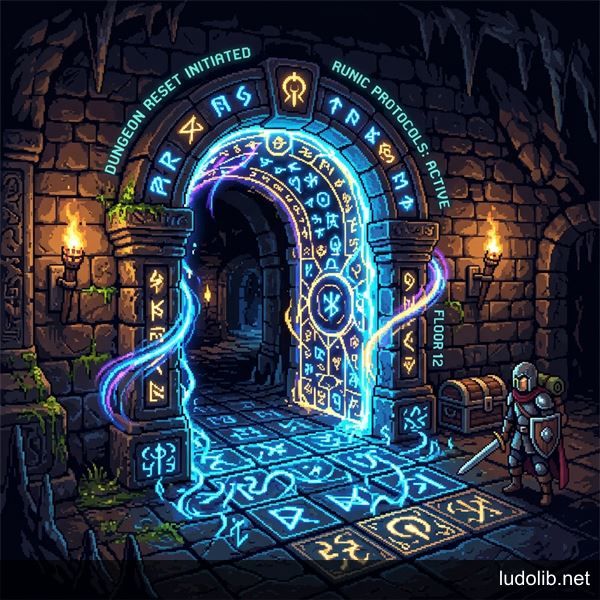
The term “Rogue” has origins in a 1980 computer game programmed to display through an ASCII character framework. The old-era die-and-restart loop setup directly formed an extremely valuable iterative gameplay concept, leading most small development teams (Indie) to expand and exploit the product lifecycle at broad scale with no clear endpoint.
Foundational System Structure
According to the Berlin Definition established in 2008, a traditional Rogue game is bound by these core tenets:
- Permadeath: When survival stats drop to zero, the movement lifecycle ends absolutely. All accumulated stat increases — experience points, gold metrics, and collected items — are completely cleared. Players restart the sweep route at the first checkpoint with empty stats (Level 1).
- Procedural Generation: After each death (called 1 Run), the entire system randomly regenerates room map position algorithms or reward card spawn positions. The structure ensures unfamiliar information reflex challenges on each return campaign.
- Turn-Based Command Structure: In the original format, operations always require sequential management of branching vertical turn-counting commands — unlike today’s expanded products that integrate this into action skill-release speed format (Hack & Slash).
Separation Between Roguelike and Roguelite
Market expansion created two sub-identifications:
- Rogue-LIKE: Maintains the absolute standard of the original definition (e.g., Spelunky, The Binding of Isaac, Returnal). No concept of permanent stat progression — the experience of mastering the environmental element is the only progression.
- Rogue-LITE (Softened): A reduced-punishment and softened approach designed to reduce player stress. Despite restarting at zero, the system allows players to carry some fixed cumulative milestone (like a “Crystal”) to upgrade starting attributes for subsequent runs.
- Representative products: Hades (2020 GOTY) allows players to receive many dialogue-linked rewards if they die before a barrier. Positive strength compensation accumulates through passive stat upgrades from the family shrine of the demigod appearing after each reincarnation. (Or Dead Cells, Risk of Rain 2).
Exploitation Connections
Rogue design reduces the manual map structure (Level Design) placement burden because Random Code algorithms handle spatial block generation. However, it requires game engineers to continuously calibrate the system’s item drop rates, ensuring the user experience alternates between difficulty and the sustained motivation to continue playing harmoniously.