
⏱️ Turn-Based Role-Playing
Quick Summary
Turn-Based Role-Playing is a role-playing game branch where the flow of combat time is interrupted. Characters on the field (both player and enemy) execute attack and defense actions in alternating turns — requiring deep tactical thinking rather than quick hand reflexes.
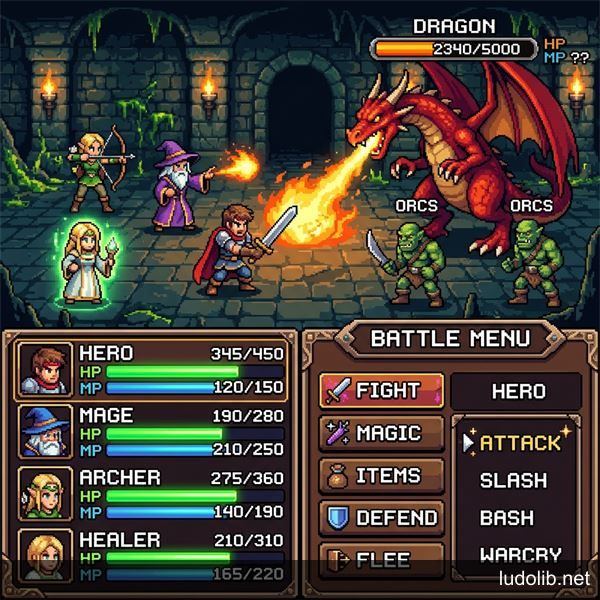
Turn-Based RPG is the most foundational classic classification of the role-playing game genre. In contrast to the continuous real-time control experience of Action Role-Playing, turn-based games apply the philosophy of “pausing the time stream.” Players have full authority to regulate pace and calculate multi-outcome systems through a static command list control interface.
The “Turn Cycle” Management Mechanic
The system borrows foundational rules from board game (Tabletop) and traditional dice-rolling mechanics:
- Match Time Decomposition: When confronted, all physical movements are not randomly marked in real time. The world “freezes,” the system allocates sequential waiting, and only continues the data cycling process when the player confirms their operation command.
- Action Economy: Within their own Turn, each character is only provided a limited number of Action Points. Players must measure the efficiency of spending these points on relentless attacks, movement, or strengthening defensive protection before the AI counterattacks in the next cycle.
Why Does the Turn-Based Structure Survive and Thrive?
Rather than evaluating the Turn-based mechanic as a technical graphics limitation of the 20th century, modern developers use it to direct the control experience toward strategic calculation capability. The static pacing allows algorithms to process dozens of layers of complex natural damage attacking back against the player’s cognitive system — something action hack-and-slash operation models cannot accommodate.
Classic Ecosystem Representatives
- Persona 5 Royal / Dragon Quest XI: The peak group bearing strong hallmarks of the JRPG branch. They use a “Weakness-Exploitation” combat system like Press-Turn: when hitting an enemy’s weakness, players are rewarded with extra attack turn beats to press relentlessly.
- Pokémon Series: The greatest legacy representing the Creature Collector genre — applying an elemental rock-paper-scissors combat system (Fire-Water-Grass).
- Deck-Building Card Game Genre: Like Slay the Spire, Hearthstone. The alternating card draw-and-play creates foundational rules based on probability ratios.
Equipment System Connections
Item and equipment systems typically play a dominantly decisive role (up to 90%) in win/loss outcomes. Players cannot rely on mechanical key-press capability to dodge out of Hitbox damage zones — they must depend on the optimized power stats and healing systems of their equipped gear.