
🤝 Co-op (Cooperative Multiplayer)
Quick Summary
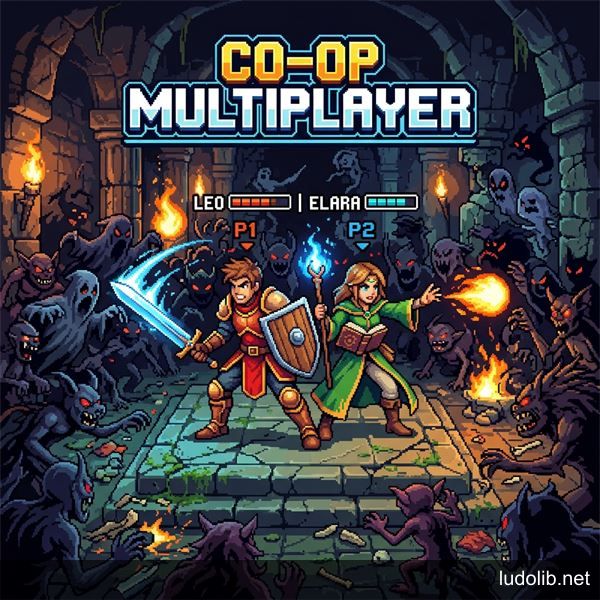 Illustration: The ally connection mechanic in Co-op, where players’ cross-power graphs compensate for each other to fight a common enemy network.
The Co-op genre promotes a distinct branch of network interaction and psychology: Social Interaction. Instead of creating a competitive zero-sum game stratification, Co-op design encourages a shared resource network. The algorithm’s skill information no longer aims at finishing off the adjacent user, but shifts focus to synergistic compensation.
Structural Infrastructure Stratification
The connection network of Co-op mode usually operates in parallel on two main system protocols:
- Local Co-op (Couch Co-op): Two or more players share a central processing hardware platform (Console/PC) and share a common optical display plane (Split-screen or Shared camera). Examples: It Takes Two, Overcooked. This format optimizes transmission speed feedback because data is not relayed through a cloud intermediary.
- Online Co-op: Players converge through transmission protocols using Internet servers. Each person commands a separate hardware space and display perspective. The evolution of network bandwidth allows for the synchronization of massive map blocks, creating hit MMO titles featuring Raid loops like World of Warcraft or Destiny.
Interdependency Density
The highest challenge of Co-op design algorithms is solving the “Passenger” situation - when a talented user executes all tasks, leaving surrounding people with no interaction data. To prevent this, Lock-in mechanics are applied:
- Asymmetric Interactions: Providing different tools that must be paired as commands. Player A only has a flamethrower; Player B only has a freezing system. The target is only destroyed when subjected to sequential physical alteration effects from both A and B.
- Survival Constraints: Limiting shared life resources (Running out of system lives fails both) or granting Revive mechanics to force users to continuously locate allies on the 3D graphical space.