
🎮 Gaming Platforms
Quick Summary
Gaming Platforms are the hardware ecosystems on which games are played — consoles (PlayStation, Xbox, Nintendo), PC, mobile (iOS/Android), handheld, and emerging platforms (VR, cloud). Each platform has distinct technical capabilities, player demographics, and game design requirements.
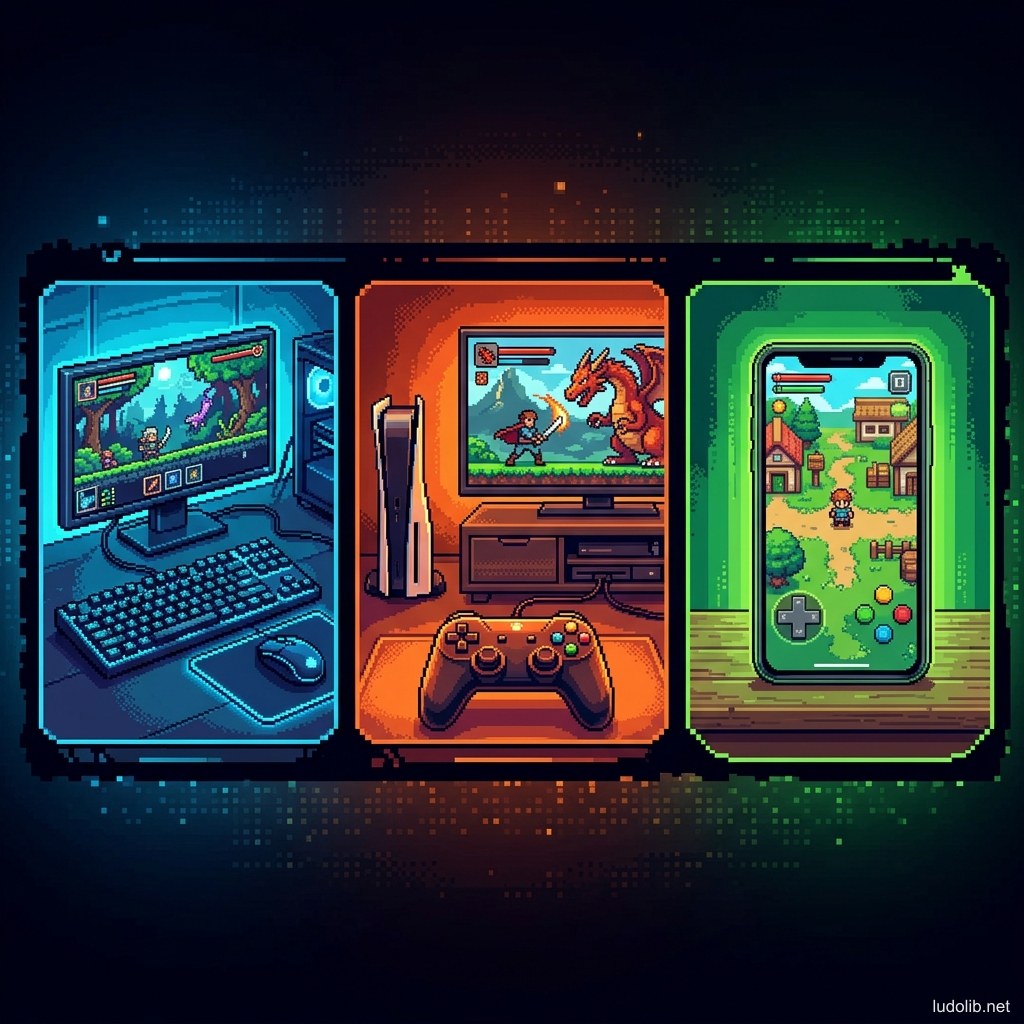
Platform Overview
| Platform | Examples | Market Share (Revenue) | Key Characteristics |
|---|---|---|---|
| Console | PS5, Xbox Series X, Nintendo Switch | ~25% | High quality floor, fixed hardware, living room |
| PC | Windows, Mac, Linux | ~20% | Infinite specs range, modding, competitive gaming |
| Mobile | iOS, Android | ~50% | Touch input, casual + hyper-casual, F2P dominant |
| Handheld | Nintendo Switch, Steam Deck | ~5% | Portable form factor, hybrid play |
| VR | Meta Quest, PSVR2 | <1% | Immersive, specialized content, growing |
| Cloud | xCloud, GeForce Now | <1% | Hardware-independent, latency-dependent |
Platform Design Implications
Console
- Fixed hardware = predictable performance baseline
- Certification process required (Sony, Microsoft, Nintendo)
- Gamepad-centric design
- Living room play distance affects UI scale
PC
- Infinite hardware variation requires robust settings menus
- Mouse + keyboard OR gamepad support needed
- Mod-friendliness is a competitive advantage (Game Modding)
- No certification gatekeeping on platforms like Steam
Mobile
- Touch-only input requires completely different UX design
- Battery and thermal limits constrain GPU usage
- Sessions typically 3–10 minutes (commute, break)
- IAP and IAA are primary revenue models