
🧅 3 Layers of Game Design
Quick Summary
3 Layers of Game Design is a structural model dividing a game’s anatomy into three concentric circles: Core Design, System Design, and Content Design. This model highlights a common production trap: many studios fail because they start building Content (Layer 3) before solidifying the Core Mechanics (Layer 1).
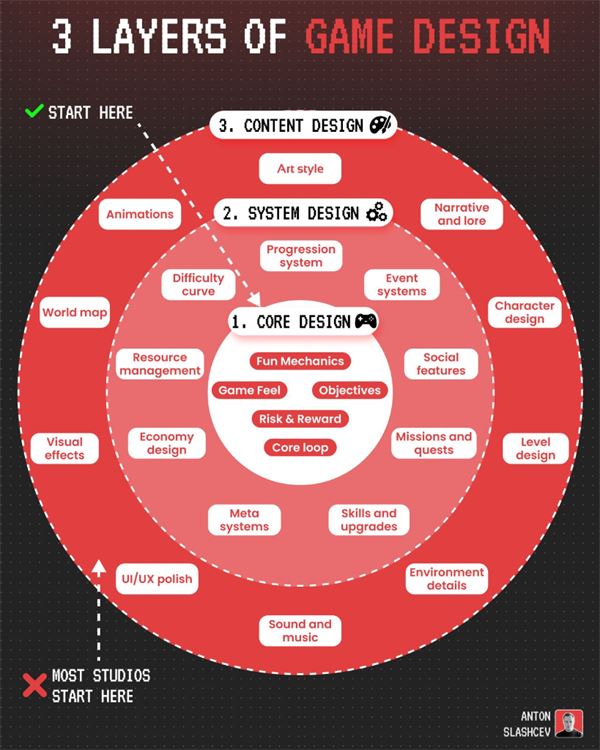
To build a project with long-term Retention that doesn’t collapse when scaled, the Lead Game Designer must strictly enforce development from the core outward:
Layer 1: Core Design
The absolute center of the game — what the player does second-to-second.
- Example: In a shooter, the core is moving, aiming, and firing. In a platformer, it’s the jump arc.
- The Rule: If the Core isn’t fun in a grey-box prototype with no art, the game will fail. No amount of progression systems or beautiful art can fix a boring core loop.
Layer 2: System Design
The rules that wrap around the core to give it context, goals, and progression.
- Example: Experience points, skill trees, economy, matchmaking, weapon upgrade paths.
- The Rule: Systems must incentivize the player to engage with the Core. If a system allows the player to bypass the fun part of the game (e.g., auto-play mechanics that are too rewarding), the system is broken.
Layer 3: Content Design
The consumable “meat” placed on the framework of Layers 1 and 2.
- Example: New levels, new character skins, storyline quests, new boss models.
- The Rule: Content is the most expensive layer to produce. Never start mass-producing content until Layers 1 and 2 are finalized and proven fun.