
🎮 How to Conduct a Playtest: The 10-Step Professional Process
Quick Summary
Playtesting is the process of observing real players experience your game to uncover design flaws, points of confusion, and difficulty issues that developers miss due to over-familiarity with their own product. According to Anton Slashcev’s 10-step framework, an effective Playtest session starts with clearly defined objectives and ends with maintaining detailed records to drive improvement across multiple iteration cycles. [S1]
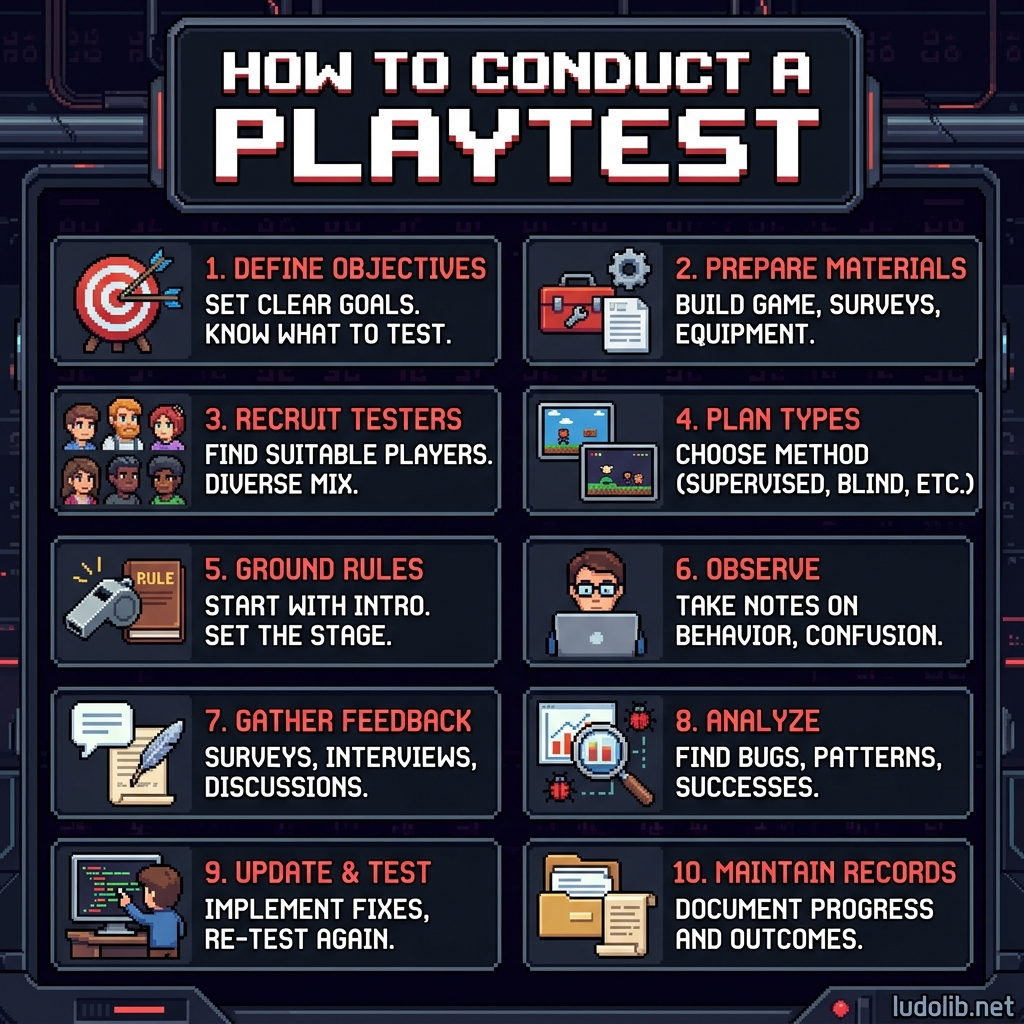 Illustration: The 10-step game Playtest process — from preparation to archiving records — by Anton Slashcev.
Why Playtesting Matters
After weeks or months of working on a product, game designers develop “The Curse of Knowledge” — they know the game too well to see what new players find confusing. Playtesting breaks this curse by introducing real players into the feedback loop. [S1]
Step 1 — Define Objectives
Before organizing any session, answer four key questions: [S1]
- What are you testing? (mechanics, difficulty, UX, pacing?)
- Outline specific, measurable goals.
- Keep the testing scope manageable — don’t test everything at once.
- Decide how you’ll measure success.
Step 2 — Prepare Materials & Environment
| Item | Requirement |
|---|---|
| Build | Stable prototype or build — no crashes |
| Instructions | Clear guidance or a short tutorial |
| Space | Distraction-free testing area |
| Tools | Feedback forms, recording software, analytics |
Step 3 — Recruit the Right Testers
Diversity in your tester pool is the key to surfacing the most issues: [S1]
- Include target audience members, outsiders, and domain experts.
- Aim for diverse skill levels (kids, casual gamers, hardcore gamers).
- Define the number of participants needed.
- Communicate the session length and expectations upfront.
Step 4 — Plan the Playtest Types
Select the playtest format appropriate to your development stage: [S1]
- Focused Tests: Drill into a specific mechanic.
- Blind Playtests: Observe natural behavior with minimal guidance.
- Exploit Hunts: Encourage testers to break the game.
Pick an approach that suits your current development stage.
Step 5 — Set Clear Ground Rules
Before beginning the session: [S1]
- Brief participants on their role, but avoid coaching (teaching them how to play).
- Let them struggle to reveal genuine design flaws.
- Encourage honest, detailed feedback.
- Establish session duration and key do’s/don’ts.
Step 6 — Observe Without Intervening
This is the hardest but most critical step: [S1]
- Note confusion, frustration, or delight without speaking.
- Only step in if progress completely halts.
- Use timestamps or notes for key observations.
- Ask open-ended, non-leading questions afterward:
- “What were you trying to achieve?”
- “What did you find challenging about this part?”
Step 7 — Gather & Document Feedback
Immediately after the session: [S1]
- Conduct post-session interviews or surveys.
- Track data: completion times, retries, stuck points.
- Encourage players to articulate their overall experience.
- Correlate in-game actions with stated feedback.
Step 8 — Analyze Patterns & Iterate
Once you have data: [S1]
- Identify recurring issues or themes across multiple testers.
- Prioritize fixes based on impact (critical vs. minor).
- Balance feedback with your core design vision.
- Outline next steps and resources needed.
Step 9 — Update & Test Again
After implementing changes: [S1]
- Address major concerns first.
- Re-test to confirm fixes and catch new issues.
- Refine mechanics incrementally.
- Invite both fresh and returning testers for comparison.
Step 10 — Maintain Detailed Records
Build a long-term knowledge asset for the project: [S1]
- Log each change or iteration in a shared file.
- Compare data across different builds and versions.
- Note which solutions worked or failed — and why.
- Archive all feedback for future reference and learning.
See Also
- How to Design a Great FTUE — FTUE is one of the most critical areas to playtest
- Game Design Document — The GDD should be updated based on Playtest findings
- Churn Rate — The metric Playtesting directly helps improve
- B Testing — A complementary testing method alongside Playtesting
- User Research — Combining research methods with Playtesting
References
- [S1] Anton Slashcev, “How to Conduct a Playtest” — Executive Producer Infographic (2024)