
🧩 Game Aspects Breakdown
Quick Summary
A game is not just code and graphics. To build a complete product, a Game Designer must simultaneously manage 9 core Game Aspects: Gameplay, Progression, Narrative, Motivation, Aesthetics, Game Feel, Social, Monetization, and Live Ops. The harmonious combination of these 9 elements is the formula for a successful game. [S1]
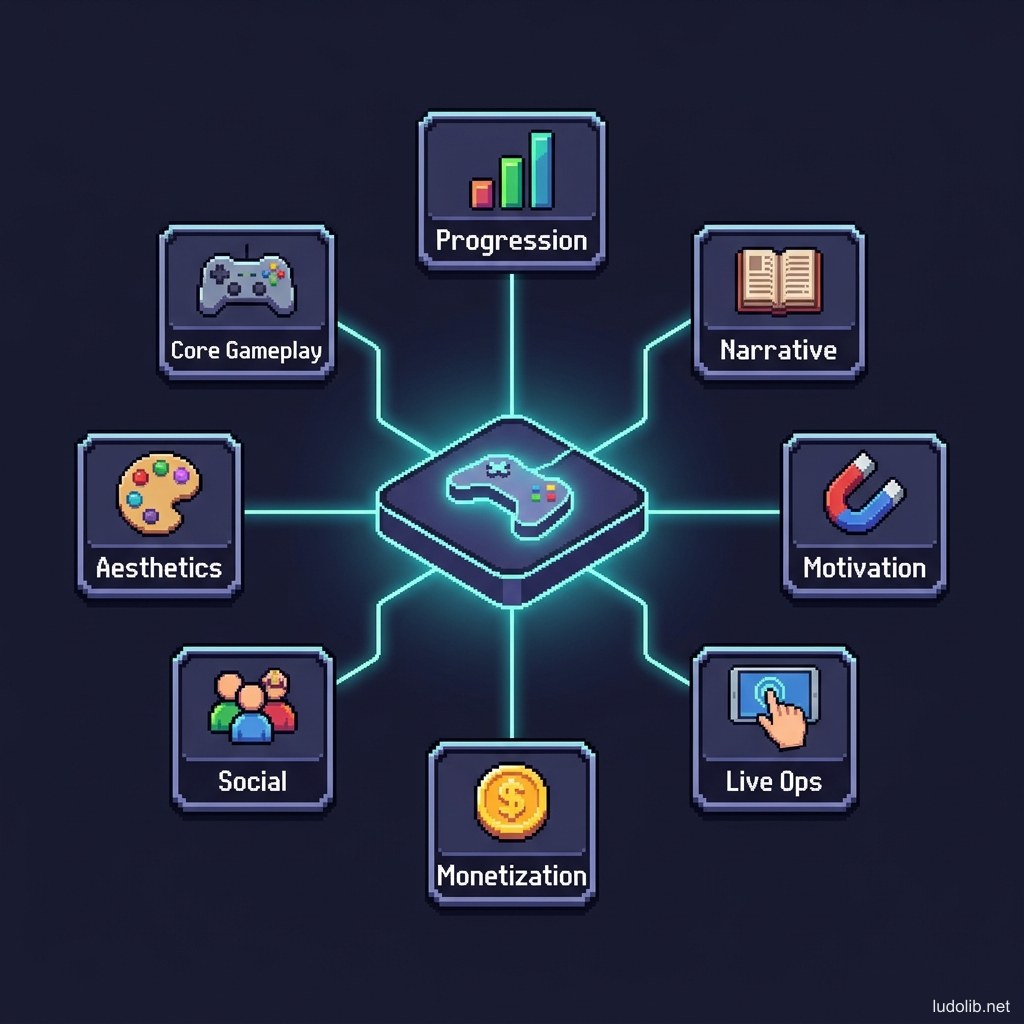 Illustration: The 9 branches of game aspects, with their sub-components forming the overall picture of Game Design.
The framework below, compiled by Anton Slashcev, serves as a mandatory mind map for anyone working as a Game Designer. [S1]
1. Core Aspects
This is the skeleton of the game. Without them, the game does not exist.
🎮 Core Gameplay
- Game Rules: The rules that define winning, losing, valid, and invalid actions.
- Fun Mechanics: The mechanics that generate enjoyment.
- Core Gameplay Loop: The cycle of actions the player repeats.
- Level & Encounter Design: How levels and enemies are arranged.
📈 Progression
- Rewards: What is earned after overcoming a challenge.
- Customization Options: Character and weapon customization.
- Upgrades: Power scaling (linear or exponential).
- New Mechanics / Milestones: Unlocking new mechanics upon reaching specific points. (Read more: Meta vs Progression)
2. Experience Aspects
Elements that give the game depth and retain players longer.
📖 Narrative
- World-Building: Creating the game’s lore and setting.
- Storyline: The main plot sequence.
- Dialogue & Writing Style: The tone and text of the game.
- Player’s Choices & Characters Relationships: How player agency affects the story and NPC dynamics.
🎯 Motivation
- Short-term / Long-term Goals: Immediate goals (clearing a level) vs. ultimate goals (beating the game).
- Meta-motivation: Motivations outside core gameplay (collecting, social status).
- Challenges & Quests: Tasks that provide direction.
- Player Agency: The feeling of control and autonomy.
3. Sensory Aspects
The outer layer that attracts players from the first look and touch.
🎨 Aesthetics
- Environment Design: Crafting the visual landscapes.
- Art Style: The visual direction (Pixel art, Low-poly, Realism).
- Audio Design: The overall auditory experience.
- User Interface (UI): The visual menus and HUD.
- Visual Consistency: Ensuring all visual elements belong to the same world.
✨ Game Feel
- VFX & Animations: Visual feedback and character movement.
- Sound: Sound effects (SFX) that emphasize actions.
- Camera: How the camera behaves (e.g., screen shake, tracking).
- Responsiveness: How tightly the game reacts to player input.
4. Operational & Business Aspects
The elements that turn a game from an “artwork” into a “commercial product.”
👥 Social
- PvP & Competitive Modes: Player vs. Player mechanics.
- Co-op & Team Play: Cooperative mechanics.
- Leaderboards & Rankings: Competitive ladders.
- Chat & Guilds: Communication and community systems.
- Matchmaking Systems: Finding opponents or allies.
💰 Monetization
- Ad Integrations / Pricing Model: Ad placements or the overall pricing structure (F2P, Premium).
- In-game Currency & Shop: The game’s economy and storefront.
- Offers System & Microtransactions: IAPs and special deals. (Read more: Game Monetization Models).
⚙️ Live Ops & Post-Launch Support
- Content Updates & Seasonal Features: Keeping the game fresh with new content.
- Limited-Time Events: Driving engagement through scarcity.
- Promotions, Sales & Performance Updates: Monetization drives and technical optimizations.
- A/B Tests: Split testing to optimize new features.
5. See Also
- Game Designer — The profession responsible for managing these 9 aspects
- Core Gameplay Loop — The foundation of Core Gameplay
- Monetization Models — Details on the Monetization branch
- Meta vs Progression — The difference between Motivation and Progression
- Live Service — The equivalent of Live Ops
References
- [S1] Anton Slashcev, “Game Aspects Breakdown” — Executive Producer Infographic (2024)