
📋 One Page Game Concept: An 11-Section Template for Pitching Game Ideas
Quick Summary
A One Page Game Concept (OPGC) is a condensed version of a GDD that presents the complete vision for a game on a single page. It is an essential tool for pitching to investors, convincing publishers, or aligning an internal team at the very start of a project. According to Anton Slashcev’s framework, an OPGC consists of 11 sections: from an Overview to a Roadmap with specific timelines. [S1]
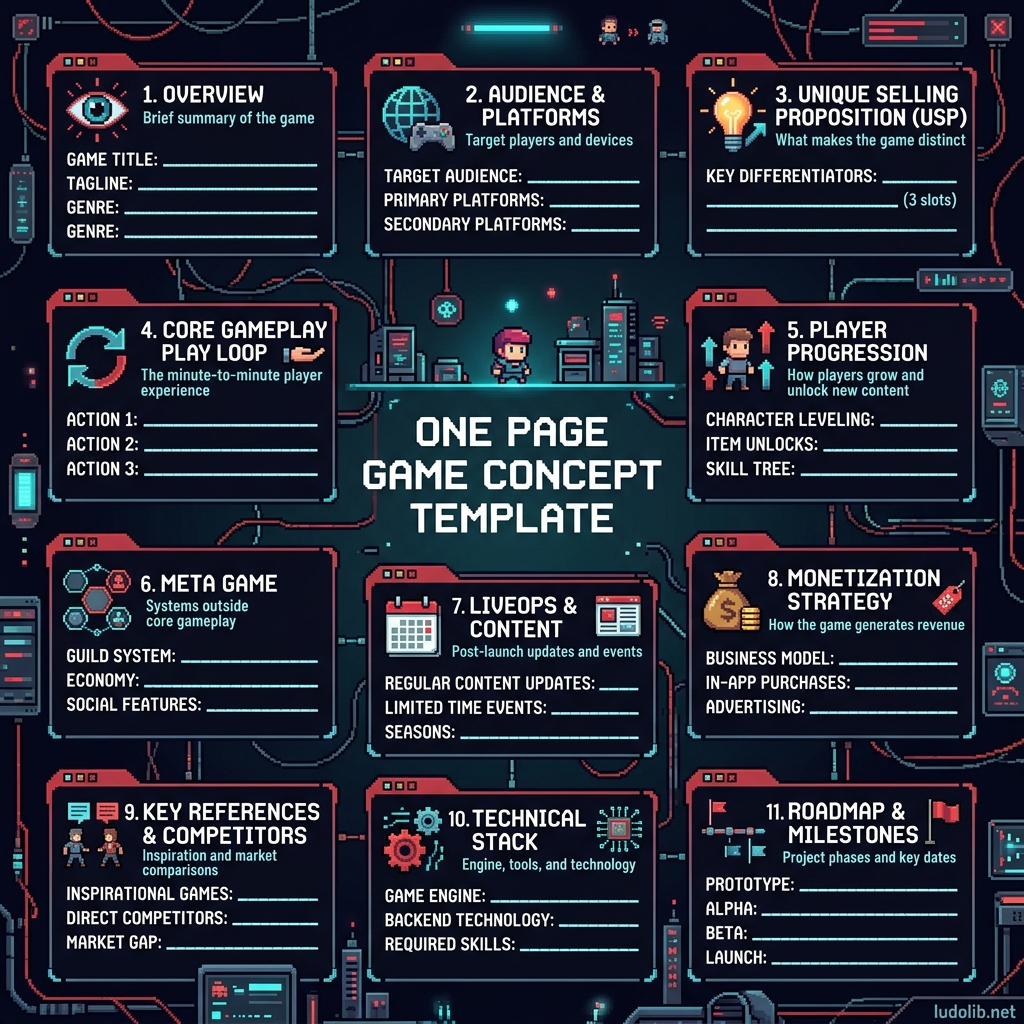 Illustration: The 11-section OPGC template by Anton Slashcev — from Overview to Roadmap with fill-in-the-blank fields.
What Is an OPGC and When to Use It?
An OPGC does not replace a GDD — it precedes it. Use an OPGC when: [S1]
- Internal pitching: You need team alignment before investing in a full GDD.
- Investor/publisher pitching: They need to understand the game in 2 minutes, not 2 hours.
- Prototype stage: When many variables are still undefined.
Section 1 — Overview
The core descriptive sentence about the game:
[Game Title] is a [Genre/Subgenre] set in [Setting] that lets [Target Audience] live the fantasy of [Core Fantasy]. Think [Game X] meets [Game Y] with a twist of [Key Feature]. [S1]
Section 2 — Audience & Platforms
- Audience: Who, age, segments, regions.
- Platforms: iOS / Android / PC / Console.
- Session length & controls: X-Y min, [touch / controller / mouse].
- Accessibility/Age rating: Special notes.
Section 3 — USP — Why Us, Why Now
Three factors that justify why this game should exist: [S1]
- Signature mechanic or loop — a unique, ownable mechanic.
- Genre mash-up or constraint — a genre combination that creates a fresh perspective.
- Production edge — advantage in tech / art pipeline / AI tools.
Section 4 — Core Gameplay
Precisely describe what players do: [S1]
- Players [Core Action 1] and [Core Action 2] to achieve [Main Goal].
- Loop: Verb → Verb → Reward/State.
- Camera/feel: Top-down / side-scroller / 3D; fast or slow pace.
- Win/fail conditions: Specific win and lose conditions.
Section 5 — Progression
Three tiers of progression that retain players across different timescales: [S1]
| Tier | Examples |
|---|---|
| Short-term | FTUE, early goals, first upgrades |
| Mid-term | Skill trees, gear, biomes, MMR |
| Long-term | Collections, mastery, meta goals |
| Growth type | Power (vertical) vs. Options (horizontal) |
| Gating | Chapters, keys, requirements |
Section 6 — Meta
Elements that retain players beyond the Core Gameplay loop: [S1]
- Systems: Collection / Crafting / Base / Customization.
- Social: Guilds / Co-op / Trade / Light PvP.
- Routines: Dailies / Weeklies / Challenges.
- Return hooks: Streaks / Timers / Limited offers.
- Narrative: Worldbuilding, questlines, character arcs, delivery/cadence.
Section 7 — LiveOps
Post-launch operational strategy: [S1]
- Cadence: Weekly events, seasons X weeks.
- Event types: Progression / Economy / Competitive / Vanity.
- Content pipeline: Tools, authoring time, CMS, remote config.
- KPIs to move: D1/D7, CCU, ARPDAU.
See also: Live Operations.
Section 8 — Monetization
Revenue model and execution strategy: [S1]
- Model: F2P / Premium / Hybrid / Subscription.
- IAPs: Cosmetics, bundles, boosters, gacha + pity rules.
- Ads: Rewarded focus, interstitial policy, frequency caps.
- Economy: Sources/sinks X/Y, price bands B, fairness rules.
See also: IAP, IAA, Gacha, Game Monetization Models.
Section 9 — References & Competitors
- Inspiration: Title 1 — why, Title 2 — why.
- Competitors: Game A, Game B.
- Our delta: Mechanic / pace / audience / monetization.
- Benchmarks: Target D1/D7, ARPDAU/LTV range.
Section 10 — Technical
Technology stack and technical risks: [S1]
- Engine/stack: Unity / Unreal + backend / services.
- Net model: Offline / async / realtime; regions.
- Tooling: Level builder, economy editor, AB testing.
- Risks/compliance: Performance / UA / regulatory / art costs.
Section 11 — Roadmap (Plain-English Timing)
Development milestones with clear, specific timelines: [S1]
| Phase | Timeline | Goal |
|---|---|---|
| Prototype | Weeks 0–X | Prove core feel/KPI; rough art OK |
| Vertical Slice | Weeks X–Y | 30–60 min content, FTUE ready |
| Soft Launch | Month Z | Hit retention/monetization gates |
| Global Launch | Target date | Team size, Budget $ |
See Also
- Game Design Document — The full expanded version of the OPGC
- Game Aspects Breakdown — A framework to validate the completeness of your concept
- Playtest — Test your concept as early as possible
- Live Ops — Expanding Section 7 — LiveOps
- Game Monetization Models — Expanding Section 8 — Monetization
References
- [S1] Anton Slashcev, “One Page Game Concept” — Executive Producer Template (2024)