
📖 Narrative Design
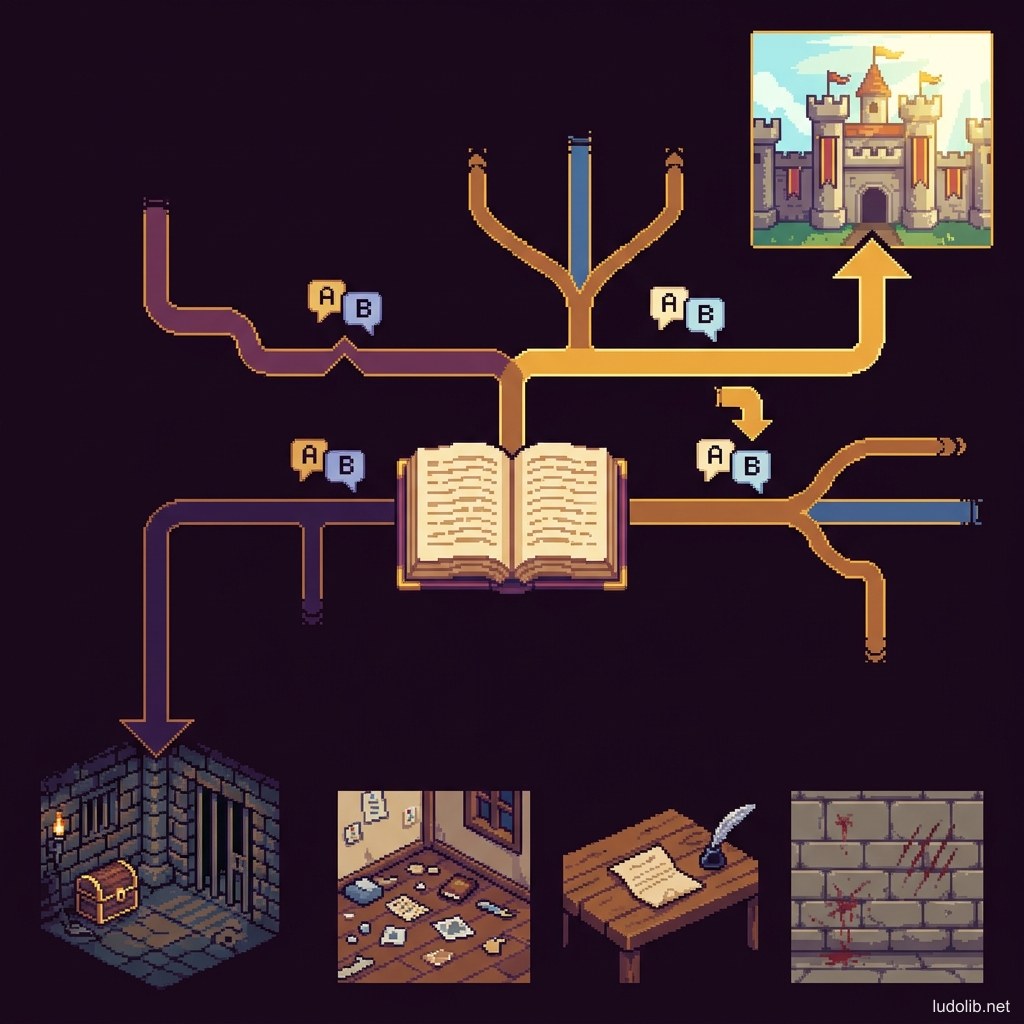 Illustration: Branching Narrative — from a starting point, the player’s choices lead to completely different endings; combined with Environmental Storytelling via objects and space.
Narrative Design is the art of weaving the story into every strand of gameplay mechanics so that the player doesn’t just “read” the Narrative but “lives” in it. Unlike a screenwriter who only writes linear scripts, a Narrative Designer must design for dozens of forks where every player decision leads to different consequences.
The Role of a Narrative Designer
The Narrative Designer sits at the intersection of the Game Designer (game rules system) and traditional screenwriting:
- Worldbuilding: History, geography, politics, religion of the game’s universe.
- Dialogue Writing: Every NPC has their own voice, personality, and motives.
- Branching Narrative Design: Decision maps, consequences, endings.
- Environmental Storytelling: Without a single word of text, the player still understands what happened — just through the arrangement of objects, lighting, and Level Design.
Storytelling Methods in Games
1. Linear Narrative
The story has a fixed beginning and end. The player experiences it in the exact sequence the developers arranged.
- Examples: Super Mario Bros (rescue Princess Peach from Bowser), The Last of Us, Uncharted.
2. Branching Narrative
The player makes decisions, each leading to a completely different storyline. This is the technical pinnacle of Narrative Design because the amount of content required scales exponentially.
- Examples: The Witcher 3 (26 minor endings, 3 major endings), Baldur’s Gate 3, Detroit: Become Human.
3. Environmental Storytelling
The story is “hidden” in the scenery: a letter dropped on a table, bloodstains on a wall, human bones in a dark cellar. The player must piece it together themselves.
- Examples: Dark Souls (the story lies entirely in item descriptions), Bioshock (audio diaries), Elden Ring.
4. Emergent Narrative
There is no pre-written script. The story arises naturally from the Game Mechanics and player behavior.
- Examples: Minecraft (every player creates their own Survival story), Dwarf Fortress, RimWorld.
Supportive Tools
| Tool | Function |
|---|---|
| Twine | Writing and testing branching storylines in flowcharts |
| Ink (by Inkle) | Specialized scripting language for branching dialogue |
| Articy:Draft | Managing all lore, characters, and story variables |
Relationship with Other Systems
- Narrative Design relies heavily on the presentation of UI UX Design to display dialogue choices.
- Sound Design plays a role in amplifying the emotion of the story via background music and effects.
- The historical context of the game industry (History of Video Games) shows that Narrative Design only began to be highly valued from the CD-ROM era (1990s), when disc capacity allowed storing large amounts of dialogue and text.