
🪖 Military Strategy
Quick Summary
Military Strategy focuses on deep simulation of the physics and mechanics of real-world weapons. The genre demands the ability to calculate logistics parameter systems, physical collision angle structures, and fire angle management tactics.
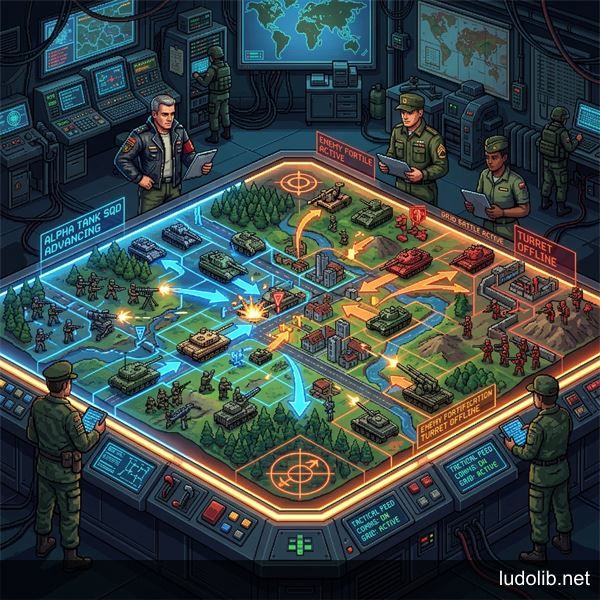
In contrast to the macro-level parameter conversion of the distant Grand Strategy genre, Military Strategy (also called Wargame) focuses on the physical and strategic troop allocation aspects of localized combat — entirely emphasizing real-world combat equipment coefficients.
Why a Separate Military Category?
The genre removes non-realistic fantasy elements to use modern and near-modern Historical settings (typical scope: World War I, World War II, or the Cold War). The emphasis of these products divides into two format streams:
1. Field Tactical RTS
As seen in franchises like Company of Heroes or Dawn of War, the system breaks the classic RTS resource harvesting rule chain.
- Soldiers are summoned through a cumulative point system from resource control points on the map.
- The decisive factor is the Suppression mechanic: When a character or squad is hit by automatic weapons like a horizontally sweeping machine gun, they automatically activate a state of being pinned to the ground — slowing them and preventing them from standing to fire back. The game thus forces participants to use flanking relief units to neutralize the opponent’s blind spot.
2. Wargame Tabletop Simulation
Focused on eliminating APM hand-skill operations and aiming squarely at the periodic simulation calculation machine (borrowing rules from analog-style war board games).
- Stats are evaluated at the strict mathematical display level — such as the thickness and angle of an aluminum tank’s armor, projectile penetration bounce coefficient, or mud factor (as in the Combat Mission franchise or multi-branch Wargame: Red Dragon).
- Navigation functions force players to establish logistics supply lines maintaining fuel and protecting key transport personnel from wide-area interception coverage.
Connections
Building military data requires developers to use an extremely in-depth specialist data-driven parameter intensity. The connecting composition creates a very large synchronization block in the specialized domain of Historical Storytelling (Narrative Design) and assessing the complex interaction processing capability of world surface construction in detailed stream Game Engines.