
🌍 Grand Strategy & 4X
Quick Summary
Grand Strategy & 4X is the most macro-scale strategy game group. Setting aside control of individual small units, players take on the role of national or empire leader, directly managing economic, diplomatic, military, and political systems on a large-scale map.
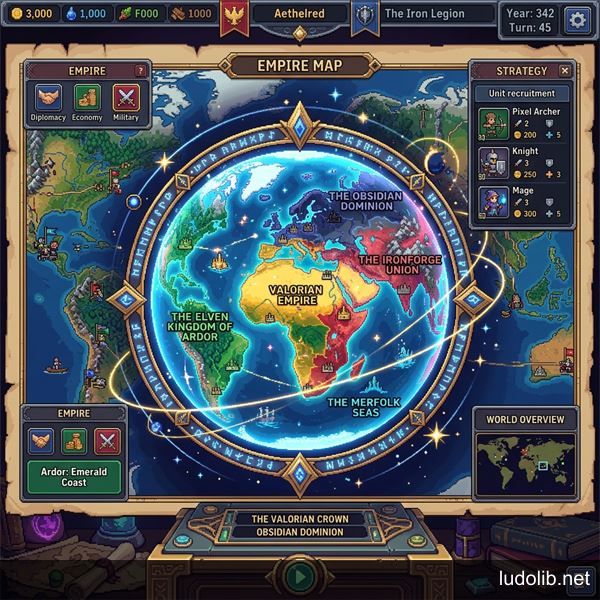
Grand Strategy and 4X are classified in the strategy genre group with the most complex allocation foundations (larger in scope than the action-oriented nature of Real-Time Strategy or the structure of Turn-Based Strategy). Players control the governance mechanisms of an entire empire to resolve assessments of diplomacy parameters, macroeconomics, and geopolitical shaping movements.
The 4X Sub-branch Concept
Shaping the core structure in 1993, 4X is an abbreviated identifier for four core operating processes to maintain the leadership engine:
- eXplore: Coordinate reconnaissance to clear the information blindness layer on unpositioned maps (Fog of War).
- eXpand: Plant control markers, establish new bases and settlements to expand territory.
- eXploit: Manage resource consumption processes and domestic production in planned zones.
- eXterminate: Organize armed forces to eliminate competition from opposing powers. (The most widely established standard representative brand of this branch is the civilization scale of the Civilization franchise.)
The Grand Strategy Sub-branch Concept
The Grand Strategy model focuses strongly on simulating specific historical factors. Rather than creating random undefined maps as in 4X, Grand Strategy typically recreates geographic map simulations based on the actual current state of the earth.
- Control operates through national governance structures, connecting characteristic design to real historical rules (e.g., Political marriage alliances in the Medieval European system of Crusader Kings).
- Rather than just creating armies, the game requires in-depth management of customs systems and long-term trade alliance chains, as in the operational model of Europa Universalis IV.
- Combat calculations are based on total resource strength and multi-branch macro training time (e.g., the World War 2 simulation approach of Hearts of Iron IV).
Connections
Most of the defining representatives of the Grand Strategy genre are currently operated by specialized producer Paradox Interactive. Due to the complexity of the big data management interface, this game industry typically targets an expansion business design through DLC content supplement systems, continuously developing systems rather than regularly releasing new versions.