
⚙️ Game Mechanics
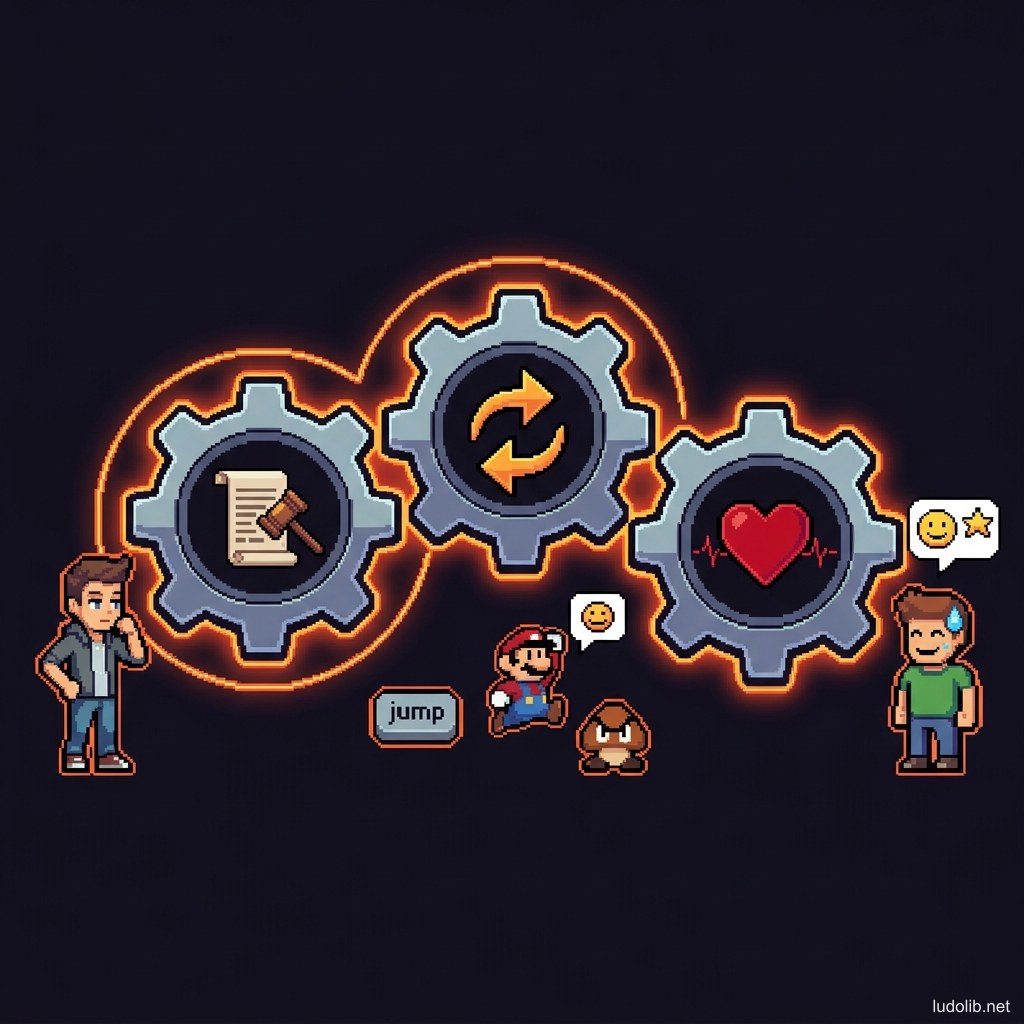
Game Mechanics are the collection of rules, systems, and interactions that players use to interact with the game world. If a Game Designer is an architect, then Game Mechanics are the building codes that the architect writes. Everything a player can “do” in a game — from jumping, shooting, fighting, trading, to cooking — is a mechanic.
MDA Theoretical Framework (Mechanics – Dynamics – Aesthetics)
This is the most classic analytical framework in the game design industry, introduced by Robin Hunicke, Marc LeBlanc, and Robert Zubek (2004):
| Layer | Perspective | Example |
|---|---|---|
| Mechanics | Foundational rules, the “rules of the game” | Press button A to jump, touching a monster loses health |
| Dynamics | Emergent behaviors when players interact with mechanics | Players learn to “head-stomp” monsters to bypass obstacles |
| Aesthetics | Emotional aesthetics players experience | Satisfaction, thrill, challenge, discovery |
Designers think from Mechanics → Dynamics → Aesthetics; Players experience in the reverse direction.
Classification of Common Mechanics
1. Core Mechanics
Actions that the player continuously repeats throughout the game:
- Aiming/Shooting: FPS like DOOM, Counter-Strike.
- Platforming: Super Mario Bros, Celeste.
- Resource Management: Civilization, Age of Empires.
- Deck Building: Slay the Spire, Hearthstone.
2. Progression Mechanics
Systems that make players feel they are getting “stronger” over time:
- Skill Tree: Unlocking new abilities creating development branches.
- Leveling/XP System: Accumulating experience points to “level up”, increasing character stats.
- Loot / Chests: Random rewards stimulating the brain’s reward mechanism (dopamine loop), directly tied to the Gacha system in Mobile Games.
3. Social Mechanics
Rules of interaction between players:
- Cooperative (Co-op): Teaming up to defeat a Boss.
- Competitive (PvP): Ranked Ranked Matches.
- Trading: Buying and selling items via virtual auction houses.
4. Feedback Loops
Self-adjusting difficulty mechanisms:
- Positive Feedback: The strong get stronger (the “snowball” effect in MOBAs).
- Negative Feedback / Rubber-banding: The weak are assisted to catch up (the Blue Shell item in Mario Kart).
Relationship with Other Systems
- The Hitbox and I-frames mechanisms are concrete examples of combat mechanics at the lowest (technical) layer.
- The arrangement and combination of mechanics into the play space is exactly the job of Level Design.
- Game mechanics are the foundational classification for all Video Game Genres.