
📜 Narrative (Story / Plot)
Terminology Distinction
This article defines Narrative (Plot/Storytelling) as a component of the game. If you are looking for the profession or design process, please see the article Narrative Design.
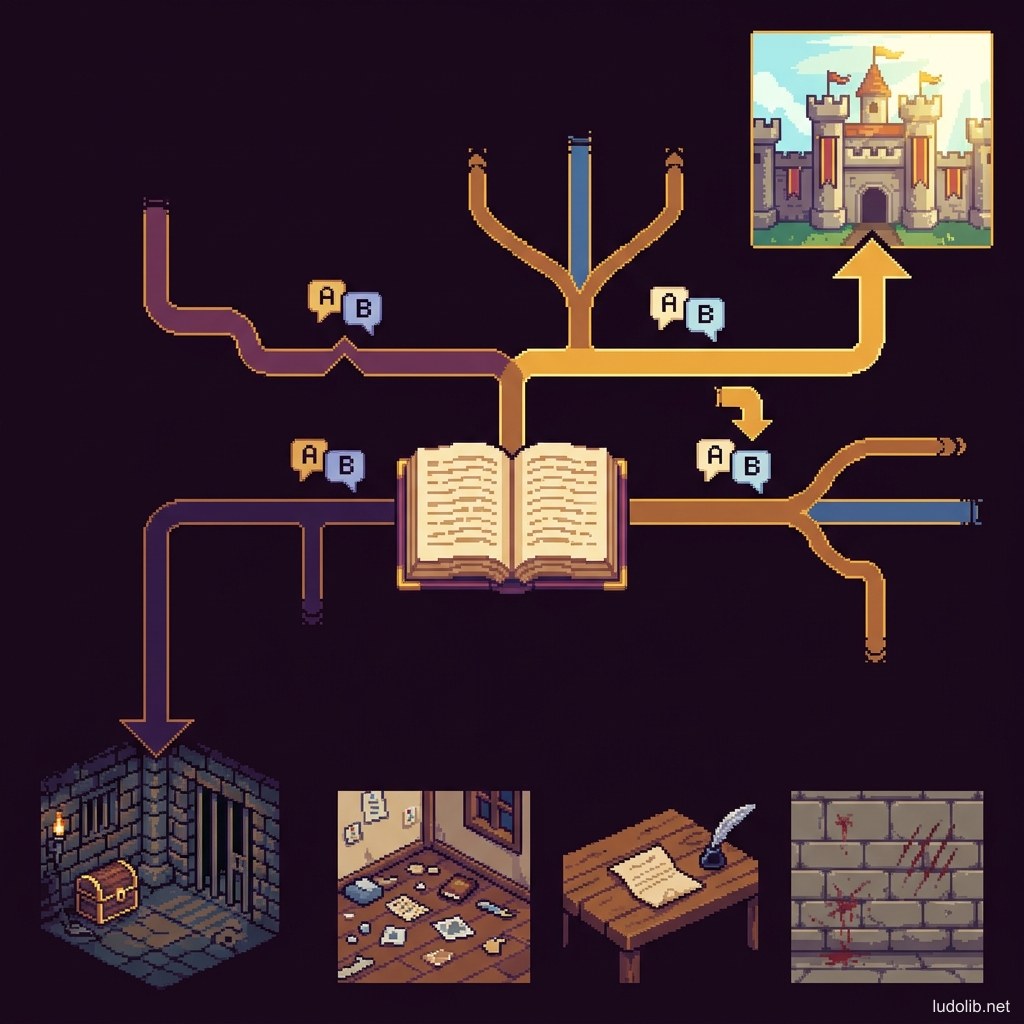 Illustration: The art of Narrative is not just writing, but the entire game world reaching out from the pages of a book.
In game design terminology, Narrative isn’t simply the “Story” — it is the manner in which that story is conveyed to the player through visuals, audio, environment, and game mechanics.
The story is what happens (The king was assassinated), while the Narrative is how the player discovers that (Reading a torn bloody paper or witnessing the assassin fleeing with their own eyes).
1. Common Forms of Narrative
- Linear Narrative: The story has a fixed beginning and end. The player only experiences a straight line (e.g., The Last of Us, God of War).
- Branching Narrative: Player choices change the subsequent events. The plot branches out into multiple paths leading to different Endings (e.g., Detroit: Become Human, Baldur’s Gate 3).
- Environmental Storytelling: Based on the “Show, Don’t Tell” rule. Players piece together the fragments themselves through the ruin of a building, a trail of mud on the floor, or the furniture in a room to envision the tragedy that occurred without needing an AI or NPC to give a presentation.
2. Ludonarrative Dissonance
This is a classic flaw in Game Narrative. It occurs when the game’s story tells you the protagonist is a gentle, peace-loving person who protects animals. But when the player grabs the Controller, they freely spray bullets, brutally massacring an entire village during gameplay. This break in emotional logic is called “Ludonarrative Dissonance”.