
🗺️ Level Design
Distinction
This article focuses on the Concept and Principles of level design. To understand the role and work of a Level Designer, see the article Level Designer.
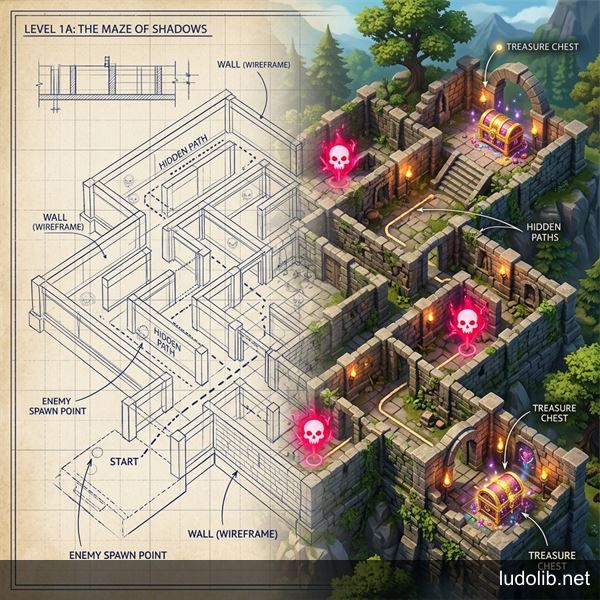
Level Design is a specialized branch of Art & Design in games. It involves building the space, terrain, arranging enemies, and item locations (Resources) within a specific scene that the player will experience.
1. The Nature of Level Design
If “Game Design” is about creating the rulebook (e.g., how chess pieces move), then “Level Design” is about arranging that chessboard so that every match has its own unique flavor and challenge.
A Level Designer will directly use Game Engine software like Unity or Unreal to sculpt 3D blockboxes, thereby sketching (Whiteboxing) the terrain before handing it over to the Art team to apply surface textures (Texturing).
2. Classic Principles
- Invisible Tutorial: Super Mario Bros level 1-1 is the greatest example of Level Design. It places Obstacles right in front of the player in a perfectly orchestrated manner, forcing the player to get used to the mechanics of pressing the jump button and bouncing mushrooms to learn the rules without a single line of instructional text.
- Lines of Sight and Landmarks: A Level Designer uses lighting or a giant mountain placed far in the distance (like the castle in Elden Ring) to unconsciously lure the player to run in that direction.
- Pacing Control: Alternating safe empty rooms with fierce monster-filled rooms (with deadly Hitbox boxes) to give the player a psychological breathing space.