
🧱 Obstacles
Quick Summary
Obstacles (Implicit barriers) are a set of environmental technical parameters programmed by the Level Designer to hinder the player’s linear movement flow. Unlike Enemies/NPCs, Obstacles typically do not possess Artificial Intelligence (AI) logic blocks but deal damage/hinder in a static form or systemic cyclical Patterns tied to the regional architecture.
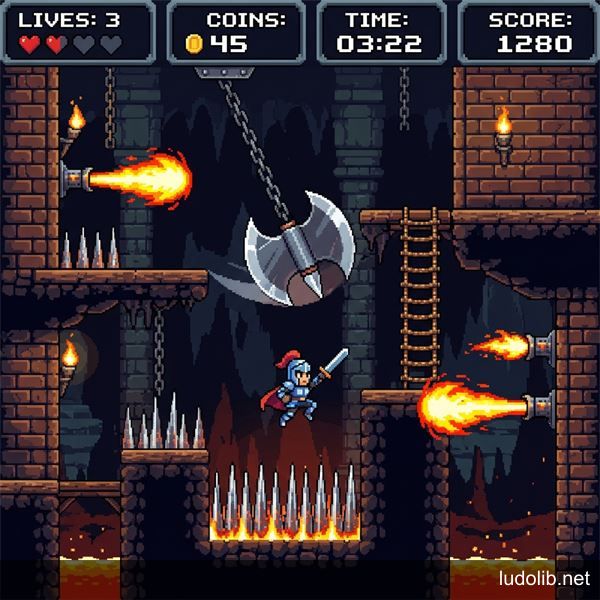 Illustration: The collision detection algorithm (Collision box) of a fiery spike trap, creating a damaging obstacle network forcing users to calculate run cycle timing instead of just charging forward.
In Interaction science (Game Design), Obstacles are fixed agents belonging to the Environment. Setting them up helps the processor alter the experience amplitude (Pacing) by shifting the real-time combat reflex segment into a “Physical spatial math problem” requiring repetitive observation skills.
Operational Structure Distribution
Obstacles act on the movement axis via 3 core mechanical properties:
- Static Blockers: Stone walls, locked doors, deep chasms, or spike pits that cannot be walked across. This object system forces the user to find jumping connection points (Platforming) or detours to alter their initial Pathfinding route.
- Dynamic Hazards: Environmental structures carrying damage limits (Hitbox) and repeating movements according to the system clock. Example: A pendulum guillotine swinging every two seconds, or a fire pillar spraying on a local clock. The player must align the Timing window of the loop grid to pass the punishment cycle.
- Trigger Traps: A parameter group that only shifts its State Transition when acted upon by human coordinates. Examples include Pressure plates or Mimic traps. They train systemic skeptical reflex levels and require the user to limit blind sprinting actions.
Pacing Checkpoint Logic
Setting up dense Obstacles allows the Game Maker to restructure the Gameplay Speed partition. Interweaving a narrow corridor filled with Fire Traps between two Monster rooms (Encounter Design) acts to release the pressure of antagonistic thinking (Micro-combat), shifting the brain segment to evaluating distance puzzle grids, providing a diverse loop of interactive information ratios.