
⚖️ Dynamic Difficulty Adjustment
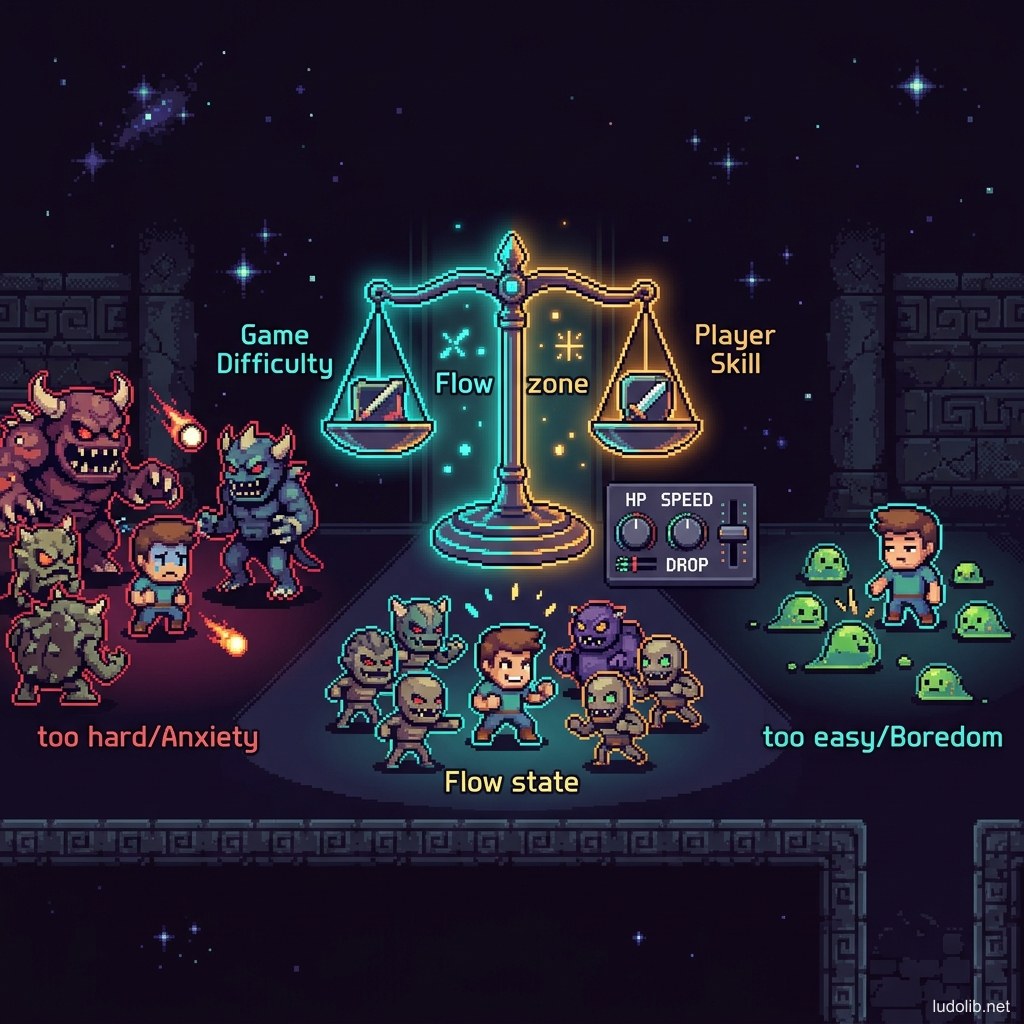 Illustration: The balancing diagram of DDA — automatically adjusting parameters (HP, Speed, Drop rate) to keep players in the central Flow state, avoiding Boredom (left) or Anxiety (right).
TL;DR: Dynamic Difficulty Adjustment (DDA) is a technique that allows a game to implicitly change challenge parameters (enemy health, drop frequency, reaction window duration) based on player performance, aiming to keep them in the Flow zone. DDA should be as invisible as possible — if the player perceives it, the technique has failed.
The DDA concept belongs to the core toolset of modern Game Design, first discussed in the context of commercial games by Jenova Chen in his master’s thesis Flow in Games (USC, 2006) [S1], and has been commercially deployed in major titles like Resident Evil 4, Left 4 Dead (via the “AI Director”), and Mario Kart (via “rubber-banding”). This is a solution to the skill diversity problem: the same game serves both players who sink hundreds of hours and newcomers playing for a free afternoon.
🎯 Core Concepts
DDA is a collection of behavior observation → analysis → gameplay parameter adjustment mechanisms in real-time, with 3 constraints:
| Constraint | Content |
|---|---|
| Implicit | Players must not know they are being “uplifted” — if they realize it, the sense of achievement is lost |
| Thematic Integrity | Adjustments must not break the consistency of the game world (a dragon cannot suddenly have 10 HP) |
| Bidirectional | DDA needs to increase difficulty when the player is too strong, not just decrease it when they struggle |
This concept is adjacent to — but not identical to — Pacing (pre-designed tempo) and Encounter Design (static combat configuration).
🧠 Operating Principles
A typical DDA system consists of 3 modules: Monitor → Heuristic → Actuator.
1. Monitor — Observation Metrics
The engine collects the following signals over a sliding window (usually 30–120 seconds):
- Consecutive Failures — 3–5 deaths in the same spot is the classic threshold [S2].
- Hit Rate — headshot %, combo break rate.
- Time to Complete Each Segment — compared to the community median or the player themselves in the previous segment.
- Resource Usage Frequency — health potions, ammo, emergency items.
- Retreat Speed — is the player constantly “running and dodging.”
2. Heuristic — Decision Logic
Simple rule sets (if-else) are more common than machine learning because they are easy to debug and respect the “thematic integrity” constraint. Example of a classic rule from Resident Evil 4:
If the player dies ≥ 3 times in area X and the headshot rate is < 30%, decrease zombie HP by an additional 5–10% and increase ammo drop rate by an additional 15%.
Some modern systems use bandit algorithms to explore the parameter space but must have safety limits.
The parameters most commonly “tweaked” by DDA:
| Parameter | Safe Variance | Risk if Overdone |
|---|---|---|
| Enemy Health | ±10% | Player feels attacks are unusually “weak” |
| Enemy Speed | ±5% | Animation desyncs, breaking realism |
| Reaction Window (parry/dodge) | ±50 ms | Low risk, highly effective |
| Resource Drop Rate | ±20% | Most easily exposed — players can measure it |
| Number of Enemies Spawned | ±1 | High impact, use cautiously |
🎮 Examples in Games
- Resident Evil 4 (2005) — Capcom openly has a secret “Difficulty Scaling System”: the game tracks deaths, accuracy, time-to-complete, and sorts players into 10 adjustment tiers [S3]. This is considered the first widely acclaimed commercial DDA system.
- Left 4 Dead / [[Left 4 Dead|Left 4 Dead 2]] (2008/2009) — “AI Director” doesn’t just tweak numbers but also decides when to spawn Tanks, where to place medical items, based on an aggregate tension score from the group of 4 players [S4].
- Mario Kart series — “Rubber-banding” makes AI opponents speed up/slow down to maintain a tight race; often controversial because it’s easily noticed by players.
- Crash Bandicoot: N. Sane Trilogy — The remake added an “Aku Aku spawn rate” that increases upon multiple consecutive deaths.
- Celeste — Doesn’t use traditional DDA but uses an explicit “Assist Mode” (player toggled) — representing the opposing view: respecting choice rather than being “implicit” [S5].
⚖️ Pros — Cons / Trade-offs
| Aspect | Content |
|---|---|
| ✅ Advantages | Keeps players of diverse skills in the flow zone; reduces churn rates during difficult phases; saves the design cost of dozens of manual difficulty presets |
| ❌ Disadvantages | Weakens the sense of achievement if discovered; conflicts with the Speedrunning and Leaderboard communities by eliminating comparability |
| ⚠️ Common Pitfalls | (1) Adjusting drop rates too obviously; (2) Forgetting to increase difficulty when the player gets stronger — the game becomes boring; (3) Applying it in high-difficulty modes — where players intentionally choose hardship |
🎨 DDA and Opposing Design Philosophies
Not every studio embraces DDA. FromSoftware, with its Souls-like ARPG titles (Dark Souls, Sekiro, Elden Ring), follows the “one difficulty for all” philosophy, considering harshness a part of the theme. This school of thought views DDA as a “mild lie” that erodes the trust between the player and the game world [S6].
🔗 Related Concepts
- Flow: The goal DDA serves — keeping players in the “flow channel”.
- Pacing: The static alternative to DDA — designing pacing in advance instead of runtime adjustments.
- Encounter Design: If an encounter is well-balanced, the need for DDA decreases.
- Grinding: DDA can reduce grinding pressure for weaker players but causes unfairness to speedrunners.
- Progression: DDA typically adjusts around the progression curve rather than replacing it.
📚 References
- Chen, J. (2006) Flow in Games, Master’s Thesis, USC School of Cinematic Arts. [S1]
- Hunicke, R. (2005) “The Case for Dynamic Difficulty Adjustment in Games”, ACM ACE Conference. [S2]
- Capcom internal post-mortem, GDC 2006, Resident Evil 4 design presentation. [S3]
- Booth, M. (2009) “The AI Systems of Left 4 Dead”, AIIDE Conference. [S4]
- Thorson, M. (2018) “Celeste and the Philosophy of Assist Mode”, GDC 2018. [S5]
- Miyazaki, H. — interview with The Guardian (2022) regarding FromSoftware’s difficulty philosophy. [S6]