
⚖️ Mobile Game Balancing
Quick Summary
Mobile Game Balancing is the continuous process of adjusting design parameters — difficulty, game economy, rewards, progression — to ensure players at every level feel appropriately challenged and that the experience is worth their effort. It is not a single perfect number but a loop of observation, measurement, and constant refinement. [S1]
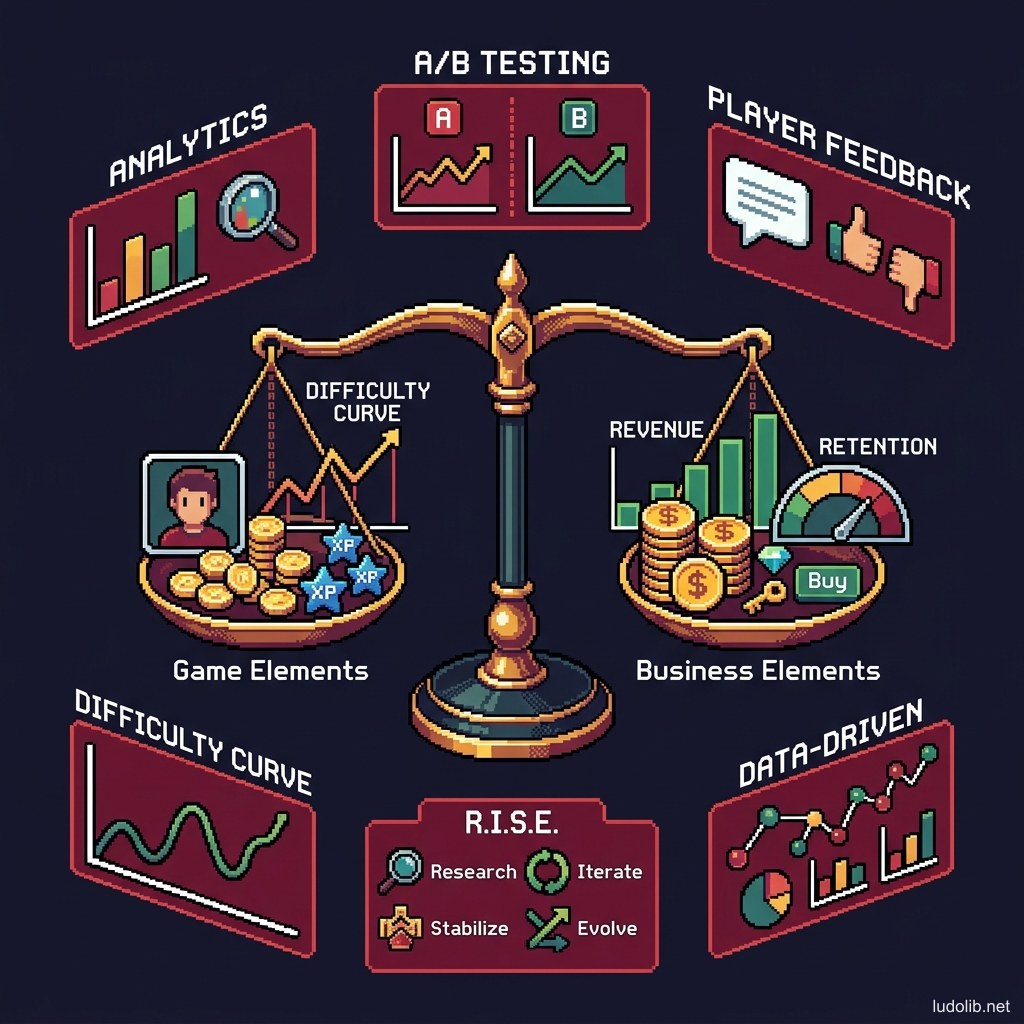 Illustration: The mobile game balancing system — from 6 foundational steps to practical frameworks.
An unbalanced mobile game dies in one of two directions: too easy causes boredom, too hard causes abandonment. Both end in high churn rates and collapsing revenue. This framework, synthesized by Anton Slashcev (Executive Producer), provides a systematic roadmap to reach the equilibrium point — where players are sufficiently challenged to keep going but not sufficiently frustrated to quit. [S1]
6 Key Steps in Balancing
Step 1 — Identify Core Values
Translate every in-game cost into player time to ensure fairness. An item worth 100 gems must accurately reflect the equivalent time investment to farm it. When value is anchored to time, every other design decision has a measurable foundation.
Step 2 — Critical vs. Non-Critical Resources
Clearly distinguish two resource types in the game:
| Type | Definition | Examples |
|---|---|---|
| Critical | Directly impacts core Progression | Exp, main currency, upgrade materials |
| Non-Critical | Optional or cosmetic | Skins, cosmetic pets, decorations |
Critical resources require strict balancing — imbalance here collapses the entire game economy.
Step 3 — Implement a Difficulty Curve
Design difficulty to increase gradually — push players without overwhelming them. The ideal curve follows the Flow principle — challenge always sits at the edge of the player’s current skill level, never exceeding it, never falling below it.
Step 4 — Refine Using Analytics
Data is the only reliable measuring tool. Track:
- Player drop-off points
- Success / failure rates per level
- Distribution of spending and farming patterns
Identify problems through numbers, not guesswork.
Step 5 — Incorporate Player Feedback
Collect feedback via surveys and community channels (Discord, Reddit, in-game surveys). But filtering is essential: distinguish feedback from casual players vs. hardcore players, as the needs of both groups frequently conflict.
Step 6 — Continuously Monitor and Adapt
Game balancing is not a destination — it is a never-ending process. Every new patch, every new meta demands a new balancing cycle. A living game is a game that continuously adjusts.
The Four Pillars of a Stable Game Economy
A healthy game economy depends on four simultaneous factors:
| Pillar | Definition |
|---|---|
| Stable Currency | Control inflation to maintain player trust |
| Rational Pricing | Prices accurately reflect item value through supply and demand |
| Fair Distribution | Rewards proportional to effort and progression |
| Dynamic Supply and Demand | Adjust prices and availability based on player behavior |
Missing any one pillar → unstable game economy → players lose trust → churn increases.
5 Balancing Techniques
Act as a Player
Experience the game from the perspective of a brand-new player. Many balancing problems only become visible when you abandon the bias of someone who “knows the game too well.”
Player Segmentation
Group players by skill or spending level, then adjust difficulty and offers for each group. Casual players and whales require fundamentally different balancing.
A/B Testing
Compare different parameters with separate player groups before rolling out to the full server. This is the only way to measure actual impact.
Iterative Approach
Release small, frequent balance updates rather than sweeping sudden changes. Each small change is easier to measure and carries less risk.
Data-Driven Decisions
Track resource usage and difficulty spikes to guide every change. Intuition has no place in serious balancing.
Key Concepts
Symmetry vs. Asymmetry
- Symmetry: All players begin with identical conditions (e.g., Chess). Balancing is simpler but diversity is lower.
- Asymmetry: Players or factions have distinct strengths and weaknesses (e.g., StarCraft). Creates depth but requires far more complex balancing.
Feedback Loops
- Positive Loop (Snowball): Amplifies an advantage — the leading player grows progressively stronger. Creates excitement but if too powerful it eliminates competition entirely.
- Negative Loop (Catch-up Mechanics): Dampens advantages to maintain parity — losing players receive support to prevent them falling too far behind. Ensures competition remains prolonged.
Power Curve
How player power scales over time or with accumulated resources. A linear power curve creates a sense of stability; an exponential curve creates a “breakthrough” feeling.
Difficulty Curve
Increase challenges step by step — never abruptly. This is the foundation of onboarding design and FTUE.
Power Creep
New content that renders old content obsolete. This is the dark side of Live Service — must be carefully managed to avoid destroying the experience of long-term players.
Sources and Sinks
- Sources: Missions, loot drops, achievements — where resources enter the economy.
- Sinks: Upgrades, repairs, cosmetics — where resources are consumed.
Balancing Sources and Sinks is the core of inflation control in game economy. See also: Faucets and Sinks.
Frameworks for Balancing
R.I.S.E. Framework
| Letter | Meaning | Action |
|---|---|---|
| R — Retention | Smooth out early difficulty | Reduce the learning curve friction |
| I — Income | Monetize without pay-to-win | Keep spending optional, not mandatory |
| S — Satisfaction | Reward sufficiently | Keep players motivated with meaningful rewards |
| E — Engagement | Encourage consistent progress | Design daily loops that feel worthwhile |
Bartle Player Types
Offer varied experiences for 4 groups: Killers (competition), Achievers (accomplishments), Socializers (community), Explorers (discovery). Good balancing must serve all four groups.
Flow Theory
Match challenge to skill for optimal engagement. This is the guiding principle when designing Dynamic Difficulty Adjustment.
Player Feedback Cycle
Collect feedback → Identify pain points → Update → Evaluate → (repeat)
The Secret to Successful Balancing
Player-Centric, Data-Driven Approach Play, observe, refine, and iterate in small steps to stay responsive and maintain balance.
There is no magic formula — only a meticulous and patient process.
Pro Tips
- Manage Gameplay Stress: Reduce intense high-tension moments or add cooldowns to create breathing room.
- Offer Free Trials: Let players preview premium items before deciding to buy — lowers the barrier and increases conversion.
- Foster Social Interaction: Clans and Co-op play boost both spending and Retention.
- Create Emotional Highs and Lows: Alternate challenge and recovery to create lasting emotional engagement.
- Early Generosity & Gradual Pacing: Hook players quickly with generous early rewards, then gradually slow progression — players who have made an emotional investment will stay.
See Also
- Game Balancing — General balancing principles for all game genres
- Feedback Loop — Positive and negative feedback loop mechanics
- Faucets and Sinks — Game economy management model
- Flow — Flow theory in difficulty design
- Dynamic Difficulty Adjustment — Automatically adjusting difficulty to the player
- Bartle Player Types — Classifying players by motivation
- Retention — Player retention strategies
- Live Service — Managing a continuously running game service
References
- [S1] Anton Slashcev, “How to Balance Your Mobile Game” — Executive Producer infographic (2024)
- [S2] Raph Koster, A Theory of Fun for Game Design (2004)
- [S3] Ernest Adams & Joris Dormans, Game Mechanics: Advanced Game Design (2012)