
📄 How to Structure a Game Design Document (GDD)
Quick Summary
A Game Design Document (GDD) is a comprehensive design document describing the complete vision, mechanics, art, technology, and production plan of a game. It is the project’s “constitution” — every decision references back to the GDD. According to Anton Slashcev’s framework, an industry-standard GDD consists of 10 sections: from a Game Overview to Appendices of supporting references. [S1]
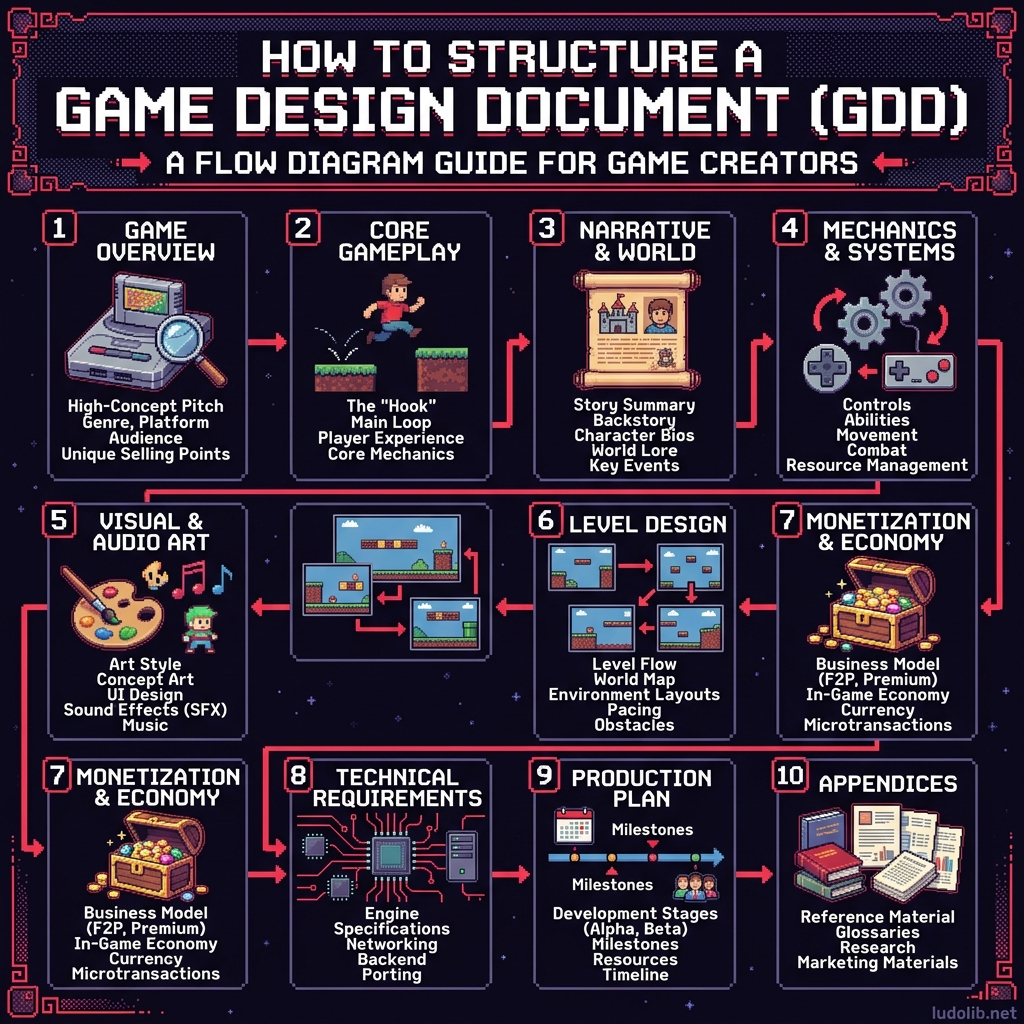 Illustration: The 10-section structure of a complete GDD according to Anton Slashcev.
What Is a GDD and Why Is It Essential?
A GDD is not a rigid, one-time document — it is a living document continuously updated throughout the development process. Its core value: [S1]
- Alignment: Ensures the entire team (designers, developers, artists) shares the same vision.
- Reference: Acts as the source of truth when design decisions are disputed.
- Onboarding: Helps new team members quickly understand the project.
Section 1 — Game Overview
This section answers: “What is this game?”
| Field | Content |
|---|---|
| Title | Game name + brief Game Summary |
| Genre | Genre + Similar Games (comparables) |
| Platform | Target platforms + Key Selling Points |
| Target Audience | Who is this for? |
Section 2 — Core Gameplay Mechanics
The most critical section of the GDD — describes how to play: [S1]
- Core Loop ↔ Key Mechanics
- Objectives & Goals ↔ Game Progression
- Player Actions ↔ Control Scheme
Section 3 — Narrative
Relevant to both story-driven and casual games: [S1]
- Story Summary ↔ Key Events
- World-Building ↔ Characters
- Plot Structure ↔ Tone and Themes
- Optional Narrative — side stories and optional content
Section 4 — Mechanics and Systems
Detailed specifications for all technical game systems: [S1]
- Combat System ↔ Progression System
- Abilities ↔ Interaction Systems
- Economy ↔ AI & Behavior
- Include flowcharts for each complex system.
Section 5 — Visual and Audio Design
Define the aesthetic language of the game: [S1]
- Art Style ↔ UX Design
- Audio ↔ Character & Asset Design
- Color Palette — the dominant color scheme
Section 6 — Level Design
Structure of space and difficulty within the game: [S1]
- Level Layout ↔ Environmental Storytelling
- Environment Types ↔ Key Challenges
- Pacing ↔ Difficulty & Progression
Section 7 — Monetization
The game’s business model: [S1]
- Business Model ↔ IAP / ADS Placements
- Premium Features — paid feature definitions
See also: Game Monetization Models, IAA, Gacha.
Section 8 — Technical Requirements
The technological foundation of the product: [S1]
- Engine ↔ Platform-Specific Features
- Performance Goals ↔ Multiplayer Requirements
Section 9 — Production Plan
The project execution roadmap: [S1]
| Field | Content |
|---|---|
| Key Milestones | Development Timeline |
| Team Roles | Risks and Mitigation |
| Costs & Budget | Project budget |
Section 10 — Appendices
Supplementary reference materials: [S1]
- References and Inspiration ↔ Diagrams and Flowcharts
- Concept Art — initial visual concepts
Practical Tips
A GDD Doesn't Need to Be Perfect from Day One
Start with a minimal GDD (e.g., a One Page Game Concept) and expand it incrementally. A 500-page GDD that nobody reads is less valuable than a 50-page GDD that the entire team uses daily.
See Also
- One Page Game Concept — A condensed version of the GDD for pitching ideas
- Playtest — The testing process that drives GDD updates
- Game Producer — The role that manages the GDD within a team
- Game Aspects Breakdown — A 9-aspect framework to ensure GDD completeness
- Core Gameplay Loop — The core of Section 2 of the GDD
References
- [S1] Anton Slashcev, “How to Structure Game Design Document” — Executive Producer Infographic (2024)