
🎮 Bartle’s Player Types
Quick Summary
Bartle’s Player Types is a player psychology taxonomy framework proposed by researcher Richard Bartle in 1996, categorizing players into 4 groups based on their primary intrinsic motivation: Killers, Achievers, Socializers, and Explorers. This is one of the most cited theoretical frameworks in game design history. [S1]
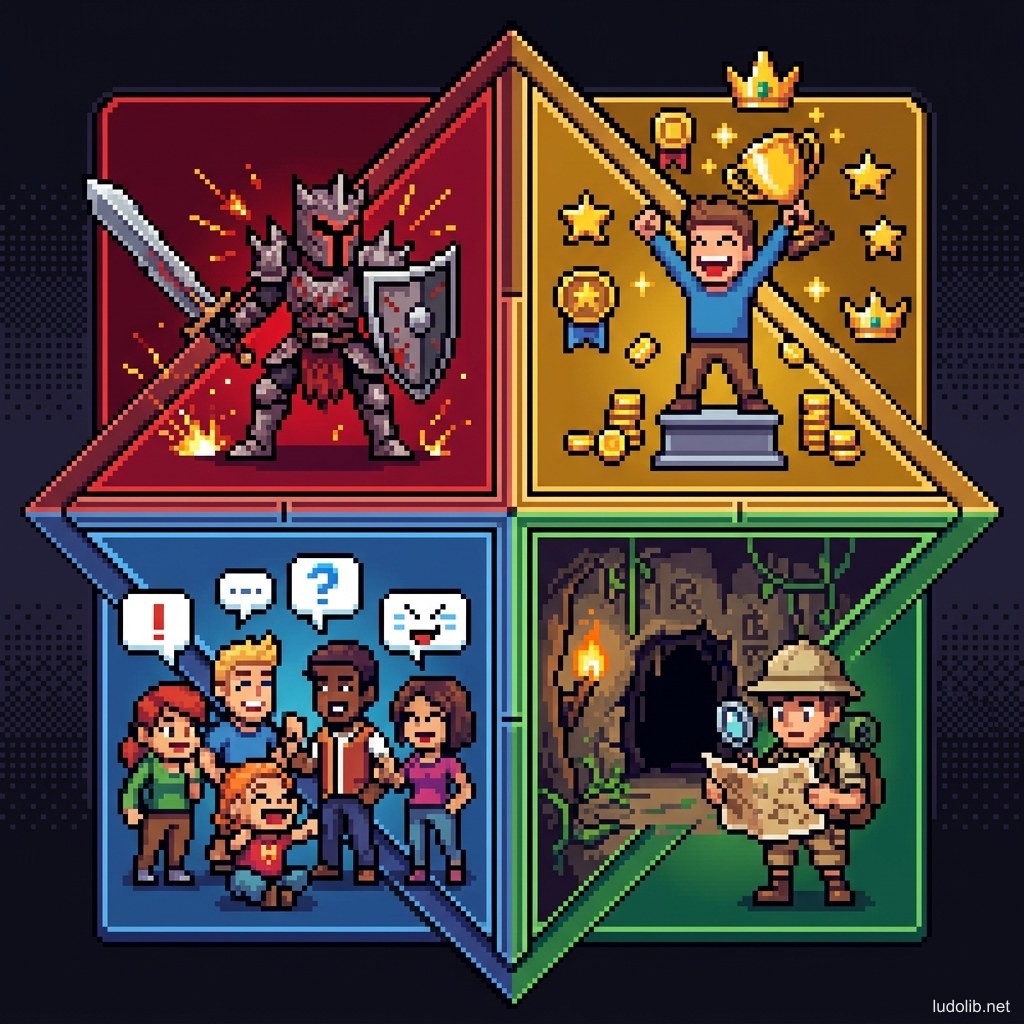 Illustration: The quartet of player types according to Bartle’s model — each quadrant represents a psychological group with specific characteristic behaviors and motivations.
Richard Bartle — a British game designer and co-author of MUD (Multi-User Dungeon, 1978) — proposed this classification framework based on empirical observations of the behavior of thousands of players in online worlds. Although born from the era of first-generation MUDs/MMOs, this model is still widely applied in modern game design — from mobile to Live Service and competitive PvP games.
The Model’s Coordinate Axes
Bartle’s model is built on 2 psychological axes forming an orthogonal coordinate system:
| Axis | Two Poles |
|---|---|
| Horizontal Axis | Players (interacting with others) ↔ World (interacting with the game world) |
| Vertical Axis | Acting (actively taking action) ↔ Interacting (reacting/interacting) |
The intersection of the 2 axes creates 4 quadrants — corresponding to 4 player types.
The 4 Player Types
⚔️ 1. Killers
Axis: Acting × Players
Primary Motivation: Dominance — wanting to prove their power by overpowering other players.
Psychological Profile: Killers don’t just want to win — they want the opponent to feel defeated. This is the player type seeking control and power in the game’s social space. To them, the game world is an arena, and other players are targets — not partners.
In-game Behavior:
- Ganking, raiding, attacking other players (Forced PvP)
- Taunting, tea-bagging, using provocative language
- Finding exploits and unbalanced Game Mechanics to gain an unfair advantage
- Participating in deep ranked climbing just to crush weaker opponents
Design Implications: Killers are the group that generates the most toxicity in the community, especially in unmoderated environments. However, when directed properly, they are the driving force that creates intense competitiveness — the core element of esports.
Design Advice for Killers
- Provide PvP Arena modes and leaderboards with skill stratification mechanics (MMR/ELO) so Killers face equally skilled opponents instead of bullying newcomers.
- Design opt-in PvP — players choose to participate, and are not forced.
- Establish clear reporting and punishment mechanisms for toxic behavior so Killers don’t ruin the experience for other groups.
🏆 2. Achievers
Axis: Acting × World
Primary Motivation: Rewards & Mastery — wanting to complete everything, collect everything, be at the top of everything.
Psychological Profile: Achievers view games as a massive checklist to complete. They receive dopamine hits from ticking the final box on an achievement list, reaching the maximum level, or climbing to the #1 spot on the Leaderboard. The social space is less important — what matters is completion.
In-game Behavior:
- Completing 100% of quests, maps, achievements
- Systematically grinding for levels, resources, and experience points
- Collecting rare items, mounts, and limited cosmetics
- Following wikis and guides to optimize every decision
Design Implications: Achievers are the group with the best retention in games with rich Progression systems. They are the ideal customers for Live Service games because they always return to complete new content every season.
Design Advice for Achievers
- Build a multi-tiered Achievement/Trophy system with clearly escalating difficulty.
- Provide Leaderboards with multiple categories (highest DPS, fastest completion time, number of bosses killed…).
- Design Milestone Rewards — special rewards at significant milestones (level 50, 100 hours played, 1000 kills…).
- Ensure there’s always a clear “next goal” — Achievers need to know what they’re progressing toward.
💬 3. Socializers
Axis: Interacting × Players
Primary Motivation: Connection & Collaboration — the game is merely a vehicle for building relationships.
Psychological Profile: For Socializers, gameplay is secondary — the most important thing is who they play with. They can play a “bland” game for hundreds of hours simply because their good friends are there. Conversely, they are willing to abandon an excellent game if the community lacks friendliness.
In-game Behavior:
- Chatting, confiding, sharing personal stories via in-game chat
- Establishing and maintaining Guilds, Clans, regular Parties
- Participating in community events, fairs, and collaborative content
- Helping newcomers, guiding, mentoring
Design Implications: Socializers are the pillars of the game community. They create the social ecosystem that helps games live longer than their pure content lifecycles. Many MMOs survive for decades largely thanks to their loyal Socializer communities.
Design Advice for Socializers
- Integrate a multi-channel chat system (guild, party, world, whisper) with good UX.
- Build Friend List, Guild Systems with management features and activity history.
- Design community content — events that can only be completed when many people cooperate (Raids, Community Challenges).
- Provide non-combat social spaces: personal housing, gathering areas, housing systems.
🗺️ 4. Explorers
Axis: Interacting × World
Primary Motivation: Discovery & Curiosity — wanting to understand the game world deeper than anyone else.
Psychological Profile: Explorers don’t need rewards or competition — they are purely satisfied by the act of discovery. They are the ones who find Easter eggs 10 years after a game’s release, map the world before developers announce it, and read every line of hidden lore in item descriptions.
In-game Behavior:
- Exploring every corner of the map, finding hidden areas and secret shortcuts
- Searching for Easter Eggs and hidden lore in environmental storytelling
- Talking to all NPCs to gather lore and dialogue
- Testing the limits of game mechanics (clipping through walls, sequence breaking)
- Contributing to wikis and the community with deep game knowledge
Design Implications: Explorers are the group that creates the most community content — from wikis, guides, datamined videos to speedrun route discoveries. They turn the “surface” of the game into deep knowledge for the entire community.
Design Advice for Explorers
- Build a world with depth — hidden spaces, secret basements, lore hidden in textures and item names.
- Design intentional and meaningful Easter Eggs, not just “developer selfies”.
- Create interactive environments with NPCs that have rich dialogue and context-sensitive reactions.
- Reward exploration with hidden loot, secret achievements, or exclusive lore — not a power advantage (to avoid pressuring Achievers and Killers to explore).
Real-world Distribution in Communities
According to Bartle’s research on early-generation MUD data (1996), the approximate distribution is [S1]:
| Type | Estimated Percentage |
|---|---|
| Achievers | ~50% |
| Explorers | ~25% |
| Socializers | ~20% |
| Killers | ~5% |
Important Note
This is not a rigid categorization — a player can change types per game, per phase, or exhibit traits of multiple types simultaneously. Bartle later (2003) expanded the model into 8 types by adding an “implicit/explicit” dimension, but the 4-type model remains the most popular version in the industry. [S2]
Practical Application in Design
A successful Live Service game or MMO needs to serve all 4 types concurrently:
| Design Feature | Which Type it Serves |
|---|---|
| Ranked PvP, Esport mode | Killers |
| Achievement system, Leaderboard, Battle Pass | Achievers |
| Guild system, Community Events, Chat | Socializers |
| Open World, Easter Eggs, NPC lore | Explorers |
Neglecting any group can cause the game to lose a potential community segment. World of Warcraft is a prime example of a game successfully catering to all 4 groups for over 20 years. [S3]
Application in Emotional Design
The Bartle model aligns directly with the Emotional Design philosophy:
- Killers need feelings of Power & Dominance
- Achievers need feelings of Mastery & Progress
- Socializers need feelings of Belonging & Connection
- Explorers need feelings of Discovery & Wonder
A designer who understands Bartle’s Types will design each system with specific emotional targets for each target group.
See Also
References
- [S1] Bartle, R. (1996). “Hearts, Clubs, Diamonds, Spades: Players Who Suit MUDs.” Journal of MUD Research, Vol. 1, No. 1.
- [S2] Bartle, R. (2003). Designing Virtual Worlds. New Riders Publishing.
- [S3] Blizzard Entertainment, “World of Warcraft”