
📜 10 Game Design Rules
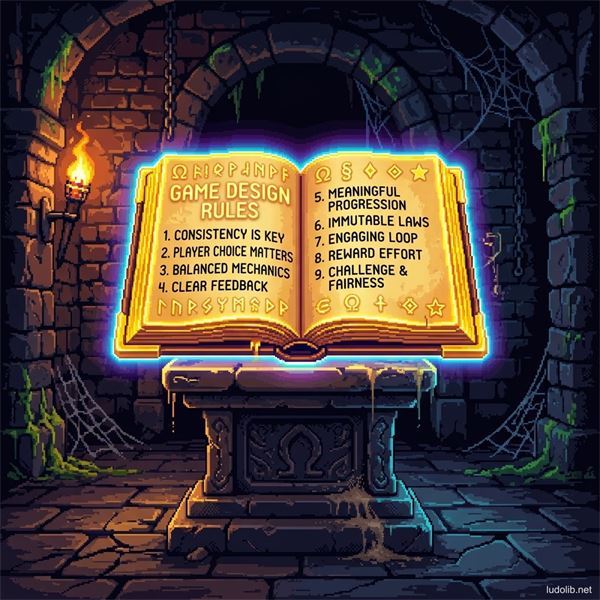 Illustration: The immutable rulebook of the Game Design industry, radiating a guiding light for all core design decisions.
Quick Summary
The 10 Game Design Rules is a guiding framework distilled by veteran Game Designers to steer all design decisions. Instead of focusing on programming or graphical techniques, these 10 rules focus entirely on player psychology, ensuring that the final experience always feels fair, transparent, and above all, Fun. Violating these rules is often the root cause of unjustified frustration and increases the Churn rate.
The system of 10 rules below is distilled from the mindset framework of Anton Slashcev, divided into 3 focal groups: Setting Expectations, Implicit Guidance, and Respecting the Player [S1].
Group 1: Setting Expectations and Trust
1. Reward Curiosity
If players decide to deviate from the main path, ensure their time is not wasted. Players with an Explorer inclination (according to Bartle Player Types) need to be rewarded with hidden treasure, a lore snippet, or a rare item. Unrewarded curiosity will quickly turn into apathy.
2. Make Victory and Defeat Crystal Clear
Absolutely avoid ambiguous win/loss conditions. Players need to know exactly why they succeeded and why they failed. Using visual cues like progress bars, or warning colors (red for danger, sharp shapes) helps the brain analyze results instantly without reading a single word.
3. Be Consistent
Consistency creates trust. If the “Exit” button is in the top right corner of menu A, it must be in the exact same spot in menu B. Once you have taught the player an operating rule, never break it. Inconsistency is the greatest enemy of the Flow experience.
Group 2: Fairness and Guidance
4. Guide, Don’t Lecture
No one likes a long, boring text-based tutorial. Help players learn for themselves through subtle hints integrated directly into the Level Design rather than dry text lessons. Let them “discover” the solution themselves — that Eureka feeling is exactly what creates the Mastery Experience.
5. Keep it Fair
Unfair moments will immediately completely shatter the experience. AI-controlled enemies must not be allowed to “cheat” by teleporting illogically or breaking the game’s physical systems. All entities — including the game itself — must abide by the same set of rules. Unless it’s an announced Asymmetry mechanic.
6. Never Take Away Rewards
Players absolutely despise losing things they’ve “grinded” hard to obtain. Taking away items without their consent creates a feeling of betrayal. Only let them lose items when they voluntarily choose to (Selling or trading).
- The only exception: During the First-Time User Experience (FTUE), you can let them try out the ultimate weapon and then take it back, because at this point they haven’t actually put in the effort to earn it.
Group 3: Respecting the Player
7. Always Provide a Clear Objective
Players must always know what they need to do next. The path to the goal can be extremely arduous and difficult, but the destination itself must be clear as day. If they have to stop and ask “Where do I go now?” in confusion, that is a design flaw.
8. Fun is the Foundation
No amount of rewards, massive content, or an excellent narrative script can save your game if your core Gameplay isn’t fun. Make Fun the starting point for every design decision. If a cumbersome mechanic doesn’t bring joy, remove it.
9. The Player is Always Right
If players feel bored, frustrated, or confused, it’s a design flaw, not their fault. Listen to community feedback (Feedback Loop). Players are usually not good at providing design solutions, but they are always absolutely accurate in pointing out where the real problems are.
10. Respect Player Choices
When you offer players choices, honor them. The returned consequences must match the initial expectations. Creating the illusion of choice but then forcing the player to follow a single “right choice” dictated by the developer will completely destroy Agency and Immersion.
🔗 References
- [S1] Anton Slashcev, “10 Game Design Rules” — Core player experience design principles system.