
🔊 Sound Design in Games
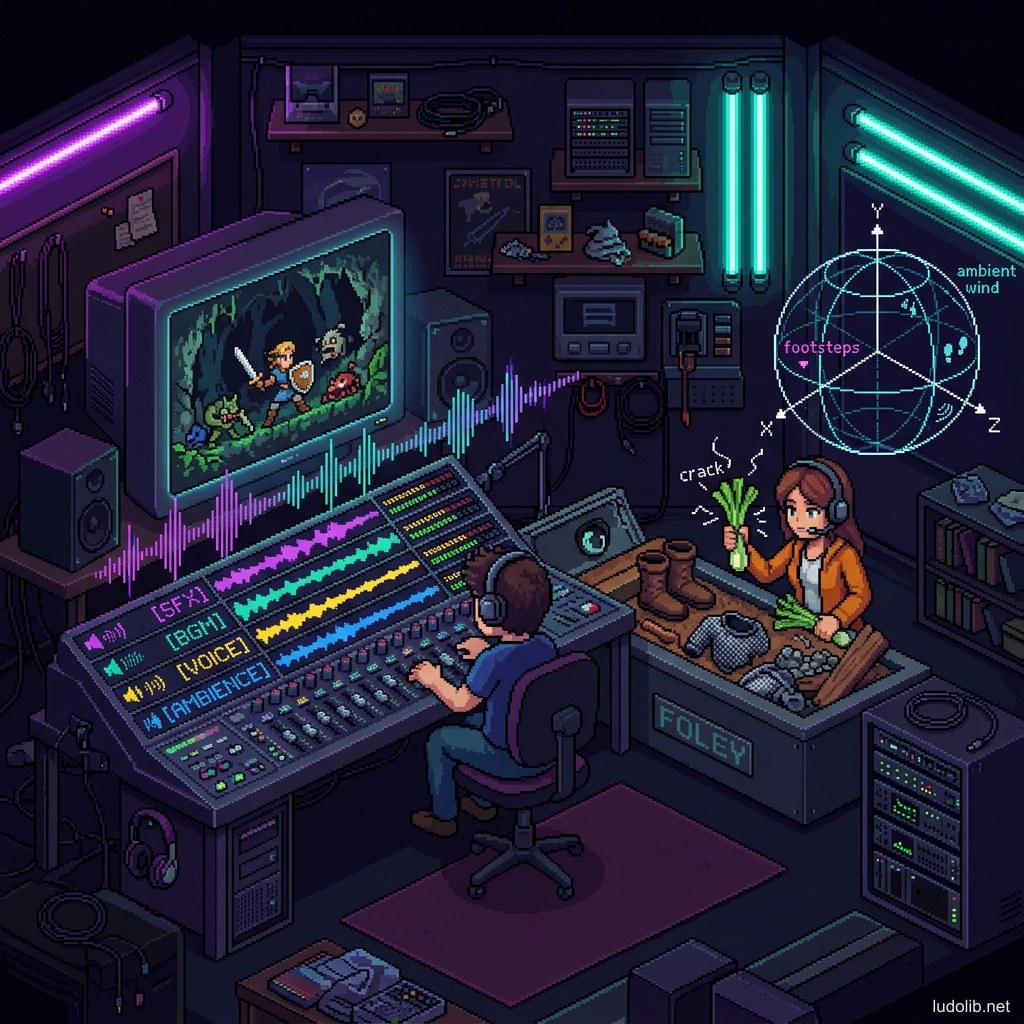 Illustration: Sound Designer at the mixer with 4 audio tracks (SFX, BGM, Voice, Ambience) — sound waves transmitting into the game screen, alongside Foley recording and 3D Audio spatial positioning system.
Sound Design is the art of creating, recording, editing, and deploying every sound players hear in a game — from footsteps on grass, sword striking flesh, to the grand symphony of the final Boss battle. A game with muted audio loses 50% of its vitality.
Technical Integration and System Design
While Sound Effects and Game Music are material components, Sound Design is the engineering discipline that places those sounds in the correct spatial and temporal position in the game — ensuring they react precisely to player interactions.
Key Concepts
Diegetic vs. Non-diegetic Sound
| Term | Meaning | Example |
|---|---|---|
| Diegetic Sound (In-world) | Characters in the game also hear it | Car radio sound, footsteps |
| Non-diegetic Sound (Out-of-world) | Only players hear it, characters don’t | Background music, UI “ding” when leveling up |
Occlusion & Spatialization (Spatial Audio)
In modern 3D games, audio must reflect real physics:
- Footsteps emit from the exact direction of the character (left/right/above/below) — 3D Audio / Binaural Audio technology.
- Muffled sound (reduced high frequencies) when the sound source is blocked by a wall (Occlusion).
- Reverb changes depending on whether you’re in a cave or open field.
Common Tools
| Software | Role |
|---|---|
| FMOD | Audio engine integrated into Unity/Unreal — handles adaptive music |
| Wwise (Audiokinetic) | AAA audio engine — used in Assassin’s Creed, Overwatch |
| Audacity / Adobe Audition | Recording, cutting, processing audio effects |
| Ableton Live / FL Studio | Composing game background music |
Relationships with Other Systems
- Sound Design closely coordinates with Game Mechanics — every mechanic needs a corresponding “audio feedback” (a “click” when Hitbox collides, a “whoosh” when I-frames activate).
- UI UX Design needs separate audio effects for menus, buttons, notifications.