
🎨 Art Styles
Quick Summary
Art Style in video games is the unified methodology for designing shapes, colors, and lighting to create a cohesive aesthetic identity for the product. It acts as the visual language that bridges the system’s narrative and gameplay mechanics to the player’s cognitive perception.
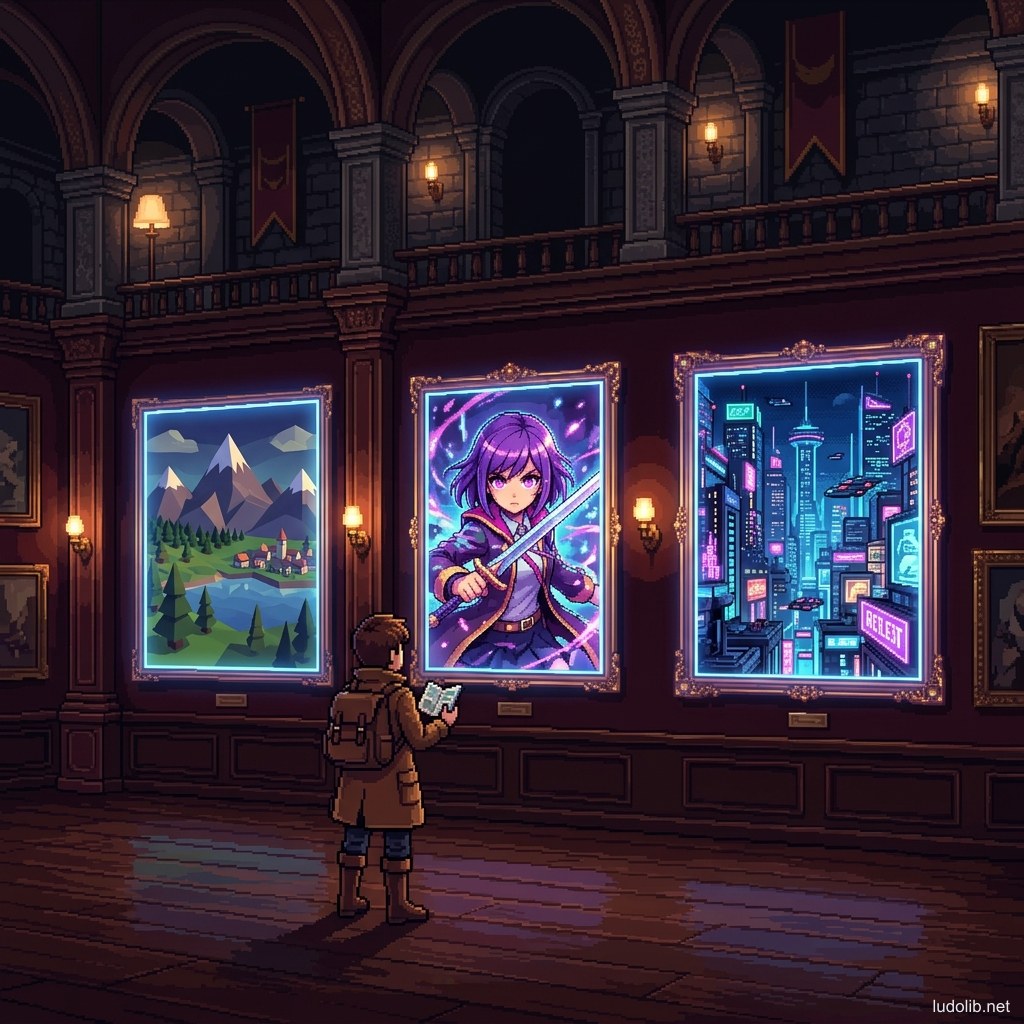
The spectrum of Art Styles is incredibly vast, born from the continuous intersection between technological limitations (hardware) and human aesthetic aspirations.
1. Why Is Art Style Important?
- Identity & Branding: An excellent Art Style allows players to instantly recognize the game from just a 2-second screenshot (e.g., the cel-shaded lines of Borderlands or the chunky pixels of Minecraft).
- Hardware Optimization: Choosing Low-poly or Pixel Art is often a clever strategy by Indie studios to bypass the massive 3D rendering budget barriers required by Hyper-realism.
- Narrative Support: The visual aesthetic directly shapes the emotional tone. A Horror game usually utilizes heavy shadows and desaturated colors, while a Farming Simulator bursts with vibrant, warm, and highly saturated palettes.
2. The Golden Triangle of Aesthetics
All existing visual branches can be mapped onto a triangular chart defined by 3 main pillars:
graph TD;
    A((Abstraction)):::abstract --> |Fewer polygons, symbolic| B((Stylization)):::style;
    B --> |Hand-drawn, bending light| C((Realism)):::real;
    C --> |Emotional erosion, LoD| A;

    classDef abstract fill:#9b59b6,stroke:#8e44ad,stroke-width:2px;
    classDef style fill:#f1c40f,stroke:#f39c12,stroke-width:2px,color:#000;
    classDef real fill:#3498db,stroke:#2980b9,stroke-width:2px;
- Realism: Attempts to mimic the optical laws, gravity, and reflections of the real world (Naturalism).
- Stylization: Intentionally distorts, exaggerates, and flattens materials to establish a unique personality aiming to evoke intense emotions that reality lacks.
- Abstraction: Completely sheds physical forms, using only geometries (Squares, Circles, Teardrops) or Symbolic fragments to convey neurological functions instead of visual figures.
2.1. Derivatives from the 3 Pillars
The blending of these 3 extremes at varying degrees creates specific stylistic “brands” commonly applied to projects:
-
Realism Derivatives:
- Photorealism / Hyper-realism: Pushing hardware boundaries to recreate microscopic hair strands and 100% authentic water droplets. (e.g., Cyberpunk 2077, Microsoft Flight Simulator).
- Grit / Dark-Realism: Realistic but using a gloomy, rusty, and decaying color palette to enhance the survival feel. (e.g., The Last of Us, Dark Souls).
- Semi-Realism: Real-life human anatomical frames but exaggerating weapons, smoothing skin textures, and reducing the Uncanny Valley effect. (e.g., Final Fantasy VII Remake).
-
Stylization Derivatives:
- Cel-Shading (Toon): Breaking physical lighting to create bold 2D black outlines, mimicking Japanese Anime. (e.g., Genshin Impact, Persona 5).
- Comic-Book / Graphic Novel: Applying ink-wash strokes and cross-hatching to simulate American comic books. (e.g., Borderlands, Telltale’s The Walking Dead).
- Painterly / Hand-drawn: Mimicking the strokes of oil paint, watercolor, or hand-drawn sketches. (e.g., Hollow Knight, Ori and the Blind Forest).
- Chibi: Squashing body proportions into large heads and small bodies to convey a cute, quirky aesthetic. (e.g., Animal Crossing).
-
Abstraction Derivatives:
- Minimalist: Stripping away 90% of details, leaving only smooth geometric planes with highly representative colors. (e.g., Journey, Superhot).
- Monochromatic: Completely abstracting by eliminating the color spectrum, establishing vision through overwhelming Black/White contrast. (e.g., Limbo, Return of the Obra Dinn).
- Cubism / Voxel / Low-Poly: Deconstructing the world into cubic voxels or extremely low-count polygon meshes. (e.g., Minecraft, Roblox).
-
Hybrids:
- HD-2D: Resonating the refined stylization of classic Pixel Art atop the 3D realistic lighting environments. (e.g., Octopath Traveler).
- 2.5D Stylized: Combining abstract linear movement mechanics with stylized 3D figures.
3. The Ecosystem of Famous Modern Art Styles
3.1. The Photorealism Spectrum
Dominating the AAA industry thanks to the capability of massive scene-building via Unreal Engine & Shader architectures.
- Photorealistic: Rendering human skin, fabrics, and Ray-traced lighting almost indistinguishable from natural photography. Extremely demanding, requiring multi-million dollar budgets. (Red Dead Redemption 2, The Last of Us Part II).
- Semi-Realism: Anatomy and architecture are realistic, but skin is smoothed out, colors are brightened, and weapons are slightly exaggerated. Serves the RPG grinding genre to avoid the Uncanny Valley element. (Final Fantasy, God of War).
3.2. The Retro & Pixel Art Spectrum
Born from the ROM/RAM restriction era, now rising as an invaluable pure aesthetic philosophy.
- 8-bit / 16-bit Classic: Dot art using a restricted base color palette. Forces the player to use their “brain’s fill-in-the-blanks syndrome” to visualize details. (Celeste, Shovel Knight).
- HD-2D (Modern Pixel): A breakthrough pioneered by Square Enix. 2D Pixel Sprite characters are pasted and animated onto deeply lit 3D map planes filled with modern real-time shadows. (Octopath Traveler, Triangle Strategy).
3.3. The Polygonal & Voxel Spectrum
- Low-Poly: Character forms and objects are created using extremely crude 3D meshes (sometimes just 500 triangle facets). No smooth Textures, just flat colors on sharp edges. Delivers a rustic and Minimalist perspective. (Journey, Monument Valley).
- Chunky PS1-style (32-bit Primitive): Currently a massive horror trend in the Indie scene. Jagged walls, flickering pixels, distorted faces glued to a single jittery JPEG texture. (Iron Lung, Signalis).
- Voxel Art: No 3D meshes; the world is assembled from thousands of “Cubic blocks” that can be dismantled exactly like a Lego physics system. (Minecraft, Teardown).
3.4. The Non-Photorealistic (NPR) Lighting Spectrum
- Cel-Shading (Toon Shading): A magical lighting filter that, instead of a soft Gradient shadow transition on human skin, “FLATTENS” the Drop Shadow into 3 Boundaries (Highlight - Midtone - Black Outline). This outline feature makes the 3D model look exactly like a Hand-drawn Anime animation. (Zelda: Breath of the Wild, Genshin Impact, Hi-Fi Rush).
- Comic-Book Style: All shadowing consists of ink cross-hatching, thick black outlines, and dialogue bubbles just like American Comics. (Borderlands, Telltale’s The Walking Dead).
3.5. The Illustrative & Hand-drawn Spectrum
Taking the techniques of millennia-old artists and sowing them into the Machine Space.
- Hand-drawn / Frame-by-Frame: Every Jump frame and Sword swing is traced and redrawn by artists across tens of thousands of separate pictures over 5 years. Completely flat 2D rusticity with no computer matrix distortion. (Cuphead, Hollow Knight).
- Watercolor / Painterly: The blurred nuances of Japanese Ink wash or Dry Oil strokes. Viscous paint layers blend into the vision just like a Theater Backdrop. (Ori and the Blind Forest, Okami).
3.6. The Neural Abstract & Experimental Spectrum
- Monochromatic: 90% of the screen is only Black and White. Red blood is only featured in the Blood Forest scene. The focus is Psychological Oppression forcing the brain to process extreme visual contrast. (Limbo, Inside).
- Glitch Art / Cyberpunk UI: Intentional corrupt screen destruction waves. Green static separating RGB frequencies, cracked CRT fonts, and blindingly glaring computer errors. Enhances the concept of a Grid Society’s disorientation. (Cyberpunk 2077 Hacking UI, Cruelty Squad).
4. Academic Works Cited
- Keo & Järvinen (2002). Making and Breaking Games: A Typology of Rules. (Treatise on gameplay mechanic polarization).
- RMCAD & Champlain College Project (2018). Visual Language and Cohesion in Interactive Media.
- Leblanc, M., Hunicke, R., & Zubek, R. (2004). MDA: A Formal Approach to Game Design and Game Research.
- The Historical Progression of Video Game Art (GDC Proceedings).