
Normal Map
Quick Summary
Normal Map (Surface Normal Map) is a special texture algorithm structure in 3D rendering. It uses an optical illusion RGB color palette (Red, Green, Blue) to report to the Engine system where a flat object surface is actually convex or concave when affected by light — simulating maximum physical volumetric bumps without requiring an increase in the source polygon count.
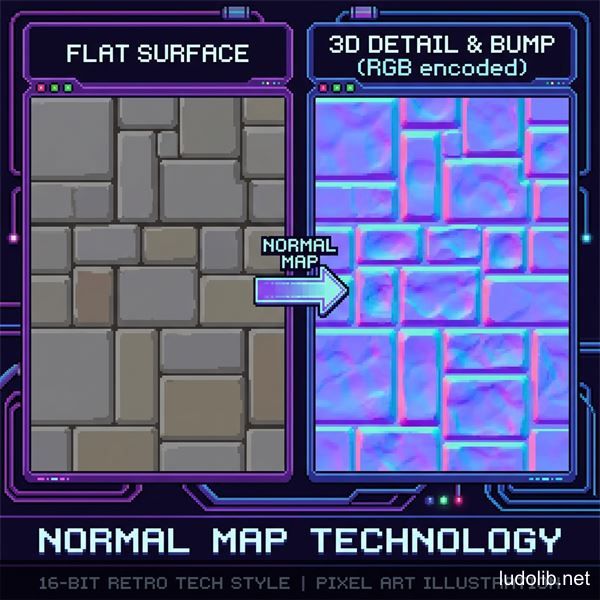 Illustration: The Normal Mapping algorithm. The 3D stone wall image is actually just a flat plane, but the mysterious blue-purple color spectrum (Normal Map) applied to the surface causes light to cast detailed deep crack groove shadows exactly like extreme multi-block 3D carved cross-sections.
In the optimal Render technical routing system of Level Design environment engineers, Normal Map volume has the largest proportional impact on interaction realism. If you increase a flat wall using Polygon algorithms to design random bumps, the device GPU will hit processing limit shutdown. Reversing the risk, using “Normal Maps” solves the problem through shading principles.
RGB Color Quantity Space Structure (RGB Mapping)
The illusion point of the Normal Map design system relates to how the coefficient defines optical Vector direction through the default color palette:
- Red Axis (R): Regulates the hidden slope height of the Horizontal coordinate space axis (Vertical X-cut axis).
- Green Axis (G): Calculates the indentation groove of the Vertical coordinate variation axis (Y axis).
- Blue Axis (B): Controls the illusory recognition parameter of the static plane projection direction (Z axis). The cross-combination of these color ranges tells the device which reflection angle each pixel coordinate molecule will bounce back toward the light source (Lightsource).
Large-Scale Engine Functionality
- Micro-detail Material Mapping: Creates human facial wrinkle texture structures, bullet scratch marks on shiny metal, or thousands of scale mesh patterns on a dragon creature’s body — all super-optimally calculated even on baseline hardware of mobile screens without distorting the base Mesh grid structure.
- Dynamic Lighting Interaction: Because Normal Map physically calculates light projection direction independently, when a character with this technique applied moves past a flickering torch in a dark tunnel (Dungeon) corner, the shadows created on their scar groove system will shift the shading direction in real-time (Realtime shading). It is the core for all PBR Material standards in AAA Games today.