
Vector Graphics
Quick Summary
Vector Graphics is a digital rendering protocol used to establish images through geometric equations (Lines, Curves, Coordinates) rather than scanning Raster/Pixel grid forms. Therefore, Vector-computed images do not break, crack, or lose quality — regardless of how many times they are freely scaled up or down.
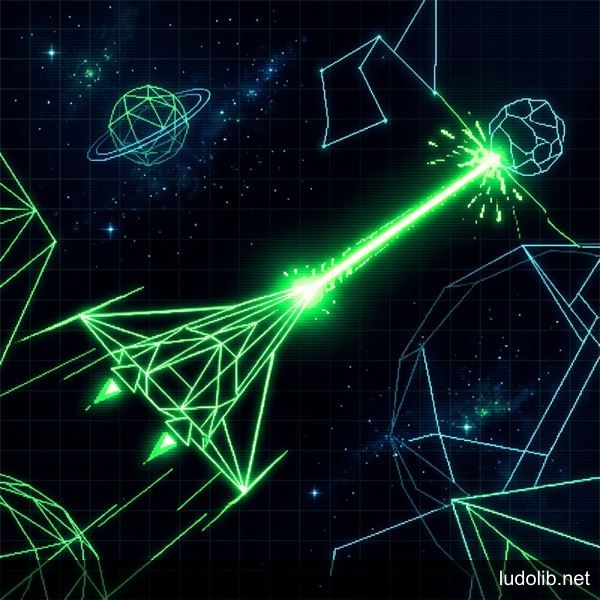 Illustration: The characteristic effect of the early-era Vector machine — routing the screen display environment with luminous grid rays constructed from a single-variable XY coordinate system.
From a release technology perspective, Vector graphics played an extremely important role in the pioneering phase of the interactive interface system (Arcade). Unlike the 2D Pixel system that consumed massive graphics buffer memory (VRAM) to calculate each block pixel configuration (e.g., 1920x1080 cells), the Vector system calculates based on mathematics — the screen only needs to know where point A’s pen drop is, and the connected stretch system extends to point B.
Application History & System Limitations
- Arcade Golden Age (1980s): Vector Monitor screens appeared powerfully on arcade machines like Asteroids or the original Star Wars spacecraft game. Using CRT electron beams fired directly to form luminous Vector edges, displayed graphic objects shone brightly similar to actual laser rays — completely eliminating the rough aliasing effect (Aliasing) inherently tied to hardware configuration limits of that era.
- Structural Shift: Vector graphics existed with the disadvantage of difficulty integrating complex multi-hue color palettes or creating smooth-surfaced multi-shape blocks. The graphics scope ultimately belonged to Raster/3D Polygon pixel algorithms because of richer array surface (Bitmap) replication capability. The rigid Vector game field became a “dead timeline” after the 1990s.
Contemporary Structural Design Applications
In modern development software suites (Game Engine), Vector mathematics is no longer used to draw entire models (Sprites) but has transitioned to the specialized department: Programming Interface Design (UI/UX). Instruction panels, Menu bars, project Logos, and character health point indicators are always stored and displayed in Vector format (typically .SVG files) — ensuring crisp precision sharpness regardless of whether players project those graphics through a small mobile TV screen (1080p) or an infinitely stretched ultra-resolution screen (4K–8K Ultra HD) — without the software capacity limit being overwhelmed by structural overload.