
🏰 Dungeon
Quick Summary
A Dungeon is a confined spatial unit in level design (Level Design), typically existing as an underground architectural network like caves, mazes, or castles. It is an isolated environment containing a large number of enemies, traps, items, and a final controlling Boss entity.
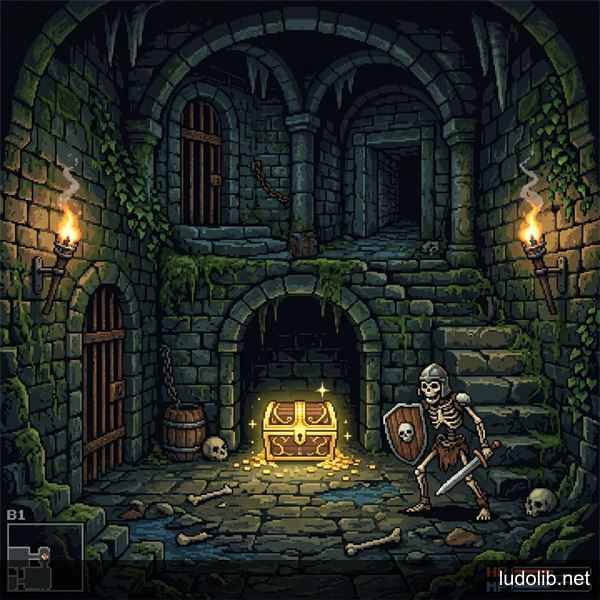 Illustration: An underground space (Dungeon) design, where the complexity of the environmental layout is proportional to the risk of encounters and the value of reward chests.
The Dungeon originated from the fragmented terrain system of the Dungeons & Dragons board game. During the digitization into video games, this structural system was standardized into a micro survival space. Unlike open-world combat setups, a Dungeon locks the character’s movement loop, forcing the player to interact with a chain of events and accurately manage physiological resources (Health, mana) before reaching the exit portal.
Spatial Architecture Classification
- Linear Dungeon: A one-way tunnel structure. The system guides the display block from entrance A straight to Boss room B without providing physical branching paths. This linear form is programmed to serve the storyline, ensuring the pacing experience is uniform for all players.
- Labyrinth/Maze: A spiderweb structure. The system intentionally hides the true exit with dead-ends, creating the risk of disorientation.
- Procedural Dungeon: Algorithms like Rogue-like (e.g., Hades, Dead Cells) allocate random survival environments. After each death, the coordinate system of room blocks and enemy spawn points is completely remixed, creating a perpetual data graph.
Impact on the Reward Chain
In mechanical essence, a Dungeon system operates as a micro-reward loop. Risks such as limited vision darkness (Fog of War) or physical traps act as mandatory “costs.” The return on investment is the Treasure Chests or Experience points located at the end of the map. The psychological counterweight between the Fear of resource loss and the Stimulation of rewards makes “Dungeon Crawling” an independent design ecosystem separate from the main core game.