
🛡️ Pity System
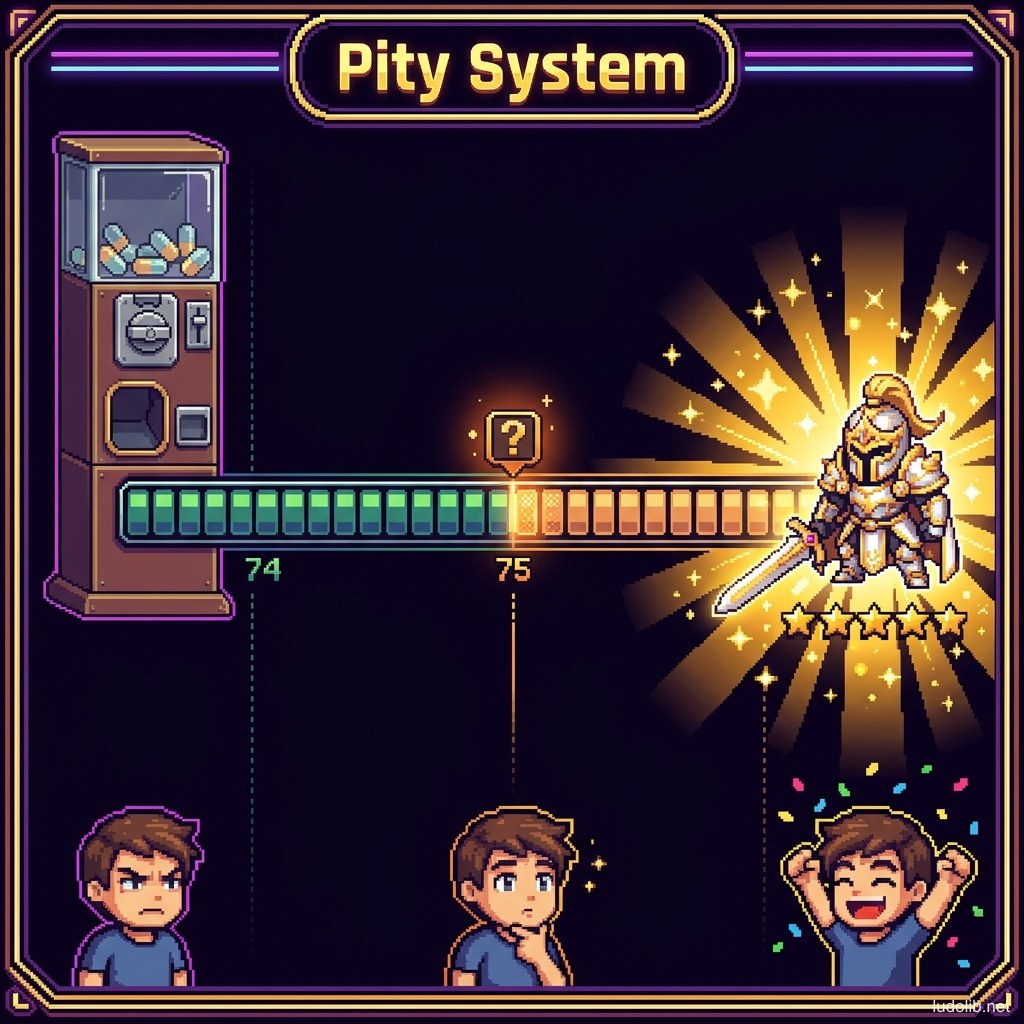 Illustration: Pity System — a progression bar accumulating across pulls, bursting with a 5★ reward at Hard Pity (the 90th pull).
The Pity System (Mercy System / Risk Protection) is a hidden mathematical design system intended to mitigate the bitter bad luck of players against statistical probability (RNG). This painful term is primarily associated with the Gacha or Lootbox monetization genre.
Pity literally means “Compassion” — the game Engine “pities” you for being unlucky, so it decides to give you the premium item directly!
1. Why design a Pity system?
If a legendary sword has an extremely low Drop Rate: . Mathematically, if you pull 100 times, the probability of empty-handed failure (Pulling 100 times and not hitting it once) is still . This means nearly 40% of the player base who sink a ton of money will receive nothing and angrily delete the game and rant online! The Pity System was born to retain customers.
2. Hard Pity and Soft Pity
(A common analysis from major gacha games like Genshin Impact or Honkai: Star Rail):
- Soft Pity (Approaching Branch Protection): The Base Drop Rate for an SSR item is 0.6%. But when a player hits the 75th pull and still gets nothing, on the 76th pull, this rate skyrockets a hundredfold to 32%. The 77th time it goes up to 45%… The success rate strongly forces a golden drop for the user at this point.
- Hard Pity (Absolute Bottom-line Protection): “If you have pulled for the 89th time and the universe still curses you with bad luck, I guarantee that on the 90th pull, the VIP item drop rate is 100%“.
3. Consumer Psychology
Despite its reputation as “pity,” the Pity System is actually a “Price Ceiling Psychological Anchor”. It lets users know for certain what the absolute maximum amount of money they can lose to buy out that Character is (e.g., Guaranteed to lose $200 to hit the Hard Pity protection), stimulating them to spend money without the fear of “bottomless, hopeless bankruptcy.”