
🎮 How to Design a Great FTUE: 8 Core Principles
Quick Summary
FTUE (First Time User Experience) is the critical first 30 minutes that decide whether players stay or leave. According to Anton Slashcev’s framework (Executive Producer at devtodev), an exceptional FTUE simultaneously executes 8 principles: from a powerful opening Hook and delayed Monetization, to gradual mechanic introduction and post-FTUE optimization. Each principle includes a Why, How, and an industry Pro Tip. [S1]
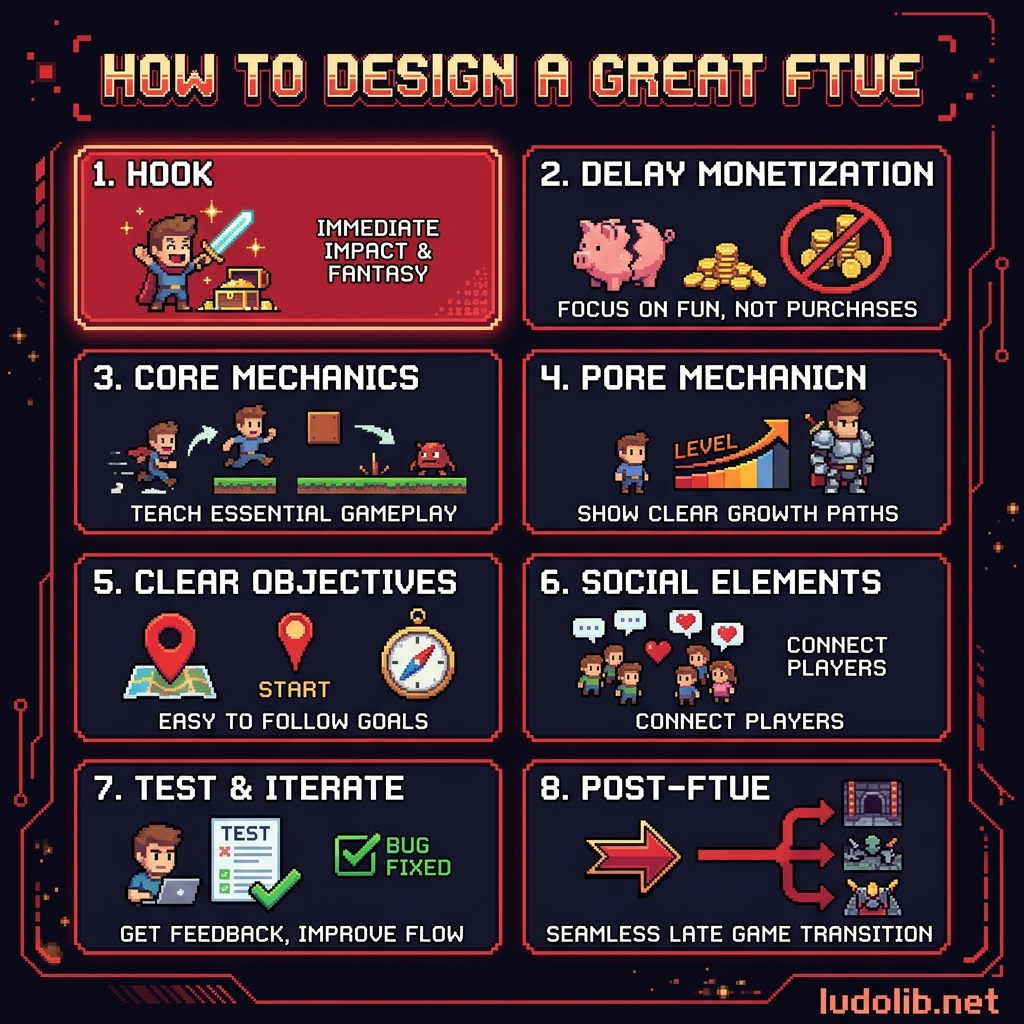 Illustration: The 8 FTUE design principles by Anton Slashcev — from the first Hook to post-FTUE optimization.
1. Start With a Hook
Why? First impressions decide if players stay or leave. [S1]
How?
- Grab attention immediately with striking visuals, a quick story beat, or a fun challenge.
- Showcase what sets your game apart — whether it’s art style, narrative, or a unique mechanic.
Pro Tip: Never start with long loading screens or dry tutorials. Drop players into a “wow” moment within the first 60 seconds.
See also: Early Hook — the technique for delivering a strong impression in the first minute.
2. Delay Monetization
Why? Early monetization can break trust and interrupt the player’s flow state. [S1]
How?
- Give premium items for free to demonstrate their value before asking for purchase.
- Introduce purchases only after players understand the Core Gameplay Loop.
- Keep ads optional and beneficial (Rewarded Video Ads).
Pro Tip: Use analytics to find the best time and place to present offers. Don’t guess — measure.
See also: Game Monetization Models, IAP, IAA.
3. Introduce Core Mechanics Gradually
Why? Too much complexity at once causes churn. [S1]
How?
- Reveal one mechanic at a time.
- Reinforce each mechanic before adding more.
- Reward players for mastering each new mechanic.
Pro Tip: Use narrative or short animations to connect mechanics to the story — this makes learning feel natural rather than like reading a manual.
4. Highlight Progression
Why? Early wins and a sense of growth build emotional investment, making players want to return. [S1]
How?
- Keep early levels easy for near 100% success rates.
- Use progress bars, collectibles, or story chapters to show advancement.
- Offer mini-goals or achievements for quick gratification.
Pro Tip: Add visual or audio cues when players unlock milestones. A “ding” sound or particle burst on level-up are critical Game Feel moments.
See also: Progression, XP System.
5. Clear Objectives
Why? Players need immediate clarity on what to do and how to do it. [S1]
How?
- Provide step-by-step instructions tied to actual gameplay (tooltips, highlights).
- Keep instructions short and skippable.
- Make core actions intuitive — players should never need to read to understand how to play.
Pro Tip: Avoid long explanations. Let actions speak louder than words — show, don’t tell.
6. Include Social Elements
Why? Social elements significantly boost Retention by creating positive social pressure. [S1]
How?
- Encourage players to share achievements with friends.
- Offer rewards for social actions (friend invites, guilds/clans).
- Add leaderboards or co-op modes.
Pro Tip: Guide the player, but avoid forcing them. Social interaction must feel organic, not obligatory.
See also: Leaderboard, Bartle Player Types, Social Features.
7. Test, Iterate, Perfect
Why? Data pinpoints churn areas for refinement. [S1]
How?
- A/B test different Onboarding flows.
- Track tutorial completion rates and bottlenecks.
- Gather feedback from real players to spot confusion.
Pro Tip: Heatmaps show exactly where players leave — this is your most important tool for FTUE optimization.
See also: How to Conduct a Playtest, B Testing.
8. Optimize Post-FTUE Onboarding
Why? Players who finish the tutorial still need direction for long-term engagement — FTUE is only the beginning. [S1]
How?
- Gradually introduce advanced features as players grow comfortable with the basics.
- Use milestone notifications to guide players deeper into gameplay.
- Add daily or weekly tasks to maintain involvement.
Pro Tip: Re-engage players with push notifications about upcoming or expiring rewards — this is the critical bridge between FTUE and Live Operations.
See also: Live Ops, Retention, Daily Quest.
See Also
- FTUE Casual Games — FTUE analysis specific to the Casual genre
- Core Gameplay Loop — The foundation FTUE must teach players
- Playtest — The professional process for testing FTUE
- Retention — The metric that measures FTUE effectiveness
- Onboarding — The complete journey of guiding new players
References
- [S1] Anton Slashcev, “How to Design a Great FTUE” — Executive Producer Infographic, devtodev (2024)