
⏱️ Frame Rate & Frame Data
Quick Summary
Frame Rate (FPS) in game design doesn’t just stop at hardware graphics quality; it acts as the core circulating time measurement unit of an interactive physical system. Frame Data is the foundation that slices the temporal structure of an Animation into smaller technical components to demarcate collision boundaries and dictate Responsiveness.
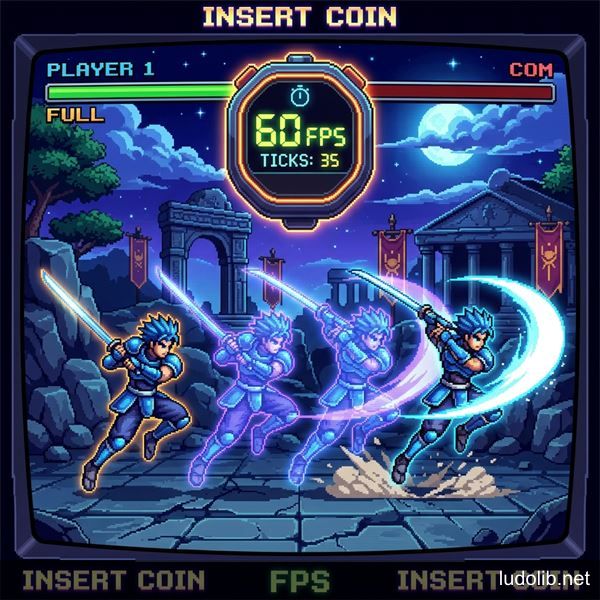
In game programming structures, the concept of a “second” is rarely used as a micro-interactive variable. At the standard software limit of 60 FPS (Frames Per Second), the Physics Engine will update the Logic Loop every 16.67 milliseconds. Managing the precision of each “Frame” is the most fundamental metric for the State Machine system, completely dictating the processing protocol of heaviness - lightness when characters execute commands.
Frame Structure In Combat Protocols
Most mechanics that create Game feel revolve around the distribution of Frame Data. An attack animation is always automatically isolated into 3 technical rendering phases, originating from the philosophy of the Fighting game franchise:
1. Startup Frames
The pre-loading phase of the animation before the character actually opens the damage measurement point. Startup Frames define the controller’s counter-reaction level: the longer the loading phase, the larger the Window of Opportunity the attack provides the opponent to anticipate the attack direction.
2. Active Frames
The extremely short time amplitude when the Hitbox collision area processor is officially Enabled and moves into the interacted object’s body part (Hurtbox). Damage and Knock-back commands only occur according to mathematical intersection equations within these Active Frames.
3. Recovery Frames
The processing delay interval after the animation has finished its Active Point but the 3D skeleton (Rig) has not returned to its basic Idle State. The purpose of the Recovery variable is to control fair punishment on the state machine: it strips the player’s right to load the next command, forcing them to risk taking a Whiff Punish if they missed the previous beat.
Connection With Other Mechanic Ecosystems
Frame data design deeply affects parallel mechanic network systems:
- I-frames (Invincibility Frames): In the Soulslike genre like Elden Ring, the Dodge command possesses a series of intrinsic Active Frames that are completely excluded from damage point calculations. The intersection of these two Frame calculation grids is the pinnacle of dictating player skill.
- Hit Stop (Frame Freeze): A common technique when a collision occurs: The Engine actively halts the entire Logic Loop for about 2-4 Frames to transmit Force feedback to the retina, maximizing Visual Weight.
- Rollback Netcode: The network processing protocol for fighting games depends directly on Frame Data. The opponent’s input prediction is simulated in advance, and “excess frames are cut” if the real command is sent later than the retrieval speed.
See Also
- Game Mechanics: The core system protocol navigating all Frame Data.
- Game Designer: The design team balancing micro Frame parameters.
- Hitbox / Hurtbox: Static collision volume frames.
- I-frames
- 60 FPS