
🧠 12 Game Design Tricks: Psychological Techniques to Retain Players
Quick Summary
12 Game Design Tricks is a toolkit of design techniques that leverage predictable human psychological tendencies — from Loss Aversion to social cognition — to boost Retention and Monetization. According to Anton Slashcev (Playliner), each trick is described across three dimensions: What it is, How to use it, and an Example. Understanding these tricks informs both game design and the analysis of why top games are so engaging. [S1]
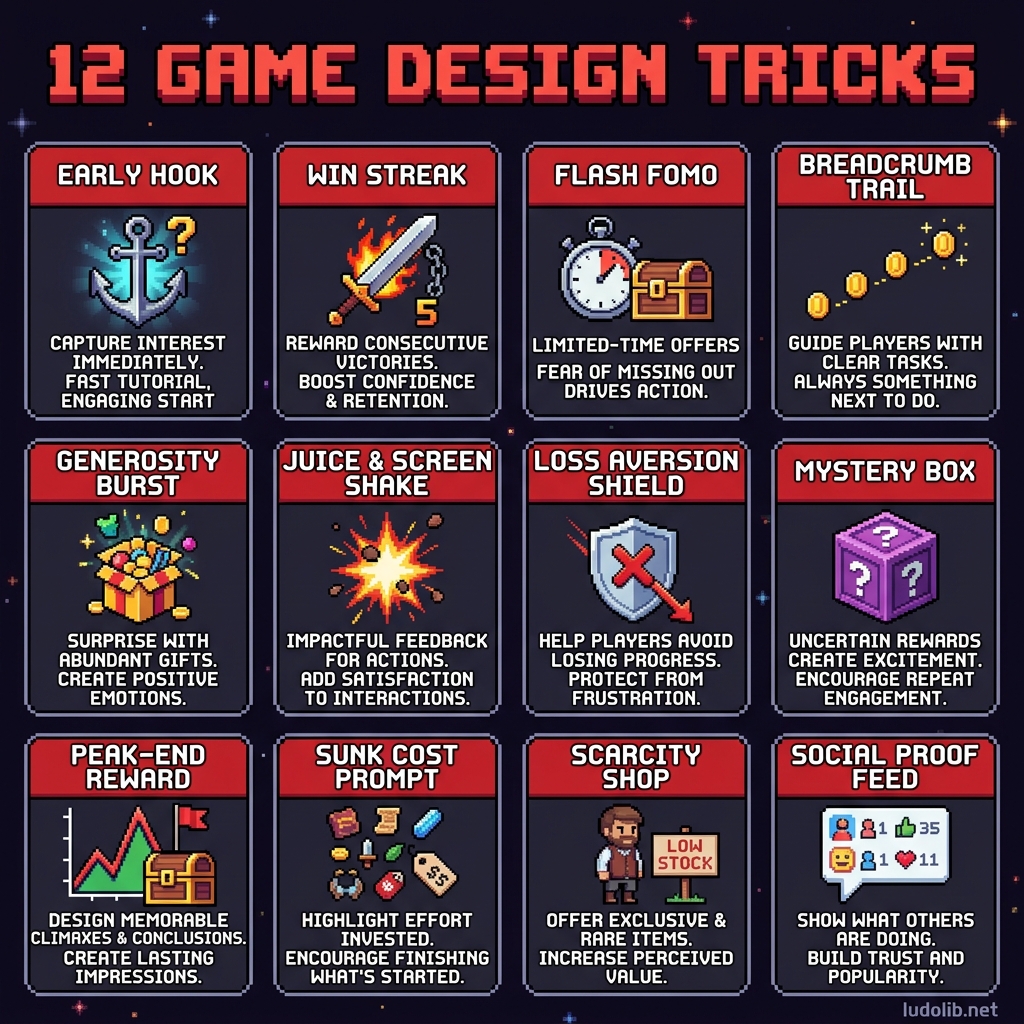 Illustration: The 12 Game Design Tricks by Anton Slashcev — each with a definition, usage guide, and real-world example.
Trick 1 — Early Hook
What it is: A powerful “wow” moment within the first minute — the moment that makes a player think “this game is actually fun.” [S1]
How to use it: Expose the core action immediately, before any menus or tutorials.
Example: Level 1 drops players directly into a boss fight.
See also: FTUE, How to Design a Great FTUE.
Trick 2 — Win Streak
What it is: Rewards that escalate with consecutive successes, creating momentum to keep playing. [S1]
How to use it: Reset the streak only on clear failures, not minor mistakes.
| Usage | Result |
|---|---|
| ✅ Escalating excitement | Players continue to maintain the streak |
| ❌ Rage on reset | Players quit out of frustration |
Trick 3 — Flash FOMO
What it is: A short-lived event that disappears forever, exploiting Fear of Missing Out. [S1]
How to use it: Use countdown timers and unique badges to enforce scarcity.
Examples:
- 24-hour limited skin
- One-time raid boss
- Exclusive countdown banner
See also: Loss Aversion, Scarcity.
Trick 4 — Breadcrumb Trail
What it is: A string of mini-goals leading to a major goal, always giving players a reason to play one more session. [S1]
How to use it: Reveal the next breadcrumb before the current one is completed.
| Step | Payoff |
|---|---|
| Collect 5 keys | Unlock gate |
| Fix generator | Power elevator |
| Reach camp | Safe save |
| Talk to NPC | New clue |
See also: Progression, Quest Design.
Trick 5 — Generosity Burst
What it is: Front-loading free gifts before monetization begins, creating goodwill and a sense of reciprocal debt. [S1]
How to use it: Give premium currency early to build goodwill.
Example: The first session showers players with 300 free gems.
See also: IAP, Delay Monetization.
Trick 6 — Juice & Screen Shake
What it is: Exaggerated visual and audio feedback for every player input — creating a distinctive game feel. [S1]
How to use it: Combine pop audio, particle effects, and micro camera shake.
| Usage | Feeling |
|---|---|
| ✅ Tactile satisfaction | Players feel engaged and want more |
| ❌ Sensory overload | Players mute the game and disengage |
Trick 7 — Loss Aversion Shield
What it is: A temporary buffer preventing resource loss, exploiting the psychology of loss aversion. [S1]
How to use it: Offer cheap insurance before risky content unlocks.
Examples:
- Cheap auto-revive token
- Safe storage vault
- Retry entry ticket
Trick 8 — Mystery Box
What it is: A hidden reward with random contents — exploiting curiosity and anticipation. [S1]
How to use it: Reveal rarity odds upfront to build anticipation, not hide it.
| Rarity | Emotion |
|---|---|
| Common | Curiosity |
| Rare | Hope |
| Epic | Thrill |
| Legendary | Euphoria |
See also: Gacha, RNG, Pity System.
Trick 9 — Peak-End Reward
What it is: Ending each session with a memorable payoff spike — exploiting the Peak-End Rule in psychology (people remember peak moments and endings most vividly). [S1]
How to use it: Schedule big rewards at session exit or level clear.
Example: The last chest in a dungeon is always larger than the ones before it.
Trick 10 — Sunk Cost Prompt
What it is: A reminder of the player’s invested effort to prevent them from quitting — exploiting Sunk Cost Fallacy. [S1]
How to use it: Show a progress bar whenever a player is considering quitting.
| Usage | Result |
|---|---|
| ✅ Boosts retention | Players stay to finish what they started |
| ❌ Induces guilt | Players feel manipulated and lose trust |
Trick 11 — Scarcity Shop
What it is: A store that rotates limited-stock items daily, creating artificial scarcity. [S1]
How to use it: Cap quantity to make purchases feel exclusive and urgent.
Examples:
- Three per user limit
- Resets at midnight
- Visual sold-out tags when depleted
See also: Scarcity, Flash FOMO.
Trick 12 — Social Proof Feed
What it is: A live ticker showing friends’ recent wins — exploiting competitive and social psychology. [S1]
How to use it: Broadcast other players’ achievements to motivate competitive engagement loops.
| Action | Feed Example |
|---|---|
| Beat boss | ”Anna defeated Hydra” |
| Pulled rare | ”Mark drew Mythic” |
| Top score | ”Liu hit 12k” |
| Bought skin | ”Jane equipped Neon” |
See also: Leaderboard, Social Features.
See Also
- Loss Aversion — The foundational psychology behind many of these tricks
- Game Feel — Trick 6 (Juice & Screen Shake) is the peak expression of Game Feel
- Retention — The ultimate goal of all 12 tricks
- Gacha — Closely related to Trick 8 — Mystery Box
- How to Design a Great FTUE — Tricks 1 and 5 are especially critical in FTUE design
References
- [S1] Anton Slashcev, “12 Game Design Tricks” — Executive Producer Infographic, Playliner (2024)