
🧅 Layers of Engagement
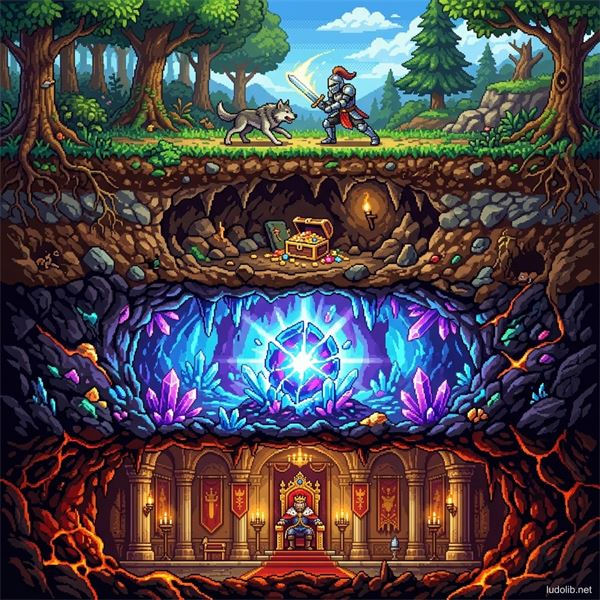 Illustration: Player engagement is like a journey to the center of the Earth. Starting from the mechanical operation surface to the deep core of emotion.
Quick Summary
Layers of Engagement is a theoretical framework in Game Design used to analyze and structure the reasons players stick with a game. According to expert Anton Slashcev, this system is divided into 4 temporal layers (from Second-to-Second Fun to Long-Term Mission) and is held tight by 4 Psychological Anchors.
A successful game does not rely on a single mechanic. If a game only has satisfying operations (Layer 1) but no goal (Layer 4), players will get bored quickly. Conversely, if it has a grand storyline (Layer 4) but clunky character controls (Layer 1), players will quit before they even understand what’s happening.
1. The Four Temporal Engagement Layers
This design framework is divided into 4 shell layers corresponding to the player’s experiential timeline:
Layer 1: Second-to-Second Fun
This is the physical base layer of the game, happening every millisecond. It represents Game Feel and visual feedback.
- Nature: Basic actions that bring pure satisfying feelings, like squeezing a stress ball.
- Requirements: Controls must be snappy, Responsive, and intuitive. The game must feel like a fun toy.
- Examples: The “satisfying” feeling of chopping a wood block in Minecraft, the crunching sound when matching 3 candies in Candy Crush, or the recoil of the gun in Doom.
Layer 2: Short-Term Objectives
Sitting right on top of the physical operation layer is the reason to perform those operations.
- Nature: Tasks that can be fully completed in a single playing Session.
- Requirements: Win/Loss conditions are extremely clear. Variety in tasks to avoid boredom. Players should only focus on one objective at a time (no cognitive overload).
- Examples: Completing the Tutorial level, carrying a cargo box past a checkpoint, defeating the final boss of a dungeon.
Layer 3: Mid-Term Goals
This is the glue that binds disconnected playing sessions together. It is the Progression system.
- Nature: Goals that require multiple playing sessions (days to weeks) to achieve.
- Requirements: Create a clear sense of advancement. Multiple goals (Multi-goals) can exist simultaneously for the player to freely choose. Rewards received must be truly valuable and commensurate with the effort exerted.
- Examples: Grinding enough experience points to Level Up, gathering enough materials to upgrade a Legendary sword, completing a Side Quests chain.
Layer 4: Long-Term Mission
The outermost layer and also the emotional core of the entire work. It lies at the boundary of Narrative Design.
- Nature: The ultimate reason for the player to stick with the game for months or years. It carries profound emotional significance.
- Requirements: This massive mission must be broken down into Milestones. The game must constantly remind the player of this grand purpose.
- Examples: Decoding all mysteries of a murder case, climbing to the Challenger tier in the Ranked system, restoring the fallen estate of a clan.
2. The Four Psychological Anchors (Player’s Anchors)
Retaining players isn’t just based on forward-moving goals, but also on the anchors pinning them to the virtual world.
⚓ Extra Depths
Curiosity is the strongest human instinct. Does the game reward those who like to leave no stone unturned?
- Secrets, Easter eggs, or Bonus levels are the perfect anchor for the Explorer player segment (According to Bartle Player Types).
⚓ Sense of Ownership
The psychological effect of “Loss Aversion”. Is there anything in the game that players built with their own hands and will lose (or let wither) if they stop logging in?
- This could be an expensively upgraded military base, intimate relationships with NPCs, or a high-level pet.
⚓ Player’s Commitment
Can the player “breathe life” into the virtual world?
- Allowing unique character creation, decorating a gorgeous house, making decisions with permanent branching storylines… helps them express their individuality. At that point, the game is no longer the developer’s; it becomes the player’s own creation.
⚓ Social Interaction
The most enduring anchor. In Live Service games, the ultimate reason keeping players around is the community.
- Can they form meaningful connections? Show camaraderie through gifting/partying? Or prove superiority through Leaderboards and PvP modes?
🔗 References
- Layers of Engagement in Games (Anton Slashcev).
🔭 See Also
- Retention — Milestones measuring retention rates
- Bartle Player Types — 4 player taxonomies
- Game Mechanics — The base layer (Second-to-Second)
- Narrative Design — The Narrative core